-
Use Cases
-
Resources
-
Pricing
1502 - 1504
Christopher Columbus’s fourth voyage explored the Caribbean coast of Central America from 1502 to 1504. The expedition searched unsuccessfully for a passage to Asia while strengthening Spain’s claims in the region.
Image source: Voyages of Christopher Columbus
1510
Afonso de Albuquerque captured Goa in 1510, making it the administrative center of Portuguese India. The port became a major base for Portugal’s commercial and naval network in the Indian Ocean.
Aug 10, 1519 - Sep 6, 1522
Ferdinand Magellan’s expedition sailed from Spain in 1519 seeking a westward route to the Spice Islands. Although Magellan died in the Philippines, the surviving crew completed the first circumnavigation of Earth.
Image source: Magellan expedition
May 26, 1521 - Aug 13, 1521
Spanish forces led by Hernán Cortés and Indigenous allies captured Tenochtitlan in 1521 after a prolonged siege. The defeat ended the Aztec Empire and established the foundation of Spanish rule in Mexico.
Image source: Fall of Tenochtitlan
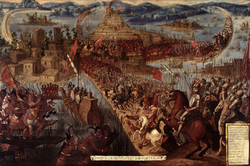
1532 - 1572
Spanish forces under Francisco Pizarro invaded the Andes beginning in 1532 and captured Atahualpa. Civil war, disease, and military conquest enabled Spain to destroy the Inca state, although resistance continued for decades.
Image source: Spanish conquest of the Inca Empire
1534
Portugal divided Brazil into hereditary captaincies in 1534 to encourage settlement and administration. The system accelerated colonization, sugar production, and the expansion of Portuguese power in South America.
Image source: Captaincies of Brazil
Dec 13, 1577 - Sep 26, 1580
Francis Drake’s expedition circumnavigated the globe between 1577 and 1580. The voyage brought England valuable plunder and strengthened its challenge to Spanish maritime power.
1508
Shah Ismail I captured Baghdad in 1508, extending Safavid power into Iraq. The conquest intensified the long rivalry between the Safavid and Sunni Ottoman empires.
1543
Portuguese merchants reached Japan in 1543, initiating sustained European contact. Firearms, Christianity, and new commercial links soon influenced Japanese warfare and regional trade.
Image source: Nanban trade
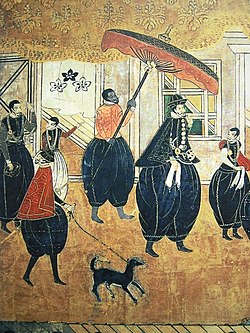
1556 - 1605
After the Second Battle of Panipat in 1556, Akbar consolidated Mughal power across northern India. His long reign expanded the empire and developed durable administrative and cultural institutions.
Image source: Akbar
1598
Shah Abbas I made Isfahan the Safavid capital in 1598. He transformed it with monumental architecture and administration, helping create one of the early modern Islamic world’s great cities.
Image source: Isfahan
Oct 31, 1517
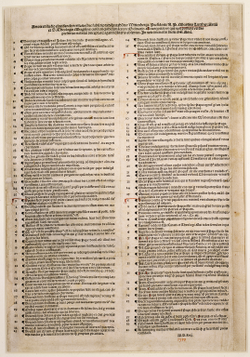
Martin Luther circulated his Ninety-five Theses in 1517, criticizing the sale of indulgences and aspects of church practice. The controversy helped initiate the Protestant Reformation.
Image source: Ninety-five Theses
Jun 7, 1520 - Jun 24, 1520
Henry VIII of England and Francis I of France met near Calais in 1520 in an elaborate diplomatic summit. The meeting displayed royal magnificence but produced no lasting alliance.
Image source: Field of the Cloth of Gold
Jan 28, 1521 - May 25, 1521
At the Diet of Worms, Martin Luther refused to retract his teachings before Emperor Charles V. The resulting Edict of Worms declared him an outlaw and deepened the religious division of the Holy Roman Empire.
Image source: Diet of Worms
Feb 24, 1525
The Imperial victory at Pavia in 1525 captured Francis I of France and decisively changed the Italian Wars. Charles V’s forces gained temporary dominance in Italy.
Image source: Battle of Pavia
Aug 29, 1526
The Ottoman army defeated Hungary at Mohács in 1526, killing King Louis II. The battle broke the medieval Hungarian kingdom into Ottoman, Habsburg, and semi-independent territories.
Image source: Battle of Mohács
May 6, 1527
Mutinous troops of Emperor Charles V sacked Rome in 1527 during the Italian Wars. The assault shocked Europe, weakened the papacy, and symbolized the political crisis of Renaissance Italy.
Image source: Sack of Rome (1527)
1534
The English Parliament’s Act of Supremacy in 1534 recognized Henry VIII as supreme head of the Church of England. It formalized England’s break with papal authority.
Image source: Acts of Supremacy
Aug 15, 1534
Ignatius of Loyola and companions founded the Society of Jesus in 1534. The Jesuits became a major force in Catholic education, missionary activity, and the Counter-Reformation.
Image source: Jesuits
1536
John Calvin published the first edition of Institutes of the Christian Religion in 1536. The work became a foundational statement of Reformed Protestant theology.
Image source: Institutes of the Christian Religion
1536 - 1540
Henry VIII’s government dissolved England’s monasteries between 1536 and 1540. Their lands and wealth were transferred to the Crown and private owners, transforming English society and religious life.
Image source: Dissolution of the monasteries
Dec 13, 1545 - Dec 4, 1563
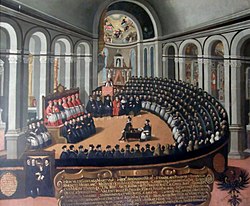
The Council of Trent defined Catholic doctrine and promoted institutional reforms in response to the Protestant Reformation. Its decisions shaped the Catholic Church for centuries.
Image source: Council of Trent
1547
Ivan IV was crowned tsar of Russia in 1547, the first Russian ruler to use the title formally. His reign centralized the state and launched major territorial expansion.
Image source: Ivan the Terrible
Sep 25, 1555
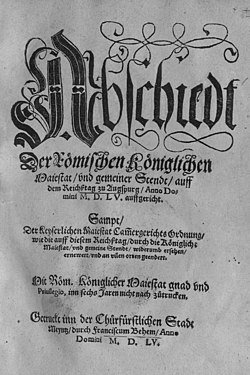
The Peace of Augsburg recognized Lutheranism within the Holy Roman Empire and allowed rulers to choose between Catholicism and Lutheranism. It temporarily reduced religious warfare while excluding other confessions.
Image source: Peace of Augsburg
Jan 7, 1558
France captured Calais in 1558, ending England’s last territorial possession on the European mainland. The loss marked a major decline in England’s medieval continental position.
Image source: Siege of Calais (1558)
Nov 17, 1558 - Mar 24, 1603
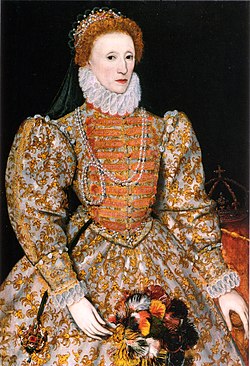
Elizabeth I became queen of England in 1558. Her reign stabilized the English religious settlement, encouraged maritime expansion, and witnessed major developments in literature and state power.
Image source: Elizabeth I
1562 - 1598
Catholic and Huguenot factions fought a series of civil wars in France from 1562 to 1598. The conflict ended with Henry IV’s conversion and the Edict of Nantes.
Image source: French Wars of Religion
May 18, 1565 - Sep 11, 1565
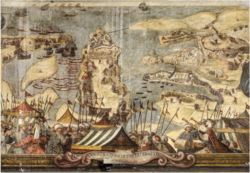
The Knights Hospitaller and Maltese defenders repelled a major Ottoman assault in 1565. The victory halted Ottoman expansion in the central Mediterranean and became a celebrated Christian triumph.
Image source: Great Siege of Malta
1568 - 1648
The Dutch Revolt against Spanish rule began in 1568. Religious, political, and economic grievances eventually produced the independent Dutch Republic.
Image source: Eighty Years' War
Jul 1, 1569
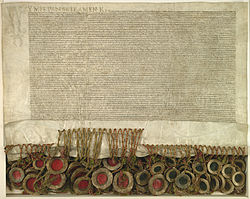
The Union of Lublin created the Polish–Lithuanian Commonwealth in 1569. The new federative state became one of Europe’s largest political entities.
Image source: Union of Lublin
Oct 7, 1571
The Holy League defeated the Ottoman fleet at Lepanto in 1571. Although Ottoman naval power soon recovered, the battle stopped Ottoman expansion in the western Mediterranean and became a major European victory.
Image source: Battle of Lepanto
Aug 24, 1572 - Oct 3, 1572
The St. Bartholomew’s Day massacre began in Paris in 1572 and spread to other parts of France. Thousands of Huguenots were killed, intensifying the French Wars of Religion.
Jul 19, 1588 - Aug 12, 1588
Spain sent the Spanish Armada against England in 1588 to support an invasion and end English intervention in the Netherlands. English resistance, weather, and operational difficulties forced the fleet to retreat.
Image source: Spanish Armada
Apr 13, 1598
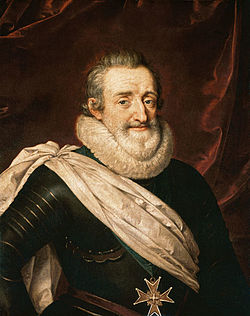
Henry IV issued the Edict of Nantes in 1598, granting French Huguenots limited religious and political rights. The settlement ended the main phase of the French Wars of Religion.
Image source: Edict of Nantes
1543
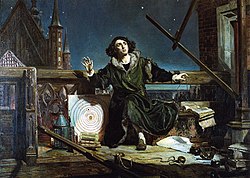
The publication of Nicolaus Copernicus’s On the Revolutions of the Heavenly Spheres in 1543 challenged the traditional geocentric model. It helped launch the Scientific Revolution that transformed astronomy and natural philosophy.
Image source: Scientific Revolution
Oct 4, 1582
Pope Gregory XIII introduced the Gregorian calendar in 1582 to correct accumulated drift in the Julian calendar. Catholic countries adopted it first, while many Protestant and Orthodox states followed later.
Image source: Gregorian calendar
Or browse the full history timeline directory, with more than 2,500 topics.
This 16th Century timeline was generated with the help of AI, using information found on the internet.
We work hard to keep these timelines accurate, but mistakes do get through. If you spot one, email us at [email protected] and we'll fix it for future visitors.
Generate yours with AI or build it from scratch, for free.
Export your timeline, add your own events, edit or remove AI-generated events, and much more
No credit card required.
Cancel anytime.
Cancel anytime.
You can create an unlimited number of timelines with up to 10 events on each one, customize how they look, export them to PDF, PNG, PowerPoint, CSV, and Excel, and share them with a link. Paid plans raise the event limit and add features like spreadsheet imports and collaborators.
Yes. You can cancel your subscription from your account page at any time, and you will not be charged again. Your subscription stays active for the rest of the period you already paid for.
Yes. We will email you a reminder before the annual renewal, and we will also email you a receipt.
Yes. You can email us within 15 days of any payment, and we will issue you a full refund.
Check out our pricing docs or send us an email anytime: [email protected].