-
Use Cases
-
Resources
-
Pricing
This timeline chronicles the life of Albert Camus (1913–1960), the French-Algerian novelist, philosopher, and journalist best known for his works exploring absurdism and existentialism, including The Stranger, The Myth of Sisyphus, and The Plague. It highlights key events from his early life in colonial Algeria to his rise as an intellectual figure in postwar France and his Nobel Prize win. More Less
Nov 7, 1913
% complete
Albert Camus was born on 7 November 1913 in a working-class neighbourhood in Mondovi (present-day Dréan), in French Algeria. Algeria had been a French territory since 1830, and Camus's paternal grandfather, along with many others of his generation, had moved there for a better life during the first decades of the 19th century.
Image source: Albert Camus
Oct 1914
% complete
Camus never knew his father, Lucien Camus, a poor French agricultural worker who was killed in action while serving with a Zouave regiment in October 1914 during World War I, leaving the family impoverished.
1924
% complete
Under the influence of his teacher Louis Germain, Camus gained a scholarship in 1924 to continue his studies at a prestigious lyceum (secondary school) near Algiers. In middle school, Germain gave Camus free lessons to prepare him for the scholarship competition, despite the fact that his grandmother had planned for him to become a manual worker to support the family.
1928 - 1930
% complete
From 1928 to 1930, Camus played as goalkeeper for the Racing Universitaire d'Alger junior team, an experience that shaped his love of football and physical life before illness intervened.
1930
% complete
In 1930, at the age of 17, Camus was diagnosed with tuberculosis, a recurring illness that forced an end to his football ambitions and profoundly affected his outlook on mortality and the absurdity of life.
1933 - 1936
% complete
In 1933, Camus enrolled at the University of Algiers and completed his licence de philosophie (BA) in 1936 after presenting his thesis on Plotinus, laying the philosophical foundations for his later work.
Image source: University of Algiers 1
1934
% complete
In 1934, Camus was in a relationship with Simone Hié, an early romantic chapter of his young adulthood in Algiers.
Dec 3, 1940
% complete
After ending up in Lyon, he married pianist and mathematician Francine Faure on 3 December 1940, beginning a significant chapter of his personal life.
Image source: Francine Faure
1945
% complete
After the war, Camus lived in Paris with Faure, who gave birth to twins, Catherine and Jean, in 1945.
Image source: Albert Camus
Apr 30, 1959
% complete
In a letter dated 30 April 1959, Germain lovingly reciprocated the warm feelings towards his former pupil, calling him 'my little Camus,' a touching exchange between teacher and student.
Jan 1935
% complete
Camus joined the French Communist Party (PCF) in early 1935, drawn by its anti-fascist stance, beginning his engagement with radical politics of the era.
Image source: French Communist Party
1936
% complete
In 1936, the independence-minded Algerian Communist Party (PCA) was founded, and Camus joined it after his mentor Grenier advised him to do so.
Image source: Algerian Communist Party
1944
% complete
In 1944, he founded the Comité français pour la fédération européenne (CFFE), declaring that Europe 'can only evolve along the path of economic progress, democracy, and peace if the nation-states become a federation,' reflecting his world federalist convictions.
May 1945
% complete
In 1945, following the Sétif and Guelma massacre after Arabs revolted against French mistreatment, Camus was one of only a few mainland journalists to visit the colony, reporting on conditions there.
Image source: Sétif and Guelma massacre
1947 - 1948
% complete
In 1947–48, he founded the Groupes de Liaison Internationale (GLI), a trade union movement in the context of revolutionary syndicalism, furthering his engagement with workers' movements.
1948
% complete
The anarchist André Prudhommeaux first introduced him at a meeting of the Cercle des Étudiants Anarchistes ('Anarchist Student Circle') in 1948 as a sympathiser familiar with anarchist thought.
Image source: Anarchism in France
1950 - 1951
% complete
Along with Albert Einstein, Camus was one of the sponsors of the Peoples' World Convention (PWC), also known as Peoples' World Constituent Assembly, which took place between 1950 and 1951 at Palais Electoral in Geneva, Switzerland.
Image source: World Constitutional Convention
1952
% complete
In 1952, he resigned from his work for UNESCO when the UN accepted Spain, under the leadership of the caudillo General Francisco Franco, as a member, protesting the legitimization of Francoist rule.
Image source: UNESCO
1954 - 1962
% complete
When the Algerian War began in 1954, Camus was confronted with a moral dilemma. During the war he kept a neutral stance, advocating a multicultural and pluralistic Algeria, a position rejected by most parties on both sides.
Image source: Algerian War
Dec 1957
% complete
In one often-misquoted incident, Camus confronted an Algerian critic during his 1957 Nobel Prize acceptance speech in Stockholm, rejecting the false equivalence of justice with revolutionary terrorism: 'People are now planting bombs in the tramways of Algiers.'
May 1936
% complete
Camus's first publication was a play called Révolte dans les Asturies (Revolt in Asturias), written with three friends in May 1936. The subject was the 1934 revolt by Spanish miners that was brutally suppressed by the Spanish government, resulting in 1,500 to 2,000 deaths.
May 1937
% complete
In May 1937 he wrote his first book, L'Envers et l'Endroit (Betwixt and Between, also translated as The Wrong Side and the Right Side). His early thoughts appeared in this first collection of essays, published in 1937.
1938
% complete
His 1938 address on 'The New Mediterranean Culture' represents Camus's most systematic statement of his views at this time, articulating his vision of a pluralistic Mediterranean civilization.
1938
% complete
Absurd themes were expressed with more sophistication in his second collection of essays, Noces (Nuptials), in 1938, which included reflections on places such as Tipasa in Algeria.
1938
% complete
In 1938, Camus began working for the leftist newspaper Alger républicain (founded by Pascal Pia), as he had strong anti-fascist feelings, and the rise of fascist regimes in Europe was worrying him.
1939
% complete
In 1939, Camus wrote a stinging series of articles for the Alger républicain on the atrocious living conditions of the inhabitants of the Kabylie highlands, exposing colonial neglect.
Image source: Kabylia
1940
% complete
Alger républicain was banned in 1940 and Camus flew to Paris to take a new job at Paris-Soir as layout editor. He was in Paris when the Germans invaded France during World War II in 1940.
Image source: Paris-soir
1942
% complete
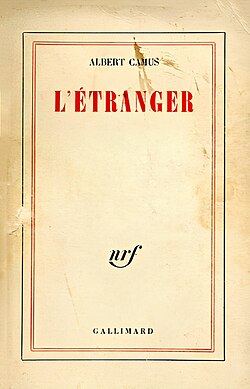
In 1942, he published the story of a man living an absurd life in The Stranger, the work that brought him widespread recognition and became one of the defining novels of the twentieth century.
Image source: The Stranger (Camus novel)
Dec 1942
% complete
Camus began his work on the second cycle while he was in Algeria, in the last months of 1942, just as the Germans were reaching North Africa, developing themes of revolt that would culminate in later works.
Jan 1943
% complete
By 1943 he was known because of his earlier work, establishing himself as a major literary and intellectual voice in occupied and liberated France.
1945
% complete
He also wrote a play about the Roman emperor Caligula, pursuing an absurd logic, which was not performed until 1945, adding to his reputation as a dramatist exploring absurdist philosophy.
1957
% complete
He wrote an essay against capital punishment in collaboration with Arthur Koestler, entitled Réflexions sur la peine capitale ('Reflections on Capital Punishment'), published by Calmann-Levy in 1957.
Image source: Capital punishment
Oct 1957
% complete
In 1957, Camus received the news that he was to be awarded the Nobel Prize in Literature. At the age of 44, he was the second-youngest recipient in history and the first laureate in literature born in Africa.
Image source: List of Nobel laureates in Literature
1958
% complete
After receiving the Nobel Prize, Camus gathered, clarified, and published his pacifist leaning views at Actuelles III: Chronique algérienne 1939–1958 (Algerian Chronicles).
Jan 1959
% complete
The play opened in January 1959 at the Antoine Theatre in Paris and was a critical success, marking one of Camus's final theatrical achievements.
Image source: Théâtre Antoine-Simone Berriau
1971
% complete
La mort heureuse (A Happy Death) (1971) is a novel that was written between 1936 and 1938 but published posthumously, offering insight into Camus's early literary development.
Image source: A Happy Death
1994
% complete
Le Premier homme (The First Man, published in 1994) was an unfinished autobiographical novel about his childhood in Algeria which Camus was writing before he died. Its publication sparked a widespread reconsideration of Camus's allegedly unrepentant colonialism.
Image source: First Man (film)
Dec 31, 1959 - Jan 1960
% complete
He had spent the New Year's holiday of 1960 at his house in Lourmarin, Vaucluse with his family and his publisher Michel Gallimard of Éditions Gallimard, along with Gallimard's wife, Janine, and daughter, Anne.
Image source: Lourmarin
Jan 4, 1960
% complete
Camus died on 4 January 1960 at the age of 46, in a car crash near Sens, in Le Grand Fossard in the small town of Villeblevin, cutting short one of the most influential literary careers of the century.
1961
% complete
In Tipasa, Algeria, inside the Roman ruins, facing the sea and Mount Chenoua, a stele was erected in 1961 in honor of Albert Camus with the phrase from his work Noces à Tipasa: 'I understand here what is called glory: the right to love beyond measure.'
Image source: Tipasa
Jun 26, 1967
% complete
The French Post published a stamp with his likeness on 26 June 1967, commemorating the enduring legacy of the writer in France.
2011
% complete
In 2011, Italian author Giovanni Catelli argued that Camus might have been killed by the KGB for criticizing the Soviet Union, reviving speculation about the circumstances of his death.
2013
% complete
In 2013, Catelli published a book elaborating on his theory regarding Camus's death, followed by an English translation published in 2020, keeping debate over the crash alive.
Or browse the full history timeline directory, with more than 2,000 topics.
This Albert Camus timeline was generated with the help of AI, using information found on the internet.
We work hard to keep these timelines accurate, but mistakes do get through. If you spot one, email us at [email protected] and we'll fix it for future visitors.
Generate yours with AI or build it from scratch, for free.
Export your timeline, add your own events, edit or remove AI-generated events, and much more
No credit card required.
Cancel anytime.
Cancel anytime.
You can create an unlimited number of timelines with up to 10 events on each one, customize how they look, export them to PDF, PNG, PowerPoint, CSV, and Excel, and share them with a link. Paid plans raise the event limit and add features like spreadsheet imports and collaborators.
Yes. You can cancel your subscription from your account page at any time, and you will not be charged again. Your subscription stays active for the rest of the period you already paid for.
Yes. We will email you a reminder before the annual renewal, and we will also email you a receipt.
Yes. You can email us within 15 days of any payment, and we will issue you a full refund.
Check out our pricing docs or send us an email anytime: [email protected].