-
Use Cases
-
Resources
-
Pricing
Alfred Nobel (1833–1896) was a Swedish chemist, engineer, inventor, and businessman best known for inventing dynamite and for establishing the Nobel Prize through his famous last will. He held 355 patents, built an international industrial empire, and dedicated his fortune to honoring achievements in Physics, Chemistry, Medicine, Literature, and Peace. More Less
1827
% complete
Alfred's father, inventor and engineer Immanuel Nobel (1801–1872), married Andriette Nobel (née Ahlsell, 1805–1889) in 1827. The couple had eight children, with Alfred being the third son.
Image source: Alfred Nobel
Oct 21, 1833
% complete
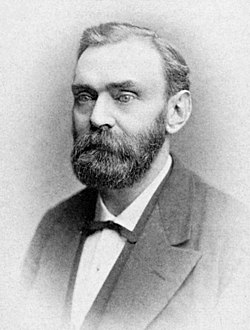
Alfred Bernhard Nobel was born in Stockholm, Sweden, on 21 October 1833. He would grow up to become a Swedish chemist, inventor, engineer, and businessman, best known for inventing dynamite and establishing the Nobel Prizes.
1841 - 1842
% complete
For 18 months, from 1841 to 1842, Nobel attended the Jacobs Apologistic School in Stockholm. This was his only formal schooling; he never attended university.
1842
% complete
In 1842, Alfred's mother and brothers joined his father in St. Petersburg, Russia, where Immanuel had established a business, reuniting the Nobel family in the city where they would live until 1859.
1850
% complete
As a young man, Nobel studied with the chemist Nikolai Zinin. Then, in 1850, he went to Paris to further his work and studies in chemistry.
1851 - 1852
% complete
In 1851 at age 18, Nobel went to the United States for one year to study, working for a short period under Swedish-American inventor John Ericsson, who designed the American Civil War ironclad USS Monitor.
1853 - 1856
% complete
The Nobel family factory produced armaments for the Crimean War (1853–1856), but had difficulty switching back to regular domestic production when the fighting ended and filed for bankruptcy.
1857
% complete
Nobel filed his first patent, an English patent for a gas meter, in 1857. His first Swedish patent, which he received in 1863, was on 'ways to prepare gunpowder'.
1859
% complete
In 1859, Nobel's father left his factory in the care of the second son, Ludvig Nobel (1831–1888), who greatly improved the business. This was also the year the Nobel family left St. Petersburg.
Image source: Ludvig Nobel
1863
% complete
Nobel invented a detonator in 1863, an important advance in the safe use of explosives, and two years later he designed the blasting cap.
Image source: Detonator
1865
% complete
In 1865, Nobel designed the blasting cap, building on his earlier detonator invention and improving the reliability of igniting nitroglycerin charges.
1867
% complete
Nobel found that when nitroglycerin was incorporated in an absorbent inert substance like kieselguhr (diatomaceous earth) it became safer and more convenient to handle. He patented this mixture in 1867 as 'dynamite', his most famous invention.
Image source: Dynamite
1875
% complete
In 1875, Nobel invented gelignite, an explosive that was more stable and powerful than dynamite, further cementing his reputation as a leading figure in the explosives industry.
Image source: Gelignite
1876
% complete
Gelignite, or blasting gelatin as it was named, was patented in 1876, followed by a host of similar combinations modified by the addition of potassium nitrate and various other substances.
1887
% complete
In 1887, Nobel patented ballistite, a smokeless propellant made of nitrocellulose and nitroglycerin and a predecessor of cordite, completing his trio of most famous explosive inventions.
Image source: Ballistite
1894
% complete
In 1894, Nobel acquired Bofors-Gullspång; the Björkborn Manor was included in the purchase, and he stayed there during his summers in Sweden.
Image source: Bofors
Sep 3, 1864
% complete
On 3 September 1864, a shed used for preparation of nitroglycerin exploded at the factory in Heleneborg, Stockholm, killing five people, including Nobel's younger brother Emil. The tragedy spurred Nobel to develop safer explosives.
1865 - 1873
% complete
From 1865 to 1873, Nobel lived in Krümmel (now part of the municipality of Geesthacht, near Hamburg), where he established explosive works along the Elbe River.
1873 - 1891
% complete
From 1873 to 1891, Nobel lived in a house on the Avenue de Malakoff in Paris, during which time he continued his inventive work and became one of Europe's wealthiest men.
1876
% complete
In 1876, Austro-Bohemian Countess Bertha von Suttner became Nobel's secretary, but she left him after a brief stay to marry her previous lover, Baron Arthur Gundaccar von Suttner. She corresponded with him until his death and probably influenced his decision to include the Nobel Peace Prize in his will.
Image source: Bertha von Suttner
1876
% complete
Nobel met Sofija Hess from Celje in 1876 in Baden bei Wien, where she worked as an employee in a flower shop catering to wealthy clientele. Their relationship lasted 18 years, his longest-lasting romance.
Apr 15, 1888
% complete
In 1888, the death of his brother Ludvig supposedly caused several newspapers to publish obituaries of Alfred in error. One was published on the first page of Le Figaro on 15 April 1888 and retracted the next day. The premature obituaries reportedly prompted Nobel to reconsider his legacy.
1891
% complete
In 1891, after being accused of high treason against France for selling Ballistite to Italy, Nobel moved from Paris to Sanremo, Italy, acquiring Villa Nobel overlooking the Mediterranean Sea, where he later died.
Image source: Villa Nobel
1894
% complete
Sofija Hess eventually converted to Protestantism in 1894 in what has been described as a naive attempt to grow closer to Nobel, toward the end of their long relationship.
1895 - Dec 10, 1896
% complete
By 1895, Nobel had developed angina pectoris, a heart condition that foreshadowed his declining health in his final year of life.
Image source: Angina
Dec 10, 1896
% complete
On 10 December 1896, Nobel suffered a stroke/intracerebral hemorrhage at Villa Nobel in Sanremo, Italy. He was first partially paralyzed and then died, aged 63. His will set in motion the creation of the world-famous Nobel Prizes.
1884
% complete
In 1884, Nobel was elected a member of the Royal Swedish Academy of Sciences, the same institution that would later select laureates for two of the Nobel Prizes.
Image source: Royal Swedish Academy of Sciences
1893
% complete
In 1893, Nobel received an honorary doctorate from Uppsala University, recognizing his contributions to science despite never having attended university himself.
Image source: Uppsala University
Nov 27, 1895
% complete
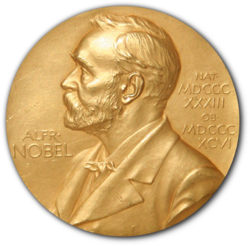
On 27 November 1895, at the Swedish-Norwegian Club in Paris, Nobel signed his last will and testament, setting aside the bulk of his estate—unbeknownst to his family—to fund the Nobel Prizes, to be awarded annually without distinction of nationality.
Image source: Nobel Prize
1901
% complete
In accordance with Nobel's will, the first Nobel Prizes were awarded in 1901, honoring outstanding achievements in physics, chemistry, physiology or medicine, literature, and peace.
1905
% complete
Bertha von Suttner, Nobel's former secretary and longtime correspondent, was awarded the 1905 Nobel Peace Prize 'for her sincere peace activities', vindicating her influence on Nobel's decision to establish the prize.
1930
% complete
Pastor Nathan Söderblom, leader of the Church of Sweden Abroad in Paris that Nobel regularly attended during his years living there, received the Nobel Peace Prize in 1930.
Image source: Nathan Söderblom
1968
% complete
Sweden's central bank Sveriges Riksbank celebrated its 300th anniversary in 1968 by donating a large sum of money to the Nobel Foundation to be used to set up a sixth prize in the field of economics in honor of Alfred Nobel.
1984
% complete
The 1984 public artwork Nobel Metamorphoses in Troisdorf, Germany—at the time the location of the Dynamit Nobel headquarters—contrasts war death statistics to peace prize recipients since the latter's inauguration in 1901 through a critical lens.
Image source: Troisdorf
1989
% complete
Diplomat Thomas Bertelman and Professor Arkady Melua initiated the creation of the Monument to Alfred Nobel in 1989 and provided funds for its construction, on the Petrogradskaya Embankment street where Nobel's family lived until 1859.
1991
% complete
The Monument to Alfred Nobel stands in Saint Petersburg along the Bolshaya Nevka River on the Petrogradskaya Embankment, the street where Nobel's family lived until 1859. It was dedicated in 1991 to mark the 90th anniversary of the first Nobel Prize presentation.
2001
% complete
In 2001, Alfred Nobel's great-great-nephew, Peter Nobel (born 1931), asked the Bank of Sweden to differentiate its award to economists given 'in Alfred Nobel's memory' from the five other awards established by Nobel himself.
Image source: Nobel Memorial Prize in Economic Sciences
2003
% complete
A biography noting that Nobel was Swedish was published in Sweden in 2003 and has been translated into Slovenian, French, Italian, and Spanish, extending interest in Nobel's life story across Europe.
2022
% complete
By 2022, the Nobel Foundation, created to administer Nobel's bequest, had approximately 6 billion Swedish Kronor of invested capital, sustaining the annual Nobel Prize awards long after his death.
Image source: Nobel Foundation
Or browse the full history timeline directory, with more than 2,000 topics.
This Alfred Nobel timeline was generated with the help of AI, using information found on the internet.
We work hard to keep these timelines accurate, but mistakes do get through. If you spot one, email us at [email protected] and we'll fix it for future visitors.
Generate yours with AI or build it from scratch, for free.
Export your timeline, add your own events, edit or remove AI-generated events, and much more
No credit card required.
Cancel anytime.
Cancel anytime.
You can create an unlimited number of timelines with up to 10 events on each one, customize how they look, export them to PDF, PNG, PowerPoint, CSV, and Excel, and share them with a link. Paid plans raise the event limit and add features like spreadsheet imports and collaborators.
Yes. You can cancel your subscription from your account page at any time, and you will not be charged again. Your subscription stays active for the rest of the period you already paid for.
Yes. We will email you a reminder before the annual renewal, and we will also email you a receipt.
Yes. You can email us within 15 days of any payment, and we will issue you a full refund.
Check out our pricing docs or send us an email anytime: [email protected].