-
Resources
-
Pricing
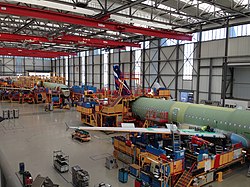
The assembly line is a manufacturing system in which products move through a sequence of specialized workstations, making production faster and more efficient. More Less
Build a timeline like this one in minutes, for free. Start Yours →
1500 - 1530
At its peak efficiency in the early sixteenth century, the Venetian Arsenal employed approximately 16,000 people and could reportedly produce nearly one ship per day.
Image source: Venetian Arsenal
1500 - 1530
The Venetian Arsenal could fit out, arm, and provision newly built galleys using standardized parts on an assembly-line basis.
1776
In The Wealth of Nations, published in 1776, Adam Smith discussed the division of labour at length through the example of manufacturing pins.
Image source: The Wealth of Nations
1785
Oliver Evans built an automatic flour mill in 1785. Roe later called it the beginning of modern bulk material handling.
Image source: Oliver Evans
1801 - 1803
The Portsmouth Block Mills were built between 1801 and 1803 and are probably the earliest industrial example of a linear and continuous assembly process.
Image source: Portsmouth Block Mills
1803
Once completed, the Portsmouth Block Mills embodied a continuous, linear industrial process for producing pulley blocks.
1853
An assembly-line area known as The Long Shop, named for its length, was fully operational by early 1853.
Image source: Long Shop Museum
1867
Chicago's meatpacking industry is believed to have begun using one of the first industrial assembly lines, or disassembly lines, in the United States in 1867.
Image source: Explosion
1800 - 1899
Many industries saw rapid improvements in assembly practices during the nineteenth century, even though the modern terms industrial engineering and logistics had not yet been coined.
Image source: Industrial Revolution
1800 - 1899
Throughout the nineteenth century, industries including textiles, firearms, clocks, watches, vehicles, locomotives, sewing machines, and bicycles improved materials handling, machining, and assembly.
1800 - 1850
The development of jigs, fixtures, and improved toolpath control supplied important prerequisites for the modern assembly line by supporting repeatable manufacturing.
Image source: Jig (tool)
1800 - 1850
During the early nineteenth century, machine tools such as screw-cutting lathes, metal planers, and milling machines helped make interchangeable parts practical.
Image source: Machine tool
1875 - 1899
Steam-powered conveyor lifts began to be used for loading and unloading ships sometime in the last quarter of the nineteenth century.
Image source: Conveyor system
1885
A circa-1885 sketch documented an electric-powered conveyor moving cans through a filling line in a canning factory.
1901
Ransom Olds patented the assembly-line concept and put it to work at his Olds Motor Vehicle Company factory in 1901.
Image source: Ransom E. Olds
1906
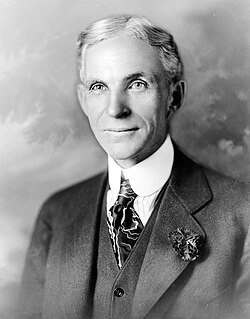
Henry Ford was influenced by the highly automated, 40-acre Sears mail-order handling facility, which he visited around 1906.
Image source: Henry Ford
1908
1908 - 1913
Ford Motor Company developed the direct line of succession from mass production to its intensification into automation between 1908 and 1913.
Image source: Fordism
1908
By 1908, Walter Flanders had laid groundwork for Ford's later development through the intelligent placement and layout of machine tools.
Image source: Walter Flanders
1911
Ford's operations in France and Britain adopted assembly-line production in 1911.
Image source: Ford Motor Company
1913 - 1920
After the moving line began operating, Ford's production system continued to evolve through time-and-motion study.
Image source: Time and motion study
1913 - 1914
Only Japan black dried quickly enough for Ford's production process, forcing the company to reduce the variety of colors available before 1914.
Oct 7, 1913
The moving assembly line developed for the Ford Model T began operation on October 7, 1913, at the Highland Park Ford Plant.
Image source: Assembly line
1919
Vulcan of Southport, Lancashire, became the first native European manufacturer identified in the list to adopt assembly-line production in 1919.
Image source: Vulcan (motor vehicles)
1923
Ford Denmark adopted assembly-line production in 1923.
1925
Ford's German and Japanese operations adopted assembly-line production in 1925.
1926
Fast-drying Duco lacquer was developed in 1926, allowing automobile manufacturers to move beyond the limited color choices imposed by the use of Japan black.
Image source: Duco
1912
By 1912, the Model T's price had fallen to around $575, demonstrating the cost reductions associated with Ford's production methods.
1914
The assembly line was associated with efforts to address employee turnover. When it was introduced in 1913, Ford reportedly needed to hire 963 people to add 100 workers because of the line's unpopularity.
Image source: Henry Ford
1914
In 1914, an assembly-line worker could buy a Model T with four months' pay, illustrating the effects of lower prices and mass production.
1925 - 1930
By the late 1920s, companies increasingly had to adopt assembly lines or risk going out of business because they could not compete with mass-production costs.
1930
By 1930, approximately 250 companies that had not adopted assembly-line methods had disappeared, according to the account summarized in the source list.
1939 - 1945
After producing fewer than 3,000 planes for the United States military in 1939, American aircraft manufacturers built more than 300,000 planes during World War II.
Image source: Military production during World War II
2000
The reduction in the Model T's price from approximately $825 to $575 was compared with a reduction from $15,000 to $10,000 in year-2000 dollar terms.
Build a timeline like this one in minutes, for free. Start Yours →
Or browse the full history timeline directory, with more than 3,000 topics.
This Assembly Line timeline was generated with the help of AI, using information found on the internet.
We work hard to keep these timelines accurate, but mistakes do get through. If you spot one, email us at [email protected] and we'll fix it for future visitors.
Generate yours with AI or build it from scratch, for free.
Export your timeline, add your own events, edit or remove AI-generated events, and much more
No credit card required.
15-day money-back guarantee.
You can create an unlimited number of timelines with up to 10 events on each one, customize how they look, export them to PDF, PNG, PowerPoint, CSV, and Excel, and share them with a link. Timelines made with Timeline Maker AI keep every event the generator created, and you can add up to 5 events of your own. Paid plans remove the event limit, add spreadsheet imports and hide Preceden's branding, and the higher-priced plan also adds collaborators, a custom logo and a custom domain.
Yes. You can cancel your subscription from your account page at any time, and you will not be charged again. Your subscription stays active for the rest of the period you already paid for.
Yes. We email you a reminder 15 days before your annual renewal, and we email you a receipt after every payment.
Yes. You can email us within 15 days of any payment, and we will issue you a full refund.
Check out our pricing docs or send us an email anytime: [email protected].