
-
Use Cases
-
Resources
-
Pricing
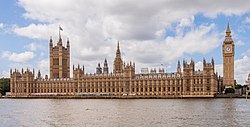
Big Ben is the nickname for the Great Bell of the Great Clock at the north end of the Palace of Westminster in London. Completed in 1859, the clock tower—officially named the Elizabeth Tower since 2012—is one of the most recognizable landmarks in the world and a symbol of British history and parliamentary democracy. More Less
Oct 16, 1834
% complete
The old Palace of Westminster was largely destroyed by fire on 16 October 1834, creating the need for a new palace. Charles Barry's design for a new Palace of Westminster included a clock tower, which would become popularly known as Big Ben.
Image source: Burning of Parliament
1840 - 1859
% complete
The tower was designed by Augustus Pugin and Sir Charles Barry in the Perpendicular Gothic style. It was Pugin's last design before his descent into mental illness and death in 1852; he wrote of the bell tower, 'it is beautiful'.
Sep 28, 1843
% complete
Construction of Elizabeth Tower, originally named the Clock Tower, began on 28 September 1843 as part of Charles Barry's design for a new Palace of Westminster.
1859
% complete
Completed in 1859, the tower is designed in Pugin's Gothic Revival style and is 316 feet (96.3 m) high, making it the third-tallest clock tower in Britain.
Image source: Big Ben
1859 - 1914
% complete
The tower's shaft was intended to draw cool, fresh air into the Palace of Westminster; in practice this did not work and the shaft was repurposed as a chimney until around 1914.
1873
% complete
A new feature was added in 1873 by Acton Smee Ayrton, then First Commissioner of Works. It was last used in 1880 when Charles Bradlaugh, an atheist MP for Northampton, was imprisoned by the Serjeant at Arms after protesting against swearing a religious oath of allegiance to Queen Victoria.
Oct 26, 1950
% complete
Two floors of the tower are occupied by the current Commons chamber, which was used for the first time on 26 October 1950, replacing the chamber destroyed during the Blitz.
Image source: Palace of Westminster
1854
% complete
Construction of the clock was entrusted to clockmaker Edward John Dent; after his death in 1853, his stepson Frederick Dent completed the work in 1854.
Aug 6, 1856
% complete
The original bell was a 16-ton (16.3-tonne) hour bell, cast on 6 August 1856 in Stockton-on-Tees by John Warner & Sons.
Apr 10, 1858
% complete
The original bell cracked and was recast on 10 April 1858 at the Whitechapel Bell Foundry as a lighter 13.5-ton (13.76-tonne) bell, which became known as Big Ben.
Apr 1859
% complete
As the tower was not completed until 1859, Denison had time to experiment before the clock's installation in April that year: instead of a deadbeat escapement and remontoire, he invented a double three-legged gravity escapement, which provides the best separation between pendulum and clock mechanism, mitigating the effects of rain, wind and snow on the dials.
Jul 11, 1859
% complete
The newly recast bell first chimed on 11 July 1859; in September it too cracked under the hammer.
Image source: Big Ben
Aug 2007
% complete
In August 2007 the striker was replaced for the first time since installation, following a six-week maintenance stoppage that began on 11 August 2007.
2009
% complete
Coins have long been placed on the pendulum to regulate its timing; in 2009, three old pennies were replaced with a £5 commemorative coin minted to celebrate the then-upcoming 2012 Summer Olympics.
Dec 31, 2024
% complete
On New Year's Eve 2024, the bell struck midnight within about five-thousandths of a second of the correct time, demonstrating remarkable precision.
1876
% complete
Originally, the dials were backlit using gas lamps, at first only when Parliament was sitting, but they have routinely been illuminated from dusk until dawn since 1876.
1900
% complete
Electric bulbs were installed at the beginning of the 20th century, replacing the gas lamps previously used to backlight the clock dials.
Dec 31, 1923
% complete
A practice of broadcasting the chimes, including via the BBC World Service, began on 31 December 1923, carrying the sound of Big Ben around the world.
Feb 15, 1952
% complete
The chimes of Big Ben have been used at the state funerals of monarchs on four occasions, chiming one stroke for each year of the monarch's life: King Edward VII in 1910 (68 strokes), King George V in 1936 (70 strokes), King George VI in 1952 (56 strokes), and Queen Elizabeth II in 2022 (96 strokes).
Image source: Death and state funeral of George VI
Jan 30, 1965
% complete
The bells were silenced during the funeral of Winston Churchill on 30 January 1965, as a mark of respect for the wartime prime minister.
Image source: Death and state funeral of Winston Churchill
1999
% complete
Prior to the millennium New Year, a recording of the clock was released by London Records under the title 'Millennium Chimes', with the artist labelled as Big Ben. It reached number 53 for the week ending 8 January 2000.
May 6, 2010
% complete
At the close of the polls for the 2010 general election, the results of the national exit poll were projected onto the south side of the tower.
Image source: 2010 United Kingdom general election
Dec 31, 2011
% complete
To welcome in 2012, the clock tower was lit with fireworks that exploded at every toll of Big Ben.
Jun 2, 2012 - Sep 12, 2012
% complete
On 2 June 2012 the House of Commons voted to change the name from the Clock Tower to Elizabeth Tower in commemoration of Queen Elizabeth II in her Diamond Jubilee year. The name change was confirmed on 26 June, and announced by Prime Minister David Cameron on 12 September 2012.
Jul 27, 2012
% complete
Starting at 8:12 am, Big Ben chimed 30 times to welcome the Games of the 30th Olympiad, which officially began that day in London.
Image source: 2012 Summer Olympics
Apr 17, 2013
% complete
The bells were silenced as a mark of 'profound dignity and deep respect' during the funeral of former prime minister Margaret Thatcher.
Image source: Death and funeral of Margaret Thatcher
Sep 19, 2022
% complete
At the state funeral of Queen Elizabeth II, Big Ben chimed one stroke for each year of her life – 96 strokes – continuing the tradition of honouring deceased monarchs.
Image source: Death and state funeral of Elizabeth II
1877 - 1878
% complete
Before 1878 the clock stopped for the first time in its history, 'through a heavy fall of snow' on the hands of a clock face. From 21 August 1877 to January 1878 it was also stopped for three weeks to allow the tower and mechanism to be cleaned and repaired.
Feb 1900
% complete
In February 1900, a heavy build-up of snow on a clock face impeded the progress of the hour hand, causing the clock to stop for about eight hours.
1916 - Nov 11, 1918
% complete
For two years during the First World War, the bells were silenced and the clock faces were not illuminated at night to avoid guiding attacking Zeppelins of the German Empire. The bells were restored at 11:00 am on 11 November 1918 to mark the end of the war.
Apr 2, 1934
% complete
On 2 April 1934 the clock stopped from 7:16 am to 1:15 pm, when it was repaired.
Sep 23, 1936
% complete
On 23 September 1936, a painter in the clock room placed a ladder against a shaft driving the hands, stopping the clock from 8:47 am to 10:00 am.
Sep 1, 1939 - 1945
% complete
From 1 September 1939, although the bells continued to ring, the clock faces were not illuminated at night throughout the Second World War to avoid guiding bomber pilots during the Blitz.
May 10, 1941
% complete
On 10 May 1941, the day before the Blitz ended, an air raid by the Luftwaffe damaged two of the dials and sections of the tower's stepped roof and destroyed the Commons chamber. The damage was repaired, but refurbishment from 2017 revealed greater damage than originally thought.
Jun 3, 1941 - Jun 4, 1941
% complete
The clock stopped from 10:13 pm on 3 June 1941 until 10:13 pm the following morning, after a workman repairing air-raid damage to the clock face left a hammer too close to the mechanism.
Jan 25, 1945 - Jan 26, 1945
% complete
Extremely cold temperatures froze the rubber bushings on the quarter-bell hammers, preventing the chimes sounding from 9:00 pm on 25 January 1945 to 9:00 pm the following evening; the BBC broadcast the pips in the interval. The same problem occurred on 28 January 1947.
Aug 12, 1949
% complete
The clock slowed by four-and-a-half minutes after a flock of starlings perched on the minute hand.
Jul 18, 1955
% complete
The rope operating the striking hammer broke, silencing the clock from 10:00 am to 5:00 pm. Earlier that year, on 13 January, drifts of snow had stopped the clock at 3:24 am.
Dec 31, 1962 - Jan 1, 1963
% complete
Heavy snow and ice on the hands slowed the pendulum, causing it to detach from the clockwork as designed to avoid serious damage, so the clock chimed in the 1963 new year nine minutes late.
Aug 5, 1976 - May 9, 1977
% complete
The air brake speed regulator of the chiming mechanism broke from torsional fatigue after more than 100 years of use, causing the fully wound 4-ton weight to spin the winding drum out of the movement, causing much damage. The clock was shut down for 26 days over nine months and reactivated on 9 May 1977.
Jun 11, 1984
% complete
Two members of the environmental group Greenpeace scaled the tower and blocked the face for 11 hours. Twenty years later, on 20 March 2004, Greenpeace activists again blocked the clock face for seven hours.
Apr 30, 1997
% complete
The clock stopped 24 hours before the 1997 general election, and stopped again three weeks later.
Aug 25, 2015
% complete
Maintenance crews discovered the clock to be running seven seconds fast, prompting adjustments to bring it back to accurate timekeeping.
May 10, 2023
% complete
The clock dials all stopped at 12:55 pm, and Big Ben did not chime at 1:00 pm.
Mar 8, 2025
% complete
Daniel Day scaled the side of the tower and sat on a ledge holding a Palestinian flag in protest. He pleaded guilty to trespassing on a protected site, and in June 2026 a jury found him guilty of causing a public nuisance.
1987
% complete
The tower has been part of a Grade I listed building since 1970, and in 1987 it was designated by UNESCO as a World Heritage Site as part of the Palace of Westminster.
Aug 21, 2017 - 2021
% complete
The clock and tower were renovated between 2017 and 2021, during which the bells remained silent (with a few exceptions). Originally estimated at roughly £29 million, the cost more than doubled to nearly £80 million after greater bomb damage, asbestos, lead paint and broken glass were discovered. The works added a lift in the shaft and reinstated the original Prussian blue colour scheme of the clock faces.
Dec 2021 - Apr 2022
% complete
In December 2021, after four years of renovations, the tower emerged from behind its scaffolding in time for the ringing in of the new year, and the gantry supporting the scaffolding was removed in April 2022.
Nov 13, 2022
% complete
On Remembrance Sunday, 13 November 2022, the chimes of Big Ben returned to regular service for the first time since August 2017, preceding the hour bell being sounded at 11:00 am local time, marking the beginning of two minutes of silence.
Sep 2025
% complete
The restoration of Elizabeth Tower was shortlisted for the Stirling Prize, recognising the excellence of the conservation work carried out between 2017 and 2021.
Image source: Stirling Prize
Or browse the full history timeline directory, with more than 2,000 topics.
This Big Ben timeline was generated with the help of AI, using information found on the internet.
We work hard to keep these timelines accurate, but mistakes do get through. If you spot one, email us at [email protected] and we'll fix it for future visitors.
Generate yours with AI or build it from scratch, for free.
Export your timeline, add your own events, edit or remove AI-generated events, and much more
No credit card required.
Cancel anytime.
Cancel anytime.
You can create an unlimited number of timelines with up to 10 events on each one, customize how they look, export them to PDF, PNG, PowerPoint, CSV, and Excel, and share them with a link. Paid plans raise the event limit and add features like spreadsheet imports and collaborators.
Yes. You can cancel your subscription from your account page at any time, and you will not be charged again. Your subscription stays active for the rest of the period you already paid for.
Yes. We will email you a reminder before the annual renewal, and we will also email you a receipt.
Yes. You can email us within 15 days of any payment, and we will issue you a full refund.
Check out our pricing docs or send us an email anytime: [email protected].