
-
Use Cases
-
Resources
-
Pricing
Elizabeth Cady Stanton (1815–1902) was an American writer, abolitionist, and leading figure of the early women's rights movement. Best known for organizing the 1848 Seneca Falls Convention with Lucretia Mott and authoring the Declaration of Sentiments, she fought for women's suffrage, property rights, and legal equality throughout her life, co-founding the National Woman Suffrage Association with Susan B. Anthony. More Less
Nov 12, 1815
% complete
Elizabeth Cady Stanton was born in Johnstown, New York, the eighth of eleven children of Daniel Cady, a prominent lawyer and judge, and Margaret Livingston Cady. Her privileged upbringing in a legal household exposed her early to the inequities women faced under law.
Image source: Elizabeth Cady Stanton
1826
% complete
The death of her only surviving brother Eleazar deeply affected young Elizabeth. Her grieving father reportedly told her she should have been a boy, an experience that fueled her determination to prove that girls could be equal to boys.
1830 - 1833
% complete
Stanton received one of the best educations available to American women at the Troy Female Seminary, founded by Emma Willard. There she studied subjects traditionally reserved for men, including mathematics, science, and classical languages.
Image source: Emma Willard School
1839
% complete
While visiting her cousin Gerrit Smith in Peterboro, New York, Stanton met fugitive slaves and reformers including Henry Brewster Stanton, an abolitionist orator. This immersion in the antislavery movement shaped her lifelong commitment to social reform.
Image source: Gerrit Smith
May 10, 1840
% complete
Stanton married abolitionist Henry Brewster Stanton against her parents' wishes. At their wedding ceremony she notably requested the omission of the word 'obey' from the vows, signaling her early rejection of traditional gender roles.
Image source: Henry Brewster Stanton
1847
% complete
After years living in Boston, the Stantons moved to Seneca Falls, New York, where Henry practiced law. Elizabeth found domestic life in the small town isolating and frustrating, which intensified her resolve to address women's legal and social subordination.
Image source: Seneca Falls, New York
Jun 12, 1840
% complete
Stanton attended the World Anti-Slavery Convention with her husband, where women delegates including Lucretia Mott were barred from participating because of their sex. Outraged, Stanton and Mott resolved to hold a convention for women's rights upon returning to America.
Image source: World Anti-Slavery Convention
Jul 19, 1848 - Jul 20, 1848
% complete
Together with Lucretia Mott, Martha Wright, Mary Ann McClintock, and Jane Hunt, Stanton organized the first women's rights convention in American history at the Wesleyan Chapel in Seneca Falls, drawing roughly 300 attendees over two days.
Image source: Seneca Falls Convention
1851
% complete
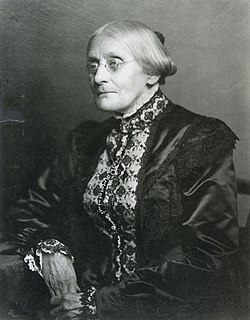
Stanton met Quaker temperance activist Susan B. Anthony through mutual acquaintances, beginning one of the most consequential partnerships in American history. With Stanton as writer and strategist and Anthony as organizer and lecturer, they led the fight for women's rights for half a century.
Image source: Susan B. Anthony
Feb 1852
% complete
Stanton made her debut as a public speaker addressing a women's temperance meeting in Albany, New York, where male delegates refused to seat women delegates. She argued that women needed the vote to effectively combat intemperance, linking temperance to suffrage.
Image source: Woman's Christian Temperance Union
1854
% complete
Stanton addressed the New York State Legislature on behalf of married women's property rights, becoming one of the first women to speak before a legislative body. Her advocacy helped secure expanded property rights for married women in New York.
May 1863 - 1864
% complete
During the Civil War, Stanton and Anthony organized the Women's Loyal National League, which gathered nearly 400,000 signatures on the largest petition drive in American history up to that time, supporting the Thirteenth Amendment abolishing slavery.
Image source: Women's Loyal National League
May 1866
% complete
Following the Civil War, Stanton and Anthony helped found the American Equal Rights Association, which campaigned for universal suffrage — voting rights for both African Americans and women — insisting that the two causes could not be separated.
Image source: American Equal Rights Association
Oct 1866
% complete
Stanton became the first woman to run for the United States House of Representatives, receiving about two dozen votes as an independent candidate in New York. The symbolic campaign demonstrated her argument that women already possessed constitutional voting rights.
1869
% complete
Stanton opposed ratification of the Fifteenth Amendment because it enfranchised Black men but not women, using racially charged arguments that alienated allies like Frederick Douglass. The dispute split the movement into rival organizations led by Stanton and by Lucy Stone.
Image source: Fifteenth Amendment to the United States Constitution
May 15, 1869
% complete
Stanton and Anthony established the National Woman Suffrage Association (NWSA), which focused on federal action for women's suffrage and admitted only women as members. Stanton served as its president for over two decades.
Image source: National Woman Suffrage Association
Jan 1880
% complete
Stanton testified before a United States Senate committee, presenting the case for a federal woman suffrage amendment. She repeatedly pressed Congress throughout the 1870s and 1880s to consider what would eventually become the Nineteenth Amendment.
Feb 1890
% complete
The NWSA and the American Woman Suffrage Association merged to form the National American Woman Suffrage Association (NAWSA). Stanton was elected its first president, though leadership soon passed to younger activists like Susan B. Anthony.
Image source: National American Woman Suffrage Association
Jul 1848
% complete
Stanton authored the Declaration of Sentiments, modeled on the Declaration of Independence, proclaiming that 'all men and women are created equal.' It listed grievances against men and included the controversial demand for women's right to vote, which passed narrowly thanks to Frederick Douglass's support.
Feb 20, 1854
% complete
Stanton delivered a powerful address to the New York Legislature arguing that women were citizens entitled to full rights, systematically cataloging the legal disabilities imposed on married women and demanding their remedy through legislation.
Jan 8, 1868 - 1870
% complete
Stanton and Anthony founded the weekly newspaper The Revolution, with Stanton as editor. Its motto declared 'Men, their rights, and nothing more; women, their rights, and nothing less.' The paper championed suffrage, divorce reform, and equal pay.
Image source: The Revolution (newspaper)
1881 - 1922
% complete
Stanton co-authored with Susan B. Anthony and Matilda Joslyn Gage the multi-volume History of Woman Suffrage, documenting the movement's origins and progress. The work became the foundational historical record of the American woman suffrage campaign.
Image source: History of Woman Suffrage
Jan 18, 1892
% complete
In her most celebrated address, delivered to congressional committees and NAWSA, Stanton argued that each individual must face life alone and therefore every person, regardless of sex, needs full education, self-reliance, and political rights.
Image source: One Hundred Years of Solitude (TV series)
1895 - 1898
% complete
Stanton published The Woman's Bible, a two-volume feminist commentary on passages of scripture concerning women, challenging religious justifications for women's subordination. The work was controversial and was formally repudiated by the NAWSA convention in 1896.
Image source: The Woman's Bible
1898
% complete
Stanton published her memoir Eighty Years and More: Reminiscences 1815–1897, recounting her childhood, marriage, motherhood, and decades of activism. The autobiography remains a key primary source on the nineteenth-century women's rights movement.
Image source: Eighty Years' War
1892
% complete
Stanton stepped down as president of NAWSA after delivering her farewell address, 'The Solitude of Self,' widely considered one of the greatest speeches of the nineteenth century, arguing for women's complete individual autonomy.
1893
% complete
At the Chicago World's Fair, Stanton spoke at the World's Congress of Representative Women, addressing thousands of attendees and reinforcing her status as the elder stateswoman of the international women's rights movement.
Image source: World's Columbian Exposition
1902
% complete
In her final years Stanton spent time abroad with her children, living in London and then New York City, where she continued writing until shortly before her death, remaining intellectually active despite declining health.
Oct 26, 1902
% complete
Stanton died of heart failure in New York City at age 86, eighteen years before the Nineteenth Amendment guaranteed women the vote. Susan B. Anthony mourned the loss of her partner of fifty-one years, calling it unthinkable to continue without her.
Aug 18, 1920
% complete
The Nineteenth Amendment, prohibiting denial of the vote based on sex, was ratified, fulfilling the demand Stanton first raised at Seneca Falls in 1848. Her Declaration of Sentiments had launched a seventy-two-year campaign that finally succeeded after her death.
Or browse the full history timeline directory, with more than 2,000 topics.
This Elizabeth Cady Stanton timeline was generated with the help of AI, using information found on the internet.
We work hard to keep these timelines accurate, but mistakes do get through. If you spot one, email us at [email protected] and we'll fix it for future visitors.
Generate yours with AI or build it from scratch, for free.
Export your timeline, add your own events, edit or remove AI-generated events, and much more
No credit card required.
Cancel anytime.
Cancel anytime.
You can create an unlimited number of timelines with up to 10 events on each one, customize how they look, export them to PDF, PNG, PowerPoint, CSV, and Excel, and share them with a link. Paid plans raise the event limit and add features like spreadsheet imports and collaborators.
Yes. You can cancel your subscription from your account page at any time, and you will not be charged again. Your subscription stays active for the rest of the period you already paid for.
Yes. We will email you a reminder before the annual renewal, and we will also email you a receipt.
Yes. You can email us within 15 days of any payment, and we will issue you a full refund.
Check out our pricing docs or send us an email anytime: [email protected].