
-
Use Cases
-
Resources
-
Pricing
The Gettysburg Address is one of the most famous speeches in American history, delivered by President Abraham Lincoln on November 19, 1863, at the dedication of the Soldiers' National Cemetery in Gettysburg, Pennsylvania. In just over two minutes and fewer than 275 words, Lincoln honored the Union soldiers who died at the Battle of Gettysburg and reaffirmed the nation's commitment to equality, democracy, and 'a new birth of freedom.' More Less
1819
% complete
In an 1819 speech, John Hobhouse, 1st Baron Broughton, said, 'I am a man chosen for the people, by the people; and, if elected, I will do no other business than that of the people.' Webster may have been influenced by this phrasing, which in turn may have influenced Lincoln's famous formulation.
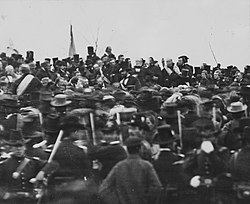
Image source: Gettysburg Address
Jan 26, 1830
% complete
In his 'Second Reply to Hayne' speech, Daniel Webster declared, 'Liberty and Union, now and forever, one and inseparable!' and described the federal government as 'made for the people, made by the people, and answerable to the people,' possibly influencing Lincoln's use of 'government of the people, by the people, for the people.'
1831
% complete
The tradition of lengthy dedication addresses at cemeteries began in 1831 when Justice Joseph Story delivered a lengthy dedication address at Mount Auburn Cemetery in Cambridge, Massachusetts, setting a precedent for ceremonial orations such as Everett's at Gettysburg.
1901
% complete
In 'A more probable origin of a famous Lincoln phrase', published in 1901 in The American Monthly Review of Reviews, Unitarian minister John White Chadwick observed that Lincoln's law partner William Herndon was known to have brought Lincoln several sermons by abolitionist minister Theodore Parker, which proved inspiring and influential to Lincoln.
Jul 1, 1863 - Jul 3, 1863
% complete
The Battle of Gettysburg was fought between July 1 and July 3, 1863, in Gettysburg, Pennsylvania. It was the bloodiest battle of the American Civil War, and its aftermath prompted the creation of Soldiers' National Cemetery on the battlefield grounds.
Nov 1863
% complete
In November 1863, a correspondent from the Cincinnati Daily Commercial described the dividing lines between state grave plots at the Gettysburg National Cemetery, then under construction, as 'the radii of a common center, where a flag pole is now raised, but where it is proposed to erect a national monument.'
Nov 18, 1863
% complete
On November 18, 1863, Lincoln departed Washington, D.C., traveling to Gettysburg, Pennsylvania, where he arrived that evening and revised his address before the following day's dedication ceremony.
Nov 19, 1863
% complete
Lincoln delivered the Gettysburg Address on the afternoon of November 19, 1863, during the formal dedication of Soldiers' National Cemetery, now known as Gettysburg National Cemetery, on the grounds where the Battle of Gettysburg had been fought four and a half months earlier.
Nov 19, 1863
% complete
Lincoln began his address with a reference to the Declaration of Independence of 1776: 'Four score and seven years ago our fathers brought forth on this continent, a new nation, conceived in Liberty, and dedicated to the proposition that all men are created equal.'
Jan 1, 1864 - Mar 31, 1864
% complete
The Everett copy, also known as the 'Everett-Keyes copy', was given to Edward Everett by Lincoln in early 1864, after Everett requested it following the dedication ceremony.
Feb 1864
% complete
The Bancroft copy of the Gettysburg Address was written out by Lincoln in February 1864, following the ceremonial dedication, at the request of George Bancroft, a former Secretary of the Navy and historian known as the 'father of American History'.
1874
% complete
In 1874, Nicolay and Hay were appointed custodians of Lincoln's papers by Robert Todd Lincoln, Lincoln's son, giving them stewardship over documents including copies of the Gettysburg Address.
1894
% complete
After appearing in facsimile in an article written by John Nicolay in 1894, the Nicolay copy was presumably among the papers given to Hay by Nicolay's daughter, Helen, following Nicolay's death in 1901.
1894
% complete
In an 1894 article, which included a facsimile of the Nicolay copy, Nicolay wrote that Lincoln brought the first part of the speech written in ink on Executive Mansion stationery, and that he wrote the second page in pencil on lined paper before the ceremonial dedication on November 19.
1901
% complete
This copy of the Gettysburg Address apparently remained in John Nicolay's possession until his death in 1901, when it passed to his friend and colleague John Hay.
1906
% complete
The Hay copy of the address was first announced to the public in 1906, following a search for the original manuscript of the Gettysburg Address.
1908
% complete
In 1908, Robert Lincoln began searching for the original copy of the Gettysburg Address, leading to his discovery of a handwritten copy that was part of the bound papers of John Hay, a copy now known as the 'Hay copy' or 'Hay draft'.
1916
% complete
Lincoln eventually gave the Hay copy of the speech to Hay, whose descendants donated it and the Nicolay copy to the Library of Congress in 1916.
1949
% complete
The Bancroft copy was held by the Bancroft family for many years, and was later sold to various dealers and purchased by Nicholas and Marguerite Lilly Noyes, who donated it to Cornell University in 1949.
1949
% complete
Cintas, a wealthy collector of art and manuscripts, purchased the Bliss copy at a public auction in 1949 for $54,000 ($731,000 as of 2025), at that time the highest price ever paid for a document at public auction.
1959
% complete
Cintas, who died in 1957, willed the Gettysburg Address to the American people, provided it would be kept at the White House, where it was transferred in 1959 after Cintas' properties were claimed by the Castro government following the Cuban Revolution.
Nov 21, 2008 - Jan 1, 2009
% complete
From November 21, 2008, to January 1, 2009, the Albert H. Small collection displayed a copy of the Gettysburg Address, allowing the public to view the historic document.
1906
% complete
A widely held misunderstanding may have originated with The Perfect Tribute, a 1906 book by Mary Raymond Shipman Andrews, which was assigned reading for generations of schoolchildren, sold 600,000 copies, and was twice adapted into a movie.
1914
% complete
In 1931, the printed recollections of 87-year-old Mrs. Goulden were summarized in remarks to the House of Representatives in 1914, preserving eyewitness accounts of the dedication ceremony at Gettysburg.
Feb 12, 1938
% complete
One year before his death in 1939, Rathvon's reminiscences were recorded on February 12, 1938, at WRUL in Boston, including his reading the address, and a 78 RPM record was pressed.
1952
% complete
Lincoln's presence in a photo taken at Gettysburg was identified in 1952 by Josephine Cobb, an archivist who enlarged a mislabeled glass plate negative from Mathew Brady's collection of photographic plates at the National Archives and Records Administration.
Jul 1963
% complete
In July 1963, President Kennedy referenced the Battle of Gettysburg and Gettysburg Address during his own speech in Gettysburg, saying, 'Five score years ago, the ground on which we here stand shuddered under the clash of arms and was consecrated for all time by the blood of American manhood.'
1973
% complete
In 1973, retired park historian Frederick Tilberg concluded the Selleck Site is 25 feet (7.6 m) lower than the crest of Cemetery Hill, and that only the crest presents a panoramic view of the battlefield, informing debates over the exact location of the speaker's stand.
1975
% complete
The Kentucky Memorial, erected in 1975, is directly adjacent to the Soldiers' National Monument, and states, 'Kentucky honors her son, Abraham Lincoln, who delivered his immortal address at the site now marked by the soldiers' monument.' Its position supports the monument site as a credible location for the speech.
1982
% complete
In 1982, Senior Park Historian Kathleen Georg Harrison analyzed photographs and proposed the location of the speaker's platform in Evergreen Cemetery, though she has not published her analysis.
1999
% complete
A copy of Rathvon's 1938 recording of his reminiscences and reading of the address was later aired by National Public Radio (NPR) during its 'Quest for Sound' project in 1999.
2013
% complete
In 2013, on the sesquicentennial of the address, The Patriot-News in Harrisburg, Pennsylvania, retracted its original reporting on the address, which it had described as 'silly remarks' deserving 'the veil of oblivion', acknowledging its judgment was flawed and tainted by hubris.
2015
% complete
In 2015, the Abraham Lincoln Presidential Library Foundation compiled Gettysburg Replies: The World Responds to Abraham Lincoln's Gettysburg Address, a book that challenges leaders to craft 272-word responses celebrating Lincoln, the Gettysburg Address, or a related topic.
Nov 18, 2022
% complete
One result concluded, 'Placing the Platform: Using 3D Technology to Pinpoint Lincoln at Gettysburg', was presented on November 18, 2022, at the Lincoln Forum XXVII in Gettysburg, using modern technology to determine the exact location of Lincoln's delivery of the address.
Or browse the full history timeline directory, with more than 2,000 topics.
This Gettysburg Address timeline was generated with the help of AI, using information found on the internet.
We work hard to keep these timelines accurate, but mistakes do get through. If you spot one, email us at [email protected] and we'll fix it for future visitors.
Generate yours with AI or build it from scratch, for free.
Export your timeline, add your own events, edit or remove AI-generated events, and much more
No credit card required.
Cancel anytime.
Cancel anytime.
You can create an unlimited number of timelines with up to 10 events on each one, customize how they look, export them to PDF, PNG, PowerPoint, CSV, and Excel, and share them with a link. Paid plans raise the event limit and add features like spreadsheet imports and collaborators.
Yes. You can cancel your subscription from your account page at any time, and you will not be charged again. Your subscription stays active for the rest of the period you already paid for.
Yes. We will email you a reminder before the annual renewal, and we will also email you a receipt.
Yes. You can email us within 15 days of any payment, and we will issue you a full refund.
Check out our pricing docs or send us an email anytime: [email protected].