-
Resources
-
Pricing
The Ghost Dance was a Native American religious movement that spread widely in the late nineteenth century, promising the return of ancestors, restoration of Indigenous lands, and renewal of traditional life through peaceful ceremony. More Less
Build a timeline like this one in minutes, for free. Start Yours →
1867
A devastating typhoid fever epidemic struck Paiute communities in 1867, preceding the religious movement later associated with the Ghost Dance.
1869
In 1869, Hawthorne Wodziwob, a Paiute man, organized a series of community dances to announce a vision.
1869
Hawthorne Wodziwob used community dances in 1869 to announce a religious vision, helping establish an earlier Paiute form of the movement.
1869
Wodziwob's 1869 activities formed an earlier Paiute religious movement that preceded the Ghost Dance practiced in 1889.
1889
Wovoka's teachings stated that people must work and must not steal or lie.
1889
The Ghost Dance, also called Nanissaanah in Caddo and the Ghost Dance of 1890, was incorporated into numerous Native American belief systems.
1889
Following his reported vision, Wovoka became known as the prophet associated with the Ghost Dance movement.
1889
The Ghost Dance was first practiced by the Nevada Northern Paiute in 1889.
Image source: Ghost Dance
Jan 1, 1889
Wovoka, also known as Jack Wilson, was believed to have had a vision during a solar eclipse on January 1, 1889.
Image source: Wovoka
1889
Wovoka instructed followers not to engage in traditional self-mutilation practices connected with mourning the dead.
1889
Wovoka taught that his followers should not engage in the old practices of war.
1892
Wovoka stated that Jesus was being reincarnated on Earth in 1892.
1890
Reservation reductions and failed agricultural yields shaped the conditions in which the Ghost Dance gained widespread acceptance among the Lakota.
1890
During the 1890 growing season, intense heat and low rainfall made it clear that the land could not produce substantial agricultural yields.
1890
The Ghost Dance movement achieved widespread acceptance in 1890, even though some Native leaders, including Navajo leaders, rejected it.
1890
Despite the movement's widespread acceptance, Navajo leaders described the Ghost Dance as “worthless words” in 1890.
1890
Scholars believe that in 1890 Chief Kicking Bear introduced the Ghost Dance concept to the Lakota.
Image source: Kicking Bear
1890
The Ghost Dance spread to the Lakota in 1890, in part through the influence attributed to Chief Kicking Bear.
1890
By the end of the 1890 growing season, poor weather had left the land unable to produce substantial agricultural yields.
Feb 1890
In February 1890, the United States government broke a Lakota treaty by adjusting the Great Sioux Reservation of South Dakota.
Image source: Great Sioux Reservation
Feb 1890
The United States government's treaty breach and reservation restructuring formed part of the difficult circumstances surrounding Lakota adoption of the Ghost Dance.
Feb 1890
The former reservation, which encompassed most of South Dakota, was broken into five smaller reservations in February 1890.
1890
The events surrounding the arrest of Sitting Bull and the movement's suppression culminated in the historical context associated with Wounded Knee in 1890.
Image source: Wounded Knee Massacre
Dec 15, 1890
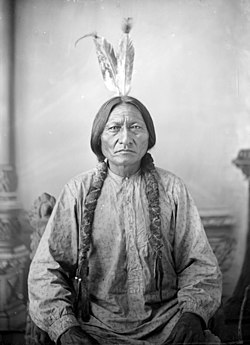
On December 15, 1890, Sitting Bull was arrested for failing to stop his people from practicing the Ghost Dance.
Image source: Sitting Bull
Dec 29, 1890
On December 29, 1890, Spotted Elk was stopped while en route to convene with the remaining Lakota chiefs.
1973
During the Wounded Knee incident of 1973, Lakota men and women, including Mary Brave Bird, performed the Ghost Dance ceremony at the site where their ancestors had been killed.
Image source: Wounded Knee Occupation
1973
Mary Brave Bird was among the Lakota people who performed the Ghost Dance ceremony at Wounded Knee during the 1973 incident.
1990
Congress officially apologized for the Wounded Knee Massacre in 1990, but did not rescind any awards of the Medal of Honor.
1892
Anthropologist James Mooney conducted an interview with Wovoka before 1892 and referred to him by his English name.
1892
James Mooney's pre-1892 interview documented Wovoka's account and teachings for scholarly and public audiences.
1894
Shortly after the commercialization of Emile Berliner's Gramophone, a small set of Ghost dances curated by James Mooney was recorded and pressed in 1894.
Image source: James Mooney
1894
The original masters of the small set of Ghost Dance recordings made in 1894 are held at the Library of Congress.
Build a timeline like this one in minutes, for free. Start Yours →
Or browse the full history timeline directory, with more than 3,000 topics.
This Ghost Dance timeline was generated with the help of AI, using information found on the internet.
We work hard to keep these timelines accurate, but mistakes do get through. If you spot one, email us at [email protected] and we'll fix it for future visitors.
Generate yours with AI or build it from scratch, for free.
Export your timeline, add your own events, edit or remove AI-generated events, and much more
No credit card required.
15-day money-back guarantee.
You can create an unlimited number of timelines with up to 10 events on each one, customize how they look, export them to PDF, PNG, PowerPoint, CSV, and Excel, and share them with a link. Timelines made with Timeline Maker AI keep every event the generator created, and you can add up to 5 events of your own. Paid plans remove the event limit, add spreadsheet imports and hide Preceden's branding, and the higher-priced plan also adds collaborators, a custom logo and a custom domain.
Yes. You can cancel your subscription from your account page at any time, and you will not be charged again. Your subscription stays active for the rest of the period you already paid for.
Yes. We email you a reminder 15 days before your annual renewal, and we email you a receipt after every payment.
Yes. You can email us within 15 days of any payment, and we will issue you a full refund.
Check out our pricing docs or send us an email anytime: [email protected].