
-
Resources
-
Pricing
This timeline traces the rise and fall of Gran Colombia, the short-lived republic that united present-day Colombia, Venezuela, Ecuador, and Panama after independence from Spain. More Less
Build a timeline like this one in minutes, for free. Start Yours →
1819
The Fundamental Law of the Republic of Colombia was issued during the Congress of Angostura, proclaiming a country named Colombia and giving the term a specific geographic and political reference.
Image source: Congress of Angostura
1819
The former Department of Cundinamarca was established in 1819 at the Congress of Angostura as part of the new Colombian state.
Image source: Gran Colombia
1821
The Constitution of Cúcuta established Bogotá as the capital of the republic.
Image source: Colombian Constitution of 1821
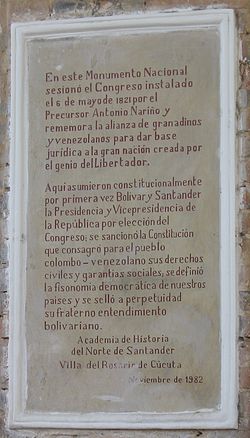
1821
The Congress of Cúcuta drafted the Constitution of Cúcuta in 1821, providing the constitutional framework for Gran Colombia.
1821
Although proclaimed in 1819, Gran Colombia came into being when the Congress of Cúcuta promulgated the Constitution of Cúcuta in 1821.
Nov 1821
Panama joined the federation in November 1821, becoming part of the territory claimed and administered by Gran Colombia.
Image source: History of Panama
1822
The province of Quito joined Gran Colombia in 1822, extending the federation's authority into territory that had still been under Spanish rule in 1821.
1822
The province of Pasto joined Gran Colombia in 1822 after the republic's military campaigns against Spanish rule.
1822
The province of Guayaquil joined Gran Colombia in 1822.
1824
A new territorial division was implemented in 1824 to curb regionalist tendencies and establish more efficient central control of local administration.
1819
Before a new constitution could be written, the Congress of Angostura appointed Simón Bolívar president of the newly proclaimed republic.
Image source: Simón Bolívar
1819
The Congress of Angostura appointed Francisco de Paula Santander vice president, establishing the initial executive leadership of Gran Colombia.
Image source: Francisco de Paula Santander
1820 - 1825
From 1820 to 1825, Gran Colombia was ruled directly by Bolívar under extraordinary powers granted to him.
1820 - 1825
From 1820 to 1825, the area's textile industry suffered because cheaper textiles were imported.
1825
By 1825, differences between leaders and regions that had fought together against Spanish rule became public and contributed to political instability.
1826
In 1826, Venezuela came close to seceding from Gran Colombia, reflecting the federation's growing regional and political tensions.
Image source: La Cosiata
1826
Bolívar and Santander were reappointed by the national congress in 1826, even as political differences within the federation became increasingly public.
1828
The new constituent assembly, known as the Convention of Ocaña, began its sessions in 1828 to address the republic's constitutional and political crisis.
1821
At the Battle of Carabobo, all of Venezuela except Puerto Cabello was liberated from Spanish rule, strengthening Gran Colombia's position.
Image source: Battle of Carabobo
1824
Gran Colombia's army helped consolidate the independence of Peru in 1824.
Image source: Peruvian War of Independence
1828
The dispute with Peru centered on Gran Colombian claims over the territories of Jaén and Maynas.
Image source: Gran Colombia–Peru War
Jun 3, 1828
On 3 June 1828, Bolívar declared war on Peru over Gran Colombian claims to the Peruvian territories of Jaén and Maynas.
Sep 22, 1829
The war between Gran Colombia and Peru ended with the Treaty of Guayaquil, signed on 22 September 1829.
Image source: Treaty of Guayaquil
Oct 27, 1829
The Treaty of Guayaquil went into effect on 27 October 1829, formalizing the settlement that ended the war with Peru.
1830
As the collapse of the country became evident in 1830, Bolívar resigned from the presidency.
1830
The status of treaties and accords dating from the revolutionary period and the Gran Colombia period continued to have a profound effect on international relations.
1830
The federation dissolved during the closing months of 1830 as political differences between federalists and centralists and regional tensions became irreconcilable.
Image source: Dissolution of Gran Colombia
1831
The former federation broke into the successor states of Colombia, Ecuador, and Venezuela.
1831
The former Department of Cundinamarca became a new country, the Republic of New Granada, after the dissolution of Gran Colombia.
Image source: Republic of New Granada
1831
Gran Colombia was formally abolished in 1831 after its federation had dissolved.
Build a timeline like this one in minutes, for free. Start Yours →
Or browse the full history timeline directory, with more than 2,500 topics.
This Gran Colombia timeline was generated with the help of AI, using information found on the internet.
We work hard to keep these timelines accurate, but mistakes do get through. If you spot one, email us at [email protected] and we'll fix it for future visitors.
Generate yours with AI or build it from scratch, for free.
Export your timeline, add your own events, edit or remove AI-generated events, and much more
No credit card required.
15-day money-back guarantee.
You can create an unlimited number of timelines with up to 10 events on each one, customize how they look, export them to PDF, PNG, PowerPoint, CSV, and Excel, and share them with a link. Timelines made with Timeline Maker AI keep every event the generator created, and you can add up to 5 events of your own. Paid plans remove the event limit, add spreadsheet imports and hide Preceden's branding, and the higher-priced plan also adds collaborators, a custom logo and a custom domain.
Yes. You can cancel your subscription from your account page at any time, and you will not be charged again. Your subscription stays active for the rest of the period you already paid for.
Yes. We email you a reminder 15 days before your annual renewal, and we email you a receipt after every payment.
Yes. You can email us within 15 days of any payment, and we will issue you a full refund.
Check out our pricing docs or send us an email anytime: [email protected].