-
Use Cases
-
Resources
-
Pricing
Helen Keller (1880–1968) was an American author, disability rights advocate, and lecturer who became deaf and blind at 19 months old. With the help of her teacher Anne Sullivan, she learned to communicate and became the first deafblind person to earn a Bachelor of Arts degree. She dedicated her life to advocating for people with disabilities and social causes worldwide. More Less
Jun 27, 1880
% complete
Helen Adams Keller was born on June 27, 1880, in Tuscumbia, Alabama, the daughter of Arthur Henley Keller and Catherine Everett 'Kate' Adams Keller. She would become a renowned American author, disability rights advocate, political activist and lecturer.
Image source: Helen Keller
1886
% complete
In 1886, Keller's mother, inspired by an account in Charles Dickens' American Notes of the successful education of Laura Bridgman, a deaf and blind woman, dispatched the young Keller and her father to consult physician J.
Mar 5, 1887
% complete
Sullivan arrived at Keller's house on March 5, 1887, beginning decades of teaching and companionship. Keller would forever remember this day as "my soul's birthday".
May 1888
% complete
In May 1888, Keller started attending the Perkins Institute for the Blind, continuing her formal education with Anne Sullivan's support.
Image source: Perkins School for the Blind

1893
% complete
In 1893, Keller, along with Sullivan, attended William Wade House and Finishing School as part of her ongoing education.
1894
% complete
In 1894, Keller and Sullivan moved to New York to attend the Wright-Humason School for the Deaf, and to learn from Sarah Fuller at the Horace Mann School for the Deaf.
1896
% complete
In 1896, Keller and Sullivan returned to Massachusetts, and Keller entered The Cambridge School for Young Ladies before gaining admittance to Radcliffe College in 1900.
1900
% complete
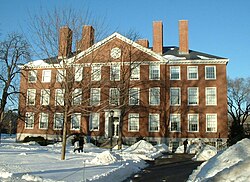
In 1900, Keller gained admittance to Radcliffe College of Harvard University, where she lived in Briggs Hall, South House.
Image source: Radcliffe College
1904
% complete
In 1904, at the age of 24, Keller graduated from Radcliffe as a member of Phi Beta Kappa, becoming the first deafblind person to earn a Bachelor of Arts degree.
1936
% complete
Sullivan married John Macy in 1905, and her health started failing around 1914; Polly Thomson had been hired in 1914 to keep house. Sullivan died in 1936, with Keller holding her hand, after falling into a coma as a result of coronary thrombosis.
Image source: Anne Sullivan
Mar 21, 1960
% complete
Polly Thomson, hired in 1914 to keep house, had a stroke in 1957 from which she never fully recovered and died in 1960. Winnie Corbally, a nurse originally hired to care for Thomson in 1957, stayed on after Thomson's death and was Keller's companion for the rest of her life.
1891
% complete
One of Keller's earliest pieces of writing, at age 11, was The Frost King (1891).
Image source: The Frost King
1903
% complete
At age 22, with help from Sullivan and Sullivan's husband John Macy, Keller published her autobiography, The Story of My Life (1903), which publicized her education and life with Sullivan.
Image source: The Story of My Life (biography)
1903
% complete
Keller also published Optimism: an essay in 1903, reflecting her famously hopeful outlook on life.
1908
% complete
In 1908, Keller wrote The World I Live In, giving readers an insight into how she felt about the world.
Image source: The Skin I Live In
1909
% complete
Keller, along with her friend Mark Twain, became involved in the dispute about the authorship of the Shakespeare plays, which they discussed extensively during Keller's, Sullivan's and Macy's visit to Twain's home in 1909. She later asked Richard Watson Gilder to publish an article advocating Booth's hypothesis, but he declined.
Image source: Mark Twain
1910
% complete
Keller's work The song of the stone wall was published by The Century Co. in 1910.
1913
% complete
Out of the Dark, a series of essays on socialism, was published in 1913. That year she also gave her first public talk on behalf of progressive causes.
1927
% complete
When Keller was young, Anne Sullivan introduced her to Phillips Brooks, who introduced her to Christianity. Her spiritual autobiography, My Religion, was published in 1927 and then in 1994 extensively revised by Ray Silverman, and re-issued under the title Light in My Darkness.
Image source: My Religion (Keller book)
1929
% complete
Keller's work We bereaved was published in 1929.
1932
% complete
Keller's book Peace at eventide was published by Methuen & Co. in 1932.
1938
% complete
Helen Keller's journal was published in 1938.
1940
% complete
Let us have faith was published by Doubleday, Doran & Co., Inc. in 1940.
1907
% complete
In an article Keller wrote in 1907, she brought to public attention the fact that many cases of childhood blindness could be prevented by washing the eyes of every newborn baby with a disinfectant solution.
1909
% complete
In 1909, Keller became a member of the Socialist Party of America (SPA); she actively campaigned and wrote in support of the working class from 1909 to 1921.
Image source: Socialist Party of America
1912
% complete
In 1912, Keller joined the Industrial Workers of the World (the IWW, known as the Wobblies), saying that parliamentary socialism was "sinking in the political bog". She cited the 1912 strike of textile workers in Lawrence, Massachusetts, as instigating her support of socialism.
Image source: Industrial Workers of the World
1915
% complete
In 1915, she wrote in favor of refusing life-saving medical procedures to infants with severe mental impairments or physical deformities, saying that their lives were not worthwhile and they would likely become criminals.
1916
% complete
In 1916, Keller sent money to the NAACP, as she was ashamed of the Southern un-Christian treatment of "colored people".
Image source: NAACP
1916 - 1918
% complete
Keller wrote for the Industrial Workers of the World between 1916 and 1918, supporting labor organizing efforts.
Jan 22, 1916
% complete
On January 22, 1916, Keller and Sullivan traveled to Menomonie, Wisconsin, delivering a lecture described by the Dunn County News as "a message of optimism, of hope, of good cheer, and of loving service" that would linger long with those fortunate enough to have received it.
Image source: Mabel Tainter Memorial Building
1920
% complete
In 1920, Keller helped to found the American Civil Liberties Union (ACLU).
Image source: American Civil Liberties Union
Jun 1937
% complete
She visited Akita Prefecture in June 1937 and asked about Hachikō, a loyal dog who searched for his deceased master for about 10 years.
Image source: Hachikō
1946 - 1957
% complete
From 1946 to 1957, Keller visited 35 countries as part of her advocacy work for people with disabilities around the world.
1948
% complete
In 1948, Keller touched the re-made statue of Hachikō at Shibuya Station during her international travels. That year she also went to New Zealand and visited deaf schools in Christchurch and Auckland.
Jul 1, 1953
% complete
As a result of her advocacy, Keller was placed on the FBI's watchlist; the FBI wrote on July 1, 1953, that although they had not "conducted an investigation with regard to Helen Adams Keller", their files of Keller reflected pertinent information concerning this individual.
Image source: Federal Bureau of Investigation
1919
% complete
She and her companion Anne Sullivan appeared in a silent film, Deliverance (1919), which told her story in a melodramatic, allegorical style.
Image source: Deliverance (1919 film)
1954
% complete
She was the subject of the Academy Award-winning 1954 documentary Helen Keller in Her Story, narrated by her friend Katharine Cornell; in 2023, the film was added to the National Film Registry by the Library of Congress for being deemed culturally, historically, or aesthetically significant.
Image source: Helen Keller in Her Story
1957
% complete
William Gibson's first realization of The Miracle Worker, starring Patty McCormack as Keller and Teresa Wright as Sullivan, was the 1957 Playhouse 90 teleplay. When Keller heard about it, she said: "Never did I dream a drama could be devised out of the story of my life."
Image source: The Miracle Worker
1959
% complete
Within the cultural context of the early civil rights movement, Gibson adapted his teleplay for a Broadway production in 1959, which was praised by critics as a contemporary classic.
1961
% complete
Keller had a series of strokes in 1961 and spent the last years of her life at her home, Arcan Ridge, in Easton, Connecticut.
1962
% complete
Gibson adapted his play as an Oscar-winning feature film in 1962, starring Anne Bancroft and Patty Duke.
Image source: The Miracle Worker (1962 film)
1964
% complete
In 1964, Keller was made an honorary member of the Southern Dames of America during their second national assembly in Washington, D.C.
Sep 14, 1964
% complete
On September 14, 1964, President Lyndon B. Johnson awarded Keller the Presidential Medal of Freedom, one of the United States' highest civilian honors.
Image source: Presidential Medal of Freedom
1965
% complete
In 1965, Keller was elected to the National Women's Hall of Fame at the New York World's Fair.
Image source: National Women's Hall of Fame
Jun 1, 1968
% complete
She died in her sleep on June 1, 1968, at her home, Arcan Ridge, located in Easton, Connecticut, at the age of 87.
1971
% complete
Keller was posthumously inducted into the Alabama Women's Hall of Fame in 1971.
Image source: Alabama Women's Hall of Fame
1973
% complete
In 1973, Keller was inducted into the National Women's Hall of Fame.
1980
% complete
A commemorative stamp was issued in 1980 by the United States Postal Service, depicting Keller and Sullivan, to mark the centennial of Keller's birth.
Image source: United States Postal Service
1981
% complete
An anime movie called The Story of Helen Keller: Angel of Love and Light was made in 1981.
1984
% complete
In 1984, Keller's life story was made into a TV movie called The Miracle Continues.
1999
% complete
In 1999, Keller was listed fifth (at 30 percent) in Gallup's List of Most Widely Admired People of the 20th Century. That same year, she was named one of Time magazine's 100 Most Important People of the 20th Century.
Image source: Gallup's List of Most Widely Admired People of the 20th Century
2003
% complete
2005
% complete
The Bollywood movie Black (2005) was largely based on Keller's story from her childhood to her graduation. Also in 2005, a documentary called Shining Soul: Helen Keller's Spiritual Life and Legacy was produced by the Swedenborg Foundation.
Image source: Black (2005 film)
Mar 6, 2008
% complete
On March 6, 2008, the New England Historic Genealogical Society announced that a staff member had discovered a rare 1888 photograph showing Helen and Anne, which, although previously published, had escaped widespread attention.
Image source: New England Historic Genealogical Society
Oct 7, 2009
% complete
On October 7, 2009, the State of Alabama donated a bronze statue of Keller to the National Statuary Hall Collection, as a replacement for its 1908 statue of education reformer Jabez Lamar Monroe Curry.
Image source: National Statuary Hall Collection
Jun 8, 2015
% complete
Keller was one of twelve inaugural inductees to the Alabama Writers Hall of Fame on June 8, 2015.
Image source: International Motorsports Hall of Fame
2020
% complete
In 2020, the documentary essay Her Socialist Smile by John Gianvito evolved around Keller's first public talk in 1913 before a general audience, when she started speaking out on behalf of progressive causes.
Or browse the full history timeline directory, with more than 2,000 topics.
This Helen Keller timeline was generated with the help of AI, using information found on the internet.
We work hard to keep these timelines accurate, but mistakes do get through. If you spot one, email us at [email protected] and we'll fix it for future visitors.
Generate yours with AI or build it from scratch, for free.
Export your timeline, add your own events, edit or remove AI-generated events, and much more
No credit card required.
Cancel anytime.
Cancel anytime.
You can create an unlimited number of timelines with up to 10 events on each one, customize how they look, export them to PDF, PNG, PowerPoint, CSV, and Excel, and share them with a link. Paid plans raise the event limit and add features like spreadsheet imports and collaborators.
Yes. You can cancel your subscription from your account page at any time, and you will not be charged again. Your subscription stays active for the rest of the period you already paid for.
Yes. We will email you a reminder before the annual renewal, and we will also email you a receipt.
Yes. You can email us within 15 days of any payment, and we will issue you a full refund.
Check out our pricing docs or send us an email anytime: [email protected].