-
Use Cases
-
Resources
-
Pricing
Algeria's history spans thousands of years, beginning with indigenous Berber (Amazigh) civilizations, followed by Phoenician, Roman, Arab, and Ottoman influences. French colonization from 1830 profoundly shaped the country, leading to a brutal war of independence (1954–1962) that ended colonial rule. Since independence, Algeria has experienced socialist experiments, political turmoil, a civil war in the 1990s, and ongoing efforts toward political and economic reform. More Less
202 BC
After the Second Punic War, the Berber kingdom of Numidia emerged in what is now northern Algeria under King Masinissa, who united the tribes and built a powerful state allied with Rome.
Image source: Numidia
112 BC - 106 BC
King Jugurtha of Numidia resisted Roman expansion in a bitter war marked by guerrilla tactics and bribery of Roman officials, but he was ultimately captured by Rome, ending Numidian independence.
Image source: Jugurthine War
46 BC
Following the defeat of Juba I, Julius Caesar annexed eastern Numidia, incorporating it into the Roman province of Africa Nova and beginning centuries of Roman rule over the region.
Image source: Africa (Roman province)
395 AD - 430 AD
Augustine, one of Christianity's most influential theologians, served as bishop of Hippo Regius (modern Annaba, Algeria), writing major works such as Confessions and City of God during the late Roman period.
Image source: Augustine of Hippo
429 AD - 439 AD
The Vandals led by Genseric crossed from Spain into North Africa, sweeping through Roman territories including present-day Algeria and establishing a kingdom centered on Carthage.
Image source: Vandal conquest of Roman Africa
533 AD - 534 AD
The Byzantine general Belisarius defeated the Vandal Kingdom, restoring imperial rule over North Africa, including Algeria, as part of Emperor Justinian's efforts to reclaim the western empire.
Image source: Vandalic War
647 AD - 709 AD
Arab Muslim armies gradually conquered Byzantine North Africa, introducing Islam and Arabic culture to the region. Resistance was fierce, notably from Berber leaders such as Queen Kahina.
Image source: Muslim conquest of the Maghreb
776 AD
The Rustamids founded an Ibadi Muslim state with its capital at Tahert in central Algeria, becoming a major center of trade, scholarship, and Islamic learning in the Maghreb.
Image source: Rustamid dynasty
972 AD - 1148 AD
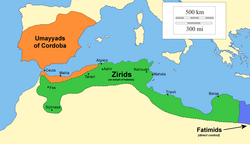
The Zirids, a Berber dynasty nominally loyal to the Fatimids, ruled much of modern Algeria and Tunisia, fostering urban growth before their power waned amid invasions and the rise of rival dynasties.
Image source: Zirid dynasty
1152 AD
The Almohads, a Berber reform movement from Morocco, unified the entire Maghreb and al-Andalus under their rule, bringing Algeria into a vast Islamic empire centered on Marrakesh.
Image source: Almohad Caliphate
1235 AD - 1554 AD
The Zayyanids established the Kingdom of Tlemcen in western Algeria after the collapse of Almohad authority, making Tlemcen a flourishing center of commerce, architecture, and scholarship.
Image source: Zayyanid dynasty
1509 AD
Spain captured several Algerian coastal cities, including Oran and Béjaïa, threatening local rulers and prompting calls for Ottoman assistance against Christian encroachment.
Image source: Spanish Oran
1516 AD
The corsair brothers Aruj and Hayreddin Barbarossa seized Algiers, expelling Spanish influence and laying the foundation for Ottoman rule in the central Maghreb.
Image source: Hayreddin Barbarossa
1518 AD
After Aruj's death, Hayreddin Barbarossa placed Algiers under Ottoman protection. The Regency of Algiers became a semi-autonomous Ottoman province governed by deys and corsair fleets.
Image source: Regency of Algiers
1541 AD
Holy Roman Emperor Charles V launched a massive amphibious assault on Algiers that was destroyed by storms and determined resistance, cementing Ottoman control of the city for centuries.
Image source: Battle of Algiers (1541)
Aug 27, 1816
A British-Dutch fleet under Lord Exmouth bombarded Algiers to force the Dey to end the enslavement of European Christians, weakening the prestige of the Regency.
Image source: Bombardment of Algiers (1816)
Apr 29, 1827
Dey Hussein struck the French consul Pierre Deval with his fly whisk during a dispute over unpaid debts, giving France a pretext to impose a blockade and eventually invade Algeria.
Image source: Bakri-Busnach affair
Jun 14, 1830 - Jul 5, 1830
A French army landed at Sidi Ferruch and captured Algiers within weeks, forcing Dey Hussein to surrender and beginning 132 years of French colonial rule in Algeria.
Image source: Invasion of Algiers (1830)
1832 AD - 1847 AD
Emir Abd al-Qadir organized prolonged and sophisticated resistance against French expansion, founding an independent state before being forced to surrender in 1847.
Image source: Emir Abdelkader
1848 AD
France formally organized Algeria into three départements administered as part of metropolitan France, though its Muslim inhabitants remained largely excluded from full citizenship rights.
Image source: French Algeria
Oct 24, 1870
The decree granted French citizenship to Algeria's Jewish population while excluding Muslims, deepening divisions in colonial society and fueling resentment among the Muslim majority.
Image source: Crémieux Decree
Mar 1871 AD - Jan 1872 AD
Cheikh Mokrani led one of the largest Kabyle uprisings against French colonization, mobilizing hundreds of thousands before it was brutally suppressed and followed by massive land confiscations.
Image source: Mokrani Revolt
May 8, 1945
Celebrations of Allied victory turned into nationalist demonstrations that were violently repressed; thousands of Algerians were killed, radicalizing the independence movement.
Image source: Sétif and Guelma massacre
Nov 1, 1954
The National Liberation Front launched coordinated attacks across Algeria on All Saints' Day, marking the start of the Algerian War of Independence against French colonial rule.
Image source: National Liberation Front (Algeria)
Aug 20, 1956
FLN leaders met in the Soummam Valley to structure the liberation movement, prioritizing political action and internal coordination over military command from outside the country.
Image source: Larbi Ben M'hidi
Sep 30, 1956 - Sep 1957
Urban guerrilla warfare between FLN fighters and French paratroopers raged in Algiers. Though France won tactically, the brutal methods used, including torture, eroded international support for France.
Image source: Battle of Algiers (1956–1957)
Feb 1959 - Mar 1960
French General Maurice Challe led large-scale sweeps using helicopters and mobile forces that severely weakened FLN military units inside Algeria, though the war's political momentum favored independence.
Image source: Challe Plan
Jan 24, 1960 - Feb 1, 1960
European settlers and army sympathizers erected barricades in Algiers to oppose de Gaulle's policies, exposing deep fractures within French society over the future of Algeria.
Image source: Algerian War
Apr 21, 1961 - Apr 25, 1961
Four French generals attempted to seize control of Algiers to prevent Algerian independence, but the coup collapsed after mass conscript refusal and de Gaulle's radio address.
Image source: Algiers putsch of 1961
Mar 18, 1962
France and the FLN signed agreements ending the war and providing for a ceasefire and referendum on independence, paving the way for Algeria's sovereignty.
Image source: Évian Accords
Jul 5, 1962
Following a near-unanimous referendum, Algeria declared independence on July 5, 1962, after eight years of war that cost hundreds of thousands of lives and ended French colonial rule.
Image source: Algerian War
Sep 29, 1963 - Jun 19, 1965
Ahmed Ben Bella became independent Algeria's first president, pursuing socialist policies and state-building until he was overthrown by his defense minister Houari Boumédiène in 1965.
Image source: Ahmed Ben Bella
Jun 19, 1965
Boumédiène ousted Ben Bella and ruled Algeria until 1978, nationalizing industry and oil resources, promoting industrialization, and championing Third World solidarity.
Image source: Houari Boumédiène
Feb 24, 1971
Boumédiène nationalized French-owned oil and gas interests, asserting economic sovereignty and using petroleum revenues to fund ambitious development programs.
Image source: Economy of Algeria
Oct 5, 1988 - Oct 10, 1988
Youth-led riots protesting austerity and unemployment swept Algeria; the violent crackdown prompted President Chadli Bendjedid to abandon the FLN monopoly and introduce multiparty democracy.
Dec 26, 1991
The Islamist FIS won a decisive victory in the first round of parliamentary elections, prompting the military to cancel the process, force President Chadli to resign, and ban the party.
Image source: 1991 Algerian parliamentary election
Jan 1992 - 2002
Conflict erupted between the government and Islamist insurgent groups after the canceled elections, killing an estimated 100,000 to 200,000 people before the insurgency largely collapsed.
Image source: Algerian Civil War
Nov 16, 1995
Presidential elections held during the civil war brought Liamine Zéroual to power, beginning a gradual process of restoring stability and institutional normalcy.
Image source: Liamine Zéroual
Apr 15, 1999
Bouteflika won the presidency and introduced the Civil Concord policy offering amnesty to insurgents, helping end most fighting and launching a long era of relative stability and oil-funded growth.
Image source: Abdelaziz Bouteflika
Sep 29, 2005
Algerians overwhelmingly approved a referendum granting amnesty to former combatants, formally closing the chapter on the civil war and banning discussion of certain wartime abuses.
Feb 22, 2019
Mass weekly demonstrations erupted against Bouteflika's bid for a fifth term, forcing his resignation and pressing for broader democratic reforms under the slogan of a civilian state.
Image source: Hirak (Algeria)
Or browse the full history timeline directory, with more than 2,500 topics.
This History of Algeria timeline was generated with the help of AI, using information found on the internet.
We work hard to keep these timelines accurate, but mistakes do get through. If you spot one, email us at [email protected] and we'll fix it for future visitors.
Generate yours with AI or build it from scratch, for free.
Export your timeline, add your own events, edit or remove AI-generated events, and much more
No credit card required.
Cancel anytime.
Cancel anytime.
You can create an unlimited number of timelines with up to 10 events on each one, customize how they look, export them to PDF, PNG, PowerPoint, CSV, and Excel, and share them with a link. Paid plans raise the event limit and add features like spreadsheet imports and collaborators.
Yes. You can cancel your subscription from your account page at any time, and you will not be charged again. Your subscription stays active for the rest of the period you already paid for.
Yes. We will email you a reminder before the annual renewal, and we will also email you a receipt.
Yes. You can email us within 15 days of any payment, and we will issue you a full refund.
Check out our pricing docs or send us an email anytime: [email protected].