-
Use Cases
-
Resources
-
Pricing
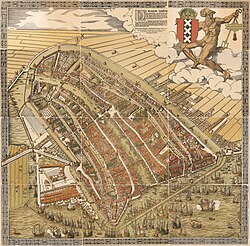
Amsterdam's history spans nearly a thousand years, beginning as a small fishing settlement on the Amstel River around 1200. It grew into a major medieval trading town, flourished spectacularly during the Dutch Golden Age of the 17th century when it became one of the world's wealthiest cities and a center of finance, art, and commerce, endured occupation and hardship in the 20th century, and today stands as a cosmopolitan European capital known for its canals, culture, and liberal traditions. More Less
1000
% complete
Around the year 1000, farmers and fishermen settled along the Amstel River near the IJ inlet, draining the peatlands of the region. This modest settlement, known as Amestelle, would gradually grow into the city of Amsterdam.
Image source: History of Amsterdam
1220
% complete
A dam was built across the Amstel River around 1220 to protect the settlement from flooding from the IJ. The structure gave the growing town its name—Amstelredamme—and the site became Dam Square, still the heart of Amsterdam today.
Image source: Dam Square
Oct 27, 1275
% complete
On October 27, 1275, Count Floris V of Holland granted the villagers of Amestelledamme exemption from tolls on goods transported through his lands. This document is considered the founding charter of Amsterdam's city rights.
Image source: Floris V of Holland
1306
% complete
The Oude Kerk (Old Church), Amsterdam's oldest building, was consecrated in 1306 by the bishop of Utrecht. Built on a sandy mound for stability, it served the growing fishing community at the center of the medieval town.
Image source: Oude Kerk, Amsterdam
1369
% complete
In the second half of the 14th century, Amsterdam became associated with the Hanseatic League, a powerful network of northern European trading cities. Membership boosted the town's Baltic trade in grain and timber, laying foundations for its commercial rise.
Image source: Hanseatic League
May 26, 1578
% complete
During the Dutch Revolt against Spain, Amsterdam's largely Catholic city government peacefully handed power to Calvinist rebels on May 26, 1578. The Alteratie brought Amsterdam into the Dutch Revolt on the side of William of Orange and opened religious tolerance that attracted immigrants.
Image source: Alteratie
1585
% complete
When Spanish forces captured Antwerp in 1585, thousands of wealthy Protestant merchants and craftsmen fled north, many settling in Amsterdam. Their capital and expertise transformed the city into Europe's premier trading port within decades.
Image source: Fall of Antwerp
1602
% complete
Following the VOC's founding, Amsterdam developed the world's first official stock exchange, where shares in trading companies were bought and sold. The Beurs van Hendrick de Keyser opened in 1611, pioneering modern securities trading.
Image source: Euronext Amsterdam
Mar 20, 1602
% complete
The Vereenigde Oostindische Compagnie, headquartered in Amsterdam, was chartered in 1602 to monopolize Dutch trade with Asia. It became the world's first multinational corporation, fueling Amsterdam's Golden Age prosperity.
Image source: Dutch East India Company
1609
% complete
The city established the Wisselbank in 1609, providing stable currency exchange and deposit services for international merchants. Widely considered the world's first central bank, it cemented Amsterdam's role as Europe's financial capital.
Image source: Bank of Amsterdam
1612 - 1660
% complete
Beginning in 1612, Amsterdam undertook an ambitious urban expansion, digging the concentric Herengracht, Keizersgracht, and Prinsengracht canals. The elegant canal belt housed wealthy merchants and remains one of the most famous urban landscapes in the world, now a UNESCO World Heritage Site.
Image source: Canals of Amsterdam
1631
% complete
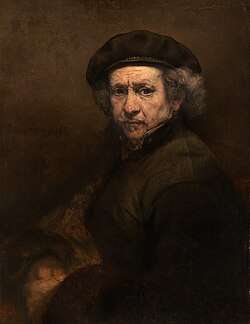
Painter Rembrandt van Rijn relocated from Leiden to Amsterdam in 1631, where he became the city's most celebrated portraitist. His masterpieces like The Night Watch (1642) defined Dutch Golden Age art and drew patrons from across Europe.
Image source: Rembrandt
Nov 1636 - Feb 1637
% complete
Speculative frenzy over tulip bulbs reached its peak in the winter of 1636–37, with contracts traded at extraordinary prices before the market collapsed in February 1637. Often cited as history's first speculative bubble, tulip mania centered on Amsterdam's exchanges.
Image source: Tulip mania
1650
% complete
By mid-century, Amsterdam stood as the richest city in Europe, dominating world commerce through its shipping, banking, and diamond industries. Its population swelled past 200,000, making it one of the largest cities on the continent.
Image source: Dutch Golden Age
1672
% complete
The 'Disaster Year' of 1672 saw France, England, Münster, and Cologne attack the Dutch Republic simultaneously. To defend Amsterdam, authorities opened the dikes and flooded surrounding polders, stopping the French advance at the water line.
Image source: Rampjaar
1675
% complete
The Portuguese Synagogue, completed in 1675, served Amsterdam's flourishing Sephardic Jewish community, which had grown after refugees fled persecution in Portugal and Spain. Amsterdam earned the nickname 'Mokum,' a haven of relative religious tolerance.
Image source: Portuguese Synagogue (Amsterdam)
1780 - 1784
% complete
Britain's victory over the Dutch Republic between 1780 and 1784 shattered Amsterdam's naval supremacy and colonial shipping. The war marked the beginning of the end of Dutch commercial dominance and accelerated the city's economic decline.
Image source: Fourth Anglo-Dutch War
1787
% complete
Inspired by the American and French revolutions, Patriot reformers challenged the stadtholder's authority in Amsterdam and across the Republic. Prussian troops restored Orangist control in 1787, but revolutionary ideas continued to spread.
1795
% complete
French revolutionary forces entered Amsterdam in January 1795, toppling the old Dutch Republic and establishing the Batavian Republic. Amsterdam lost its privileged status as a semi-independent city-state and became part of a centralized national state.
Image source: Batavian Republic
1808
% complete
King Louis Bonaparte, Napoleon's brother installed on the Dutch throne, declared Amsterdam the capital of the Kingdom of Holland in 1808 despite preferring The Hague. Amsterdam has remained the nominal national capital ever since.
Image source: Louis Bonaparte
1876
% complete
After years of decline caused by silting of the IJ, the North Sea Canal opened in 1876, linking Amsterdam directly to the sea at IJmuiden. The massive engineering project revived the port and enabled large ocean-going vessels to reach the city.
Image source: North Sea Canal
1885
% complete
The Rijksmuseum moved into its grand neo-Gothic building designed by Pierre Cuypers in 1885, housing the nation's greatest art treasures including Rembrandt's Night Watch. It became a centerpiece of Amsterdam's cultural identity.
Image source: Rijksmuseum
1894
% complete
Amsterdam's powerful diamond workers' union, led by Henri Polak, won major labor victories including reduced hours and better conditions in the 1890s. The ANDB became one of the Netherlands' first modern mass unions and a model for the Dutch labor movement.
Image source: General Diamond Workers' Union of the Netherlands
1915 - 1930
% complete
Architects Michel de Klerk and colleagues pioneered the expressive Amsterdam School style, featuring brick expressionism and sculptural forms. Housing projects like Het Schip transformed working-class neighborhoods and influenced social housing worldwide.
Image source: Amsterdam School
May 17, 1928 - Aug 12, 1928
% complete
Amsterdam hosted the ninth Olympic Games, introducing the tradition of lighting an Olympic flame and the parade of nations. The Games showcased the city internationally during the interwar period.
Image source: 1928 Summer Olympics
May 10, 1940 - May 15, 1940
% complete
Germany invaded the Netherlands in May 1940, bombing Rotterdam and forcing Dutch capitulation within days. Amsterdam endured five years of Nazi occupation, marked by persecution of its large Jewish population.
Image source: German invasion of the Netherlands
Feb 25, 1941 - Feb 27, 1941
% complete
Amsterdam workers staged a massive general strike in February 1941—the only such mass protest against deportation of Jews in occupied Europe. Though suppressed within days, the strike remains a symbol of solidarity and resistance.
Image source: February strike
Jul 6, 1942 - Aug 4, 1944
% complete
Anne Frank and her family hid in a secret annex above her father's office on the Prinsengracht for two years. Her diary, published after her death in Bergen-Belsen, became one of the world's most-read accounts of the Holocaust.
Image source: Anne Frank
May 5, 1945
% complete
German forces in the Netherlands capitulated on May 5, 1945, ending five years of occupation. Canadian troops entered Amsterdam days later, greeted joyfully by starving but liberated residents. May 5 is celebrated annually as Liberation Day.
Image source: Liberation Day (Netherlands)
1965 - 1967
% complete
The anarchist Provo movement shook Amsterdam with playful street happenings, white bicycle plans, and confrontations with police. Its provocations helped spark broader countercultural change and influenced the city's famously tolerant politics.
Image source: Provo (movement)
1967
% complete
By 1967, Amsterdam had become a mecca for hippies and youth culture, epitomized by John Lennon and Yoko Ono's 1969 Bed-In for Peace at the Hilton hotel. Squatter movements, coffeeshops, and liberal policies defined the city's reputation.
Image source: Counterculture of the 1960s
1967
% complete
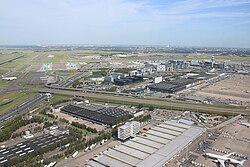
A single-terminal design inaugurated in 1967 allowed Schiphol to expand dramatically, becoming a major European aviation hub. The airport now serves tens of millions of passengers yearly, anchoring Amsterdam's economy and connectivity.
Image source: Amsterdam Airport Schiphol
Jun 2, 1973
% complete
The Van Gogh Museum opened in 1973 on Museumplein, housing the world's largest collection of Vincent van Gogh's works donated by his family. It quickly became one of the Netherlands' most visited museums.
Image source: Van Gogh Museum
Mar 24, 1975 - Apr 1, 1975
% complete
Demolition of homes in the Nieuwmarkt neighborhood for metro construction sparked violent clashes between squatters and police in March 1975. The riots led to changes in urban planning policy and greater preservation of historic neighborhoods.
Image source: Nieuwmarkt riots
Aug 1, 2010
% complete
UNESCO inscribed Amsterdam's 17th-century Canal Ring on the World Heritage List in 2010, recognizing it as a masterpiece of urban planning. The designation affirmed the enduring cultural value of the Golden Age canal district.
Apr 13, 2013
% complete
After ten years of renovation costing hundreds of millions of euros, the Rijksmuseum reopened under Queen Beatrix in April 2013. The restored building welcomed record crowds to view Rembrandt, Vermeer, and other Dutch masters.
Or browse the full history timeline directory, with more than 2,000 topics.
This History of Amsterdam timeline was generated with the help of AI, using information found on the internet.
We work hard to keep these timelines accurate, but mistakes do get through. If you spot one, email us at [email protected] and we'll fix it for future visitors.
Generate yours with AI or build it from scratch, for free.
Export your timeline, add your own events, edit or remove AI-generated events, and much more
No credit card required.
Cancel anytime.
Cancel anytime.
You can create an unlimited number of timelines with up to 10 events on each one, customize how they look, export them to PDF, PNG, PowerPoint, CSV, and Excel, and share them with a link. Paid plans raise the event limit and add features like spreadsheet imports and collaborators.
Yes. You can cancel your subscription from your account page at any time, and you will not be charged again. Your subscription stays active for the rest of the period you already paid for.
Yes. We will email you a reminder before the annual renewal, and we will also email you a receipt.
Yes. You can email us within 15 days of any payment, and we will issue you a full refund.
Check out our pricing docs or send us an email anytime: [email protected].