-
Use Cases
-
Resources
-
Pricing
Belgium's history spans from ancient Roman times through medieval trade cities, its independence from the Netherlands in 1830, colonial expansion in Africa, devastation and occupation during both World Wars, postwar European integration, and its evolution into a federal state divided into Dutch-speaking Flanders and French-speaking Wallonia. More Less
511
After the death of King Clovis I, his Frankish kingdom was divided among his sons. The region of modern Belgium became part of Austrasia, one of the Merovingian kingdoms centered on the Meuse valley.
Image source: Clovis I
843
The Treaty of Verdun split Charlemagne's empire among his grandsons. The Scheldt River became a border, placing much of modern Belgium in Lotharingia and later the Holy Roman Empire, while Flanders fell under West Francia.
Image source: Treaty of Verdun
862
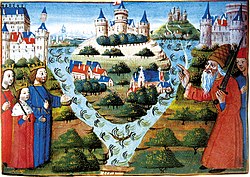
Baldwin Iron Arm established the County of Flanders after marrying Judith, daughter of Charles the Bald. The county grew into one of the most powerful principalities of medieval Europe.
Image source: Baldwin I of Flanders
Jul 11, 1302
Flemish militia forces defeated the French army of Philip IV near Kortrijk. The victory by commoners over knights became a symbol of Flemish identity and is commemorated as the Flemish national holiday.
Image source: Battle of the Golden Spurs
1384
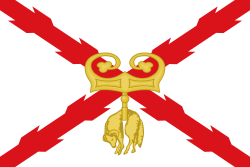
Through the marriage of Margaret of Flanders to Philip the Bold, the Low Countries came under Burgundian rule. The dukes unified the fragmented territories into a powerful state that included most of modern Belgium.
Image source: Burgundian Netherlands
Jan 5, 1477
Charles the Bold was killed fighting the Swiss, ending Burgundian power. His daughter Mary of Burgundy married Maximilian of Habsburg, transferring the Low Countries to Habsburg control.
Image source: Battle of Nancy
1506 - 1555
Charles V, born in Ghent, ruled the Seventeen Provinces and consolidated them into a single administrative entity through instruments like the Pragmatic Sanction of 1549.
Image source: Habsburg Netherlands
1566
Calvinist mobs destroyed religious images in churches across the Netherlands, sparking the Dutch Revolt against Spanish rule under Philip II.
Image source: Beeldenstorm
1567 - 1573
Fernando Álvarez de Toledo, Duke of Alba, brutally suppressed dissent with executions and heavy taxation, earning the tribunal the nickname 'Council of Blood' and intensifying resistance.
Image source: Council of Troubles
1585 - 1714
The southern provinces, roughly modern Belgium, remained Catholic territories under Spanish Habsburg rule while the northern provinces formed the independent Dutch Republic.
Image source: Spanish Netherlands
Aug 17, 1585
Spanish troops under Alexander Farnese captured Antwerp after a long siege. Half the population fled north, shifting economic dominance from Antwerp to Amsterdam and fixing the division between north and south.
Image source: Fall of Antwerp
1714
The Treaty of Rastatt transferred the Southern Netherlands from Spain to Austria following the War of the Spanish Succession, beginning a century of Habsburg administration.
Image source: Austrian Netherlands
1789 - 1790
Inspired by the French Revolution, Belgian patriots expelled Austrian forces and proclaimed the short-lived United States of Belgium before Austrian authority was restored in 1790.
Image source: Brabant Revolution
1795
Revolutionary France annexed the Austrian Netherlands, integrating them into the French Republic as departments and introducing French law, language policies, and administrative structures.
1815
The Congress of Vienna united the former Dutch Republic and Southern Netherlands under King William I to create a buffer state against France, an arrangement resented by many Belgians.
Image source: United Kingdom of the Netherlands
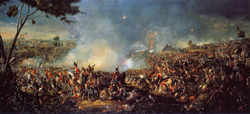
Jun 18, 1815
Napoleon was decisively defeated by Wellington and Blücher near Waterloo, ending French rule over the region and leading to the creation of the United Kingdom of the Netherlands.
Image source: Battle of Waterloo
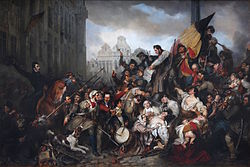
Aug 25, 1830
Riots sparked by an opera performance at La Monnaie escalated into a nationwide uprising against Dutch rule, driven by grievances over language, religion, and political representation.
Image source: Belgian Revolution
Oct 4, 1830
The provisional government declared Belgium an independent state, severing ties with the Netherlands and setting the stage for the adoption of a constitution.
Jul 21, 1831
Leopold of Saxe-Coburg-Gotha took the constitutional oath as the first king, establishing the Belgian monarchy. July 21 is now Belgium's National Day.
Image source: Leopold I of Belgium
Apr 19, 1839
The great powers formally recognized Belgian independence and guaranteed its perpetual neutrality, forcing Belgium to cede parts of Limburg and Luxembourg to the Netherlands.
Image source: Treaty of London (1839)
1840 - 1870
Belgium pioneered industrialization on the continent, with coal mining in Wallonia, ironworks, textiles, and an extensive railway network that was among the world's earliest.
Image source: Industrial Revolution
1885
At the Berlin Conference, Leopold II gained personal control over the Congo basin, ruling it as his private possession and exploiting it through brutal rubber and ivory extraction.
Image source: Congo Free State
1904 - 1908
Reports by Casement and missionary campaigns revealed mass killings and mutilations in the Congo Free State, prompting international outrage and eventual transfer of the colony to the Belgian state in 1908.
Image source: Atrocities in the Congo Free State
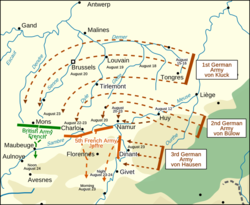
Aug 4, 1914
Germany violated Belgian neutrality as part of the Schlieffen Plan, triggering Britain's entry into World War I. The invasion featured atrocities against civilians remembered as the 'Rape of Belgium.'
Image source: German invasion of Belgium (1914)
Oct 19, 1914 - Oct 2, 1918
Three major battles around Ypres, including the first use of poison gas and the mud-soaked Passchendaele offensive, caused enormous casualties and left the Flemish landscape scarred for generations.
Image source: Battle of Ypres
1924
Following Germany's defeat, Belgium received a League of Nations mandate to administer the former German colonies of Rwanda and Burundi, expanding its African empire.
Image source: Ruanda-Urundi
May 10, 1940 - Sep 1944
Germany invaded Belgium again in World War II, forcing rapid surrender after 18 days. Four years of occupation followed, including persecution of Jews and resistance activity.
Image source: German invasion of Belgium (1940)
Dec 16, 1944 - Jan 28, 1945
Hitler's last major western offensive struck through the Ardennes in winter, but Allied forces held out at Bastogne and ultimately repelled the attack, hastening Germany's defeat.
Image source: Battle of the Bulge
Apr 4, 1949
Belgium signed the North Atlantic Treaty in Washington, becoming a founding member of NATO, whose headquarters were later established in Brussels.
Image source: NATO
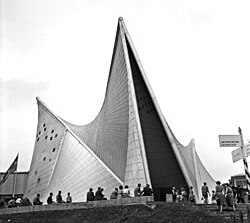
Apr 17, 1958 - Oct 19, 1958
The Brussels World's Fair, marked by the iconic Atomium, celebrated postwar recovery and technological progress, attracting millions of visitors from around the world.
Image source: Expo 58
Jun 30, 1960
The Belgian Congo became independent amid chaotic decolonization, followed by the Congo Crisis, the secession of Katanga, and decades of turbulent relations between Brussels and Kinshasa.
Image source: Democratic Republic of the Congo
1963
Belgium formalized its internal linguistic border, cementing the territorial principle of unilingual Flanders, unilingual Wallonia, and bilingual Brussels, deepening federalizing pressures.
Image source: Language legislation in Belgium
1980 - 1993
A series of constitutional reforms progressively devolved powers to Flanders, Wallonia, and Brussels, transforming unitary Belgium into a federal state officially completed in 1993.
Image source: State reform in Belgium
1997
The Amsterdam Treaty confirmed Brussels as the seat of EU institutions, cementing the city's role as the de facto capital of Europe and host of the European Commission and Council.
Image source: Brussels and the European Union
Or browse the full history timeline directory, with more than 2,500 topics.
This History of Belgium timeline was generated with the help of AI, using information found on the internet.
We work hard to keep these timelines accurate, but mistakes do get through. If you spot one, email us at [email protected] and we'll fix it for future visitors.
Generate yours with AI or build it from scratch, for free.
Export your timeline, add your own events, edit or remove AI-generated events, and much more
No credit card required.
Cancel anytime.
Cancel anytime.
You can create an unlimited number of timelines with up to 10 events on each one, customize how they look, export them to PDF, PNG, PowerPoint, CSV, and Excel, and share them with a link. Paid plans raise the event limit and add features like spreadsheet imports and collaborators.
Yes. You can cancel your subscription from your account page at any time, and you will not be charged again. Your subscription stays active for the rest of the period you already paid for.
Yes. We will email you a reminder before the annual renewal, and we will also email you a receipt.
Yes. You can email us within 15 days of any payment, and we will issue you a full refund.
Check out our pricing docs or send us an email anytime: [email protected].