
-
Resources
-
Pricing
The history of graphics cards traces the evolution from simple display adapters to powerful programmable GPUs used for gaming, visualization, artificial intelligence, and scientific computing. More Less
Build a timeline like this one in minutes, for free. Start Yours →
1974
The S-100 bus was designed in 1974 as part of the Altair 8800. It became the first industry-standard bus for the microcomputer industry and established an early platform for expansion hardware.
Image source: S-100 bus
1981
IBM introduced the Industry Standard Architecture bus in 1981. ISA became dominant in the marketplace during the 1980s and was widely used for computer expansion cards.
Image source: Industry Standard Architecture
1987
IBM introduced the Micro Channel Architecture bus in 1987. MCA was a 32-bit bus clocked at 10 MHz, representing an attempt to advance beyond earlier expansion standards.
Image source: Micro Channel architecture
1988
The Extended Industry Standard Architecture bus was released in 1988 to compete with IBM's MCA. EISA retained compatibility with the earlier ISA bus while providing an expanded standard.
Image source: Extended Industry Standard Architecture
1993
From 1993 onward, Peripheral Component Interconnect replaced the EISA, ISA, MCA, and VESA buses in many systems. PCI became a major foundation for graphics and other expansion cards.
Image source: Peripheral Component Interconnect
1995
Sun Microsystems introduced the UPA interconnect bus architecture in 1995. Its appearance reflected the continuing development of specialized high-speed computer interconnects.
1996
The listed graphics-card history records that this bus technology was first used in 1996, marking an early step in the adoption of a newer expansion interface for graphics hardware.
Image source: Graphics card
1997
Accelerated Graphics Port was first used in 1997. Unlike general-purpose expansion buses, AGP was dedicated to graphics and provided a specialized connection for graphics cards.
Image source: Accelerated Graphics Port

1998
PCI-X, an extension of the PCI bus, was introduced in 1998. It extended the PCI family for systems requiring greater bandwidth than the original implementation.
Image source: PCI-X
2004
PCI Express, abbreviated PCIe, was released in 2004. It introduced a point-to-point interface that became the principal modern connection standard for discrete graphics cards.
Image source: PCI Express
2006
By 2006, PCI Express provided a data-transfer rate double that of AGP, strengthening PCIe's position as the successor to the dedicated graphics bus.
1997
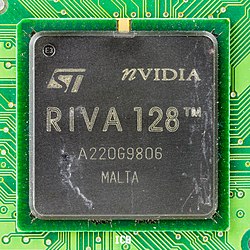
Released in 1997, the RIVA 128 was one of the first consumer-facing GPUs to integrate both 3D and 2D processing units on a single chip. This integration helped define the modern consumer graphics processor.
Image source: RIVA 128
2003
Around 2003, video memory was typically based on DDR technology. The adoption of DDR memory supported the increasing bandwidth requirements of graphics processing.
Image source: Video random-access memory
1999
Graphics card shipments peaked at a total of 114 million units in 1999, reflecting the strong expansion of the consumer graphics-card market at the end of the decade.
Image source: Graphics processing unit
2013
Graphics card shipments totaled 14.5 million units in the third quarter of 2013, representing a 17 percent fall from third-quarter 2012 levels.
2013
In the third quarter of 2013, AMD held a 35.5 percent graphics market share according to Jon Peddie Research.
Image source: AMD
2013
In the third quarter of 2013, Nvidia held a 64.5 percent graphics market share according to Jon Peddie Research.
Image source: Nvidia
2013
As of the second quarter of 2013, there were 52 add-in-board suppliers. These companies contributed to the manufacturing and distribution ecosystem surrounding graphics cards.
2015
Graphics card shipments reached an annual total of 44 million units in 2015, documenting the scale of the discrete graphics market during that year.
Jan 2018
In January 2018, mid- to high-end graphics cards experienced a major price surge. Many retailers faced stock shortages because of significant demand in this market.
Image source: Cryptocurrency
2020 - 2021
The graphics card industry suffered a setback during the 2020–21 chip shortage, which disrupted the supply of graphics hardware and affected the broader technology market.
Image source: 2020–2023 global chip shortage
2025
As of 2025, AMD and Nvidia are the primary suppliers of the GPUs, including graphics chips and chipsets, used in graphics cards.
2003
Graphics-card length and thickness can vary greatly. High-end cards commonly occupy two or three expansion slots, making physical compatibility an important consideration in computer design.
2018
When tested with video games, the Nvidia GeForce RTX 2080 Ti Founder's Edition averaged 300 watts of power consumption, illustrating the substantial power demands of high-end GPUs.
Image source: GeForce 20 series
2020
A four-card graphics configuration requires a power supply rated at more than 1000 watts, emphasizing the electrical demands of multi-GPU systems.
2020
A standard RTX 3090 can peak at up to 450 watts, demonstrating the rising power requirements of flagship graphics cards.
Image source: GeForce 30 series
2020
The RTX 3080 can reach up to 350 watts, while an RTX 3070 can reach a similar or slightly lower peak power draw.
2020
During the Ampere generation, a custom-flashed RTX 3090 named Hall of Fame was recorded to reach a peak power draw as high as 630 watts.
2022
Modern high-end graphics cards such as the RTX 4090 exceed 300 millimeters in length. Their size illustrates the physical growth of powerful graphics hardware.
Image source: GeForce RTX 40 series
2025
The combination of high-end card power figures, multi-card requirements, and increasingly large physical designs reflects the modern graphics card industry's movement toward more demanding performance hardware.
Build a timeline like this one in minutes, for free. Start Yours →
Or browse the full history timeline directory, with more than 2,500 topics.
This History of Graphics Cards timeline was generated with the help of AI, using information found on the internet.
We work hard to keep these timelines accurate, but mistakes do get through. If you spot one, email us at [email protected] and we'll fix it for future visitors.
Generate yours with AI or build it from scratch, for free.
Export your timeline, add your own events, edit or remove AI-generated events, and much more
No credit card required.
15-day money-back guarantee.
You can create an unlimited number of timelines with up to 10 events on each one, customize how they look, export them to PDF, PNG, PowerPoint, CSV, and Excel, and share them with a link. Timelines made with Timeline Maker AI keep every event the generator created, and you can add up to 5 events of your own. Paid plans remove the event limit, add spreadsheet imports and hide Preceden's branding, and the higher-priced plan also adds collaborators, a custom logo and a custom domain.
Yes. You can cancel your subscription from your account page at any time, and you will not be charged again. Your subscription stays active for the rest of the period you already paid for.
Yes. We email you a reminder 15 days before your annual renewal, and we email you a receipt after every payment.
Yes. You can email us within 15 days of any payment, and we will issue you a full refund.
Check out our pricing docs or send us an email anytime: [email protected].