-
Use Cases
-
Resources
-
Pricing
The history of Indonesia spans thousands of years, encompassing early maritime trade kingdoms such as Srivijaya and Majapahit, centuries of Dutch colonial rule, Japanese occupation during World War II, the declaration of independence on August 17, 1945, and the subsequent development of Asia's third-largest democracy under leaders such as Sukarno and Suharto. More Less
400
% complete
The Kutai Martadipura kingdom, located in eastern Borneo near the Mahakam River, is the oldest known Hindu kingdom in Indonesia. Its seven Yupa inscriptions in Sanskrit, written in the Pallava script, provide the earliest written record of a polity in the archipelago, under King Mulawarman.
Image source: Kutai
450 - 650
% complete
Tarumanagara was one of the earliest recorded kingdoms in western Java, known for King Purnawarman's irrigation projects and stone inscriptions such as the Ciaruteun inscription bearing his footprints, marking early Indianized state formation in the archipelago.
Image source: Tarumanagara
670
% complete
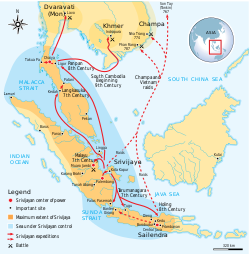
Srivijaya, centered at Palembang, grew into a dominant thalassocracy controlling the Strait of Malacca. The Chinese monk Yijing visited in 671 and described it as a major center of Buddhist learning, and the empire controlled trade routes between India and China for centuries.
Image source: Srivijaya
825
% complete
Borobudur, the world's largest Buddhist monument, was completed during the Sailendra dynasty in central Java. Its nine stacked platforms and 2,672 relief panels depict Buddhist cosmology and remain one of the greatest architectural achievements of the ancient world.
Image source: Borobudur
929
% complete
Around 929, King Mpu Sindok moved the Mataram court from central to eastern Java, founding the Isyana dynasty. This shift marked the transition of Javanese political power to the Brantas River valley, where kingdoms like Kahuripan and Kediri later emerged.
Image source: Mataram Kingdom
1019
% complete
Airlangga, a Balinese prince, restored order in eastern Java after the destruction of the Medang court and ruled the kingdom of Kahuripan until 1045. His reign is remembered for prosperity, and he later divided his realm between two successors, founding Janggala and Panjalu (Kediri).
Image source: Airlangga Hartarto
1267
% complete
Samudera Pasai on the north coast of Sumatra was one of the first Islamic states in the Indonesian archipelago, established by Meurah Silu. It became an important trading and missionary hub, helping spread Islam through maritime trade networks.
Image source: Samudera Pasai Sultanate
1268 - 1292
% complete
Kertanagara, the last king of Singhasari, pursued an aggressive expansionist policy, attacking Malayu and Bali and resisting Mongol demands for submission. His assassination in 1292 preceded the rise of his son-in-law, who founded Majapahit.
Image source: Kertanagara
1293
% complete
Majapahit was founded by Raden Wijaya after repelling a Mongol invasion fleet. It became the greatest empire in Indonesian history, and under Gajah Mada's leadership in the 14th century claimed hegemony over much of the archipelago, becoming a symbol of national unity for modern Indonesia.
Image source: Majapahit

1334 - 1364
% complete
Gajah Mada served as prime minister of Majapahit and is credited with expanding its influence across the archipelago through the oath of Palapa, vowing to unite Nusantara. His tenure marked Majapahit's golden age of political and commercial dominance.
Image source: Gajah Mada
1475
% complete
The Demak Sultanate, founded on Java's north coast, is traditionally regarded as the first Islamic kingdom in Java. The nine saints known as the Wali Songo are credited with spreading Islam there, and Demak claimed succession from declining Majapahit.
Image source: Demak Sultanate
1511
% complete
Afonso de Albuquerque's capture of Malacca gave Portugal control of the spice trade gateway to the archipelago. Portuguese ships soon reached the Maluku Spice Islands, beginning sustained European involvement in Indonesian trade and politics.
Image source: Capture of Malacca (1511)
1595 - 1597
% complete
The first Dutch fleet under Cornelis de Houtman sailed to Banten and Bali in 1595-1597, opening the way for Dutch involvement in the spice trade and setting the stage for nearly 350 years of Dutch presence in the archipelago.
Image source: First Dutch Expedition to the East Indies
Mar 20, 1602
% complete
The Vereenigde Oostindische Compagnie (VOC) was established to consolidate Dutch trade in Asia. It became the world's first multinational corporation, with sovereign powers to wage war and colonize, gradually dominating the Indonesian archipelago's trade.
Image source: Dutch East India Company
1621
% complete
To monopolize nutmeg production, Jan Pieterszoon Coen's VOC forces massacred or deported most of the indigenous Bandanese population of the Banda Islands. Survivors were replaced with enslaved laborers and Dutch planters, exemplifying the brutality of the spice monopoly.
Image source: Banda Islands
1628 - 1629
% complete
Sultan Agung, the greatest ruler of Mataram, launched two sieges against the Dutch stronghold of Batavia. Although the sieges failed, his reign unified much of Java and Mataram remained the major indigenous power resisting European expansion.
Image source: Sultan Agung of Mataram
Feb 13, 1755
% complete
The Giyanti Agreement ended the Third Javanese Succession War, splitting Mataram into the Surakarta and Yogyakarta sultanates. It cemented Dutch influence over Javanese courts, with the VOC acting as arbiter and gaining territorial and economic concessions.
Image source: Treaty of Giyanti
Dec 31, 1799
% complete
Bankrupt and corrupt, the VOC was dissolved at the end of 1799, and its possessions were nationalized by the Dutch state, beginning the period of direct colonial administration known as the Dutch East Indies.
Jul 20, 1825 - 1830
% complete
Prince Diponegoro led a massive rebellion against Dutch colonial rule and the exploitation of the Cultivation System. The war caused over 200,000 deaths and was only ended when the Dutch captured Diponegoro through treachery during peace negotiations in 1830.
Image source: Java War
1873 - 1904
% complete
The Aceh War was one of the longest and bloodiest colonial conflicts, as the Acehnese fiercely resisted Dutch conquest for over three decades. The war became a symbol of resistance and shaped Acehnese identity and later separatist sentiment.
Image source: Aceh War
1901
% complete
Queen Wilhelmina's Ethical Policy promised welfare, education, and irrigation for the Indies. Though limited, it expanded education and created a Western-educated elite that would later lead the Indonesian nationalist movement.
May 20, 1908
% complete
Budi Utomo, founded by students and intellectuals including Wahidin Sudirohusodo, was the first indigenous political association in the Dutch East Indies. Its founding date is commemorated as the Day of National Awakening in Indonesia.
Image source: Budi Utomo
1912
% complete
Sarekat Islam began as a movement against Chinese merchant dominance and grew into a mass organization advocating indigenous economic interests. It became a vehicle for early nationalist and Islamic political mobilization under figures like H.O.S. Tjokroaminoto.
Image source: Sarekat Islam
Nov 1926 - 1927
% complete
The PKI launched uprisings in Banten and West Sumatra against Dutch rule, which were swiftly crushed. Thousands were arrested or exiled to the Boven-Digoel camp, weakening the communist movement and paving the way for secular nationalist leadership.
Image source: Communist Party of Indonesia
Oct 28, 1928
% complete
At the Second Youth Congress in Batavia, young activists from across the archipelago declared one motherland, one nation, and one language: Indonesian. The pledge became a foundational moment of Indonesian national identity.
Image source: Youth Pledge
Aug 17, 1945
% complete
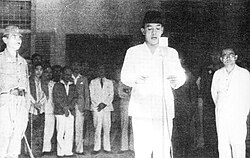
Two days after Japan's surrender in World War II, Sukarno and Mohammad Hatta proclaimed Indonesia's independence at Sukarno's home in Jakarta. The proclamation followed the Japanese occupation and ignited a four-and-a-half-year struggle against returning Dutch forces.
Image source: Proclamation of Indonesian Independence
Nov 10, 1945 - Nov 29, 1945
% complete
British and Indian troops clashed with Indonesian Republican forces and militias in Surabaya in one of the fiercest battles of the Indonesian National Revolution. The heroic resistance, despite heavy casualties, galvanized international support for Indonesian independence; November 10 is now Heroes' Day.
Image source: Battle of Surabaya
Jul 21, 1947 - Jan 5, 1949
% complete
The Dutch launched military offensives (Operatie Product and Operatie Kraai) to retake the Republic's territory, capturing Yogyakarta and Sukarno. International pressure, especially from the United Nations and the United States, forced the Dutch to negotiate.
Image source: Operation Product
Dec 27, 1949
% complete
Following the Round Table Conference in The Hague, the Netherlands formally transferred sovereignty to the United States of Indonesia, ending over 300 years of Dutch colonial rule, though West Papua remained under Dutch control until 1962.
Image source: Dutch–Indonesian Round Table Conference
Aug 17, 1950
% complete
The federal United States of Indonesia was dissolved and replaced by a unitary Republic of Indonesia with Sukarno as president, consolidating the centralized state structure that endures today.
Image source: United States of Indonesia
Apr 18, 1955 - Apr 24, 1955
% complete
The Bandung Conference brought together leaders of 29 Asian and African nations, including Nehru, Nasser, and Zhou Enlai, to promote Afro-Asian solidarity and non-alignment, cementing Indonesia's role as a leader of the Non-Aligned Movement.
Image source: Bandung Conference
Jul 5, 1959 - 1966
% complete
Sukarno dissolved the Constituent Assembly and restored the 1945 Constitution by decree, concentrating power in himself. Guided Democracy featured increasing authoritarianism, confrontation with Malaysia, and an uneasy alliance between the army and the Communist Party.
Image source: Guided Democracy in Indonesia
Aug 15, 1962 - May 1, 1963
% complete
The agreement brokered by the UN ended the Dutch-Indonesian dispute over West New Guinea. Administration was transferred to UNTEA and then to Indonesia in May 1963, followed by the controversial 1969 Act of Free Choice integrating the territory.
Image source: New York Agreement
Sep 30, 1965 - 1966
% complete
A group claiming to be the 30 September Movement kidnapped and killed six army generals, blamed on the Communist Party. The ensuing army-led purge, under General Suharto, killed an estimated 500,000 or more alleged communists and led to Sukarno's fall.
Image source: 30 September Movement
Mar 12, 1967
% complete
The People's Consultative Assembly stripped Sukarno of power and appointed Suharto acting president, later full president. His New Order regime brought political stability and rapid economic growth, but also authoritarian rule, corruption, and repression lasting over three decades.
Image source: Suharto
Dec 7, 1975
% complete
Indonesia invaded East Timor after Portugal's withdrawal, incorporating it as its 27th province in 1976. The occupation, marked by severe human rights abuses and famine, killed an estimated 100,000-180,000 people and drew international condemnation until 1999.
Image source: Indonesian invasion of East Timor
Jul 1997 - 1998
% complete
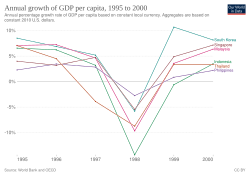
The rupiah collapsed and the economy contracted sharply, triggering mass unemployment and poverty. The crisis eroded public support for Suharto's regime, sparking protests and riots that ultimately forced his resignation in May 1998.
Image source: 1997 Asian financial crisis
May 21, 1998
% complete
Facing massive student protests and riots, Suharto resigned after 32 years in power, handing over to Vice President B.J. Habibie. His fall ushered in the Reform era of democratization, press freedom, decentralization, and constitutional reform.
Image source: Fall of Suharto
Aug 30, 1999
% complete
In a UN-supervised referendum, nearly 79% of East Timorese voted for independence from Indonesia. Pro-Indonesian militias unleashed violence afterward, prompting international intervention, and East Timor became fully independent as Timor-Leste in 2002.
Image source: 1999 East Timorese independence referendum
Jul 5, 2004 - Sep 20, 2004
% complete
Indonesia held its first direct presidential election, won by Susilo Bambang Yudhoyono over incumbent Megawati Sukarnoputri. The election marked a milestone in the country's democratic consolidation following the fall of the New Order.
Image source: 2004 Indonesian presidential election
Dec 26, 2004
% complete
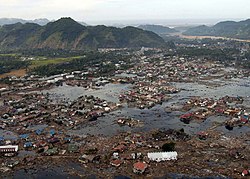
A magnitude 9.1 earthquake off Sumatra generated a devastating tsunami that killed around 170,000 people in Aceh alone. The disaster prompted a massive international relief effort and helped catalyze the 2005 Helsinki peace agreement ending the Aceh insurgency.
Image source: 2004 Indian Ocean earthquake and tsunami
Jul 9, 2014
% complete
Joko Widodo (Jokowi), the former governor of Jakarta, defeated Prabowo Subianto to become Indonesia's seventh president. A political outsider, he focused on infrastructure development and was re-elected in 2019, the first president to win two direct terms consecutively.
Image source: 2014 Indonesian presidential election
Or browse the full history timeline directory, with more than 2,000 topics.
This History of Indonesia timeline was generated with the help of AI, using information found on the internet.
We work hard to keep these timelines accurate, but mistakes do get through. If you spot one, email us at [email protected] and we'll fix it for future visitors.
Generate yours with AI or build it from scratch, for free.
Export your timeline, add your own events, edit or remove AI-generated events, and much more
No credit card required.
Cancel anytime.
Cancel anytime.
You can create an unlimited number of timelines with up to 10 events on each one, customize how they look, export them to PDF, PNG, PowerPoint, CSV, and Excel, and share them with a link. Paid plans raise the event limit and add features like spreadsheet imports and collaborators.
Yes. You can cancel your subscription from your account page at any time, and you will not be charged again. Your subscription stays active for the rest of the period you already paid for.
Yes. We will email you a reminder before the annual renewal, and we will also email you a receipt.
Yes. You can email us within 15 days of any payment, and we will issue you a full refund.
Check out our pricing docs or send us an email anytime: [email protected].