-
Use Cases
-
Resources
-
Pricing
Lisbon, the capital of Portugal, is one of Europe's oldest cities, with a history spanning nearly three millennia. Founded by the Phoenicians and shaped by Romans, Moors, and Portuguese monarchs, Lisbon flourished during the Age of Discoveries as a hub of global exploration. Devastated by the great earthquake of 1755 and later transformed by modernization, it remains a city where layered history meets contemporary culture. More Less
205 BC
% complete
Roman forces captured the settlement during the Second Punic War era, renaming it Olisipo. The city later received the status of municipium under Julius Caesar as Felicitas Julia, becoming a prosperous Roman port known for trade, salted fish, and horse breeding.
Image source: Olisipo
409 AD
% complete
During the decline of the Roman Empire, Germanic tribes including the Vandals swept through Iberia and sacked Olisipo. The city subsequently passed through the hands of the Alans, Suebi, and Visigoths, marking the end of Roman rule.
Image source: History of Lisbon
714 AD
% complete
Berber and Arab forces under Musa ibn Nusayr conquered the city, which became known as al-Ushbuna. Under Muslim rule for over four centuries, Lisbon flourished as a commercial center with mosques, markets, and distinctive Alfama district urban fabric.
Image source: Al-Andalus
Jul 1, 1147 - Oct 25, 1147
% complete
Portugal's first king, Afonso Henriques, besieged and captured Lisbon from the Moors with help from English, Flemish, and German crusaders en route to the Second Crusade. The conquest established Lisbon as a Christian city and a cornerstone of the new Kingdom of Portugal.
Image source: Siege of Lisbon
1256
% complete
King Afonso III formally designated Lisbon as the capital of Portugal, replacing Coimbra. Its growing port, population, and strategic position on the Tagus estuary made it the natural political and economic center of the kingdom.
Image source: Lisbon
1389
% complete
Queen Leonor Teles' successor Nuno Álvares Pereira founded the Gothic Convento do Carmo on a hill overlooking the city. Its ruins, left roofless after the 1755 earthquake, remain one of Lisbon's most evocative landmarks.
Image source: Carmo Convent
1415
% complete
The Portuguese conquest of Ceuta in 1415 launched the Age of Discoveries, with Lisbon serving as the organizing base for expeditions down the African coast. Prince Henry's sponsorship of navigators and cartographers transformed Lisbon into Europe's maritime hub.
Image source: Prince Henry the Navigator
Jul 8, 1497
% complete
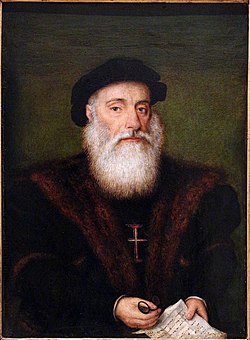
Vasco da Gama sailed from the Tagus near Lisbon with four ships, seeking a sea route to India. His return in 1499 after reaching Calicut via the Cape of Good Hope inaugurated the Portuguese spice trade and made Lisbon Europe's richest port.
Image source: Vasco da Gama
1500 - 1580
% complete
With monopolies over spice routes to Asia, Brazil, and Africa, Lisbon became the wealthiest city in Europe during the 16th century. The Casa da Índia managed royal trade, while merchants from across the continent flocked to its bustling waterfront.
Image source: Portuguese Empire
1502
% complete
King Manuel I commissioned the Jerónimos Monastery in Belém, funded by the spice trade, to celebrate Vasco da Gama's voyage. The masterpiece of Manueline architecture, adorned with maritime motifs, is now a UNESCO World Heritage Site.
Image source: Jerónimos Monastery
1514 - 1519
% complete
Francisco de Arruda designed the fortified Tower of Belém at the mouth of the Tagus to protect Lisbon's harbor. The Manueline-style fortress later became the symbolic gateway for departing explorers and an enduring emblem of Portugal.
Image source: Belém Tower
1580 - 1640
% complete
After King Sebastian's death without heir, Philip II of Spain claimed the Portuguese throne, beginning sixty years of dynastic union. Lisbon lost some commercial primacy to Amsterdam and Seville, though it remained a major imperial port.
Image source: Iberian Union
Dec 1, 1640 - 1668
% complete
A coup in Lisbon restored Portuguese independence under João IV of Braganza. The ensuing war with Spain ended with the Treaty of Lisbon in 1668, reaffirming the city's role as the capital of a sovereign empire.
Image source: Portuguese Restoration War
1731 - 1748
% complete
King João V ordered the monumental aqueduct to bring fresh water to Lisbon. Its great arch spanning the Alcântara valley, at 65 meters high among the tallest stone arches ever built, survived the 1755 earthquake and still defines the city skyline.
Image source: Águas Livres Aqueduct
Nov 30, 1807 - 1808
% complete
As General Junot's French army approached, the Portuguese royal court famously fled to Brazil aboard British ships. French troops occupied Lisbon until Anglo-Portuguese forces expelled them in 1808 during the Peninsular War.
Image source: Transfer of the Portuguese court to Brazil
Aug 24, 1820
% complete
A constitutionalist revolution demanding the return of King João VI and liberal reforms spread quickly to Lisbon, leading to Portugal's first constitution in 1822 and ending absolute monarchy amid decades of liberal-conservative conflict.
Image source: Liberal Revolution of 1820
Oct 28, 1856
% complete
Portugal's first railway opened between Lisbon's Santa Apolónia station and Carregado on the Tagus. The line marked the start of industrial-era modernization, soon expanding across the country and boosting the capital's economy.
Image source: Rail transport in Portugal
1890
% complete
The neo-Manueline Rossio Station opened, connecting Lisbon with Sintra through a tunnel under the city center. Designed by José Luís Monteiro, it became one of the city's architectural icons and a symbol of late 19th-century progress.
Image source: Rossio railway station
Oct 5, 1910
% complete
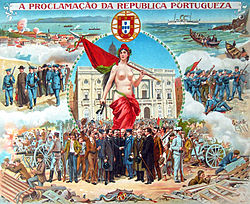
Revolutionaries seized key points of Lisbon and forced King Manuel II into exile, proclaiming the First Portuguese Republic from the city hall balcony. The revolution ended nearly eight centuries of monarchy and introduced secularizing reforms.
Image source: 5 October 1910 revolution
May 28, 1926
% complete
A military coup ended the turbulent First Republic, establishing the Ditadura Nacional centered in Lisbon. The instability paved the way for António de Oliveira Salazar's authoritarian Estado Novo regime.
Image source: 28 May 1926 coup d'état
1933 - 1968
% complete
Finance minister turned prime minister Salazar ruled from Lisbon for over three decades, creating an authoritarian corporatist state. The regime suppressed dissent through the PIDE secret police while undertaking public works that reshaped the capital.
Image source: Estado Novo (Portugal)
Sep 3, 1939 - May 8, 1945
% complete
Under Portugal's neutrality, Lisbon became one of Europe's last open ports, filled with spies, refugees, and exiles fleeing Nazi Europe. The city served as a transit hub for escapees and a stage for espionage between Axis and Allied powers.
Oct 15, 1942
% complete
Lisbon's international airport opened during wartime neutrality, quickly becoming a crucial air link between Europe and the rest of the world. It grew into Portugal's principal aviation gateway, later renamed Humberto Delgado Airport.
Image source: Lisbon Airport
Apr 25, 1974
% complete
Left-leaning military officers toppled the Estado Novo in an almost bloodless coup, signaled by radio broadcasts and carnations placed in soldiers' rifle barrels. Crowds filled Lisbon's streets, launching Portugal's transition to democracy and decolonization of its African empire.
Image source: Carnation Revolution
Mar 29, 1998
% complete
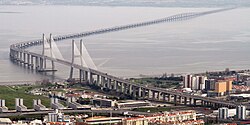
Europe's longest bridge at the time opened north of Lisbon ahead of Expo '98, spanning 17 kilometers across the Tagus estuary. The cable-stayed structure eased traffic congestion and symbolized the city's renewed ambitions.
Image source: Vasco da Gama Bridge
May 22, 1998 - Sep 30, 1998
% complete
Themed around the oceans, Expo '98 transformed a derelict eastern docklands area into the modern Parque das Nações district. The event drew millions of visitors, leaving behind the Oceanário aquarium, pavilions, and a revitalized waterfront.
Image source: Expo '98
2008
% complete
A former industrial complex under the 25 de Abril Bridge was converted into the LX Factory creative hub, catalyzing Lisbon's emergence as a startup and tourism hotspot. The transformation reflected the city's broader economic and cultural renaissance.
2016
% complete
One of the world's largest technology conferences moved to Lisbon, drawing tens of thousands of attendees annually and cementing the city's reputation as a European tech and entrepreneurship center.
Image source: Web Summit
Nov 1, 1755
% complete
On All Saints' Day, a massive earthquake struck Lisbon, followed by tsunami waves and fires that destroyed most of the city. Tens of thousands died, churches and palaces collapsed, and the disaster profoundly shocked Enlightenment Europe, influencing thinkers like Voltaire.
Image source: 1755 Lisbon earthquake
1756 - 1775
% complete
Prime Minister Sebastião José de Carvalho e Melo, the Marquis of Pombal, directed one of history's first planned reconstructions. The grid-planned Baixa district featured earthquake-resistant construction and standardized facades, pioneering modern urban planning and seismic engineering.
Image source: Lisbon Baixa
Or browse the full history timeline directory, with more than 2,000 topics.
This History of Lisbon timeline was generated with the help of AI, using information found on the internet.
We work hard to keep these timelines accurate, but mistakes do get through. If you spot one, email us at [email protected] and we'll fix it for future visitors.
Generate yours with AI or build it from scratch, for free.
Export your timeline, add your own events, edit or remove AI-generated events, and much more
No credit card required.
Cancel anytime.
Cancel anytime.
You can create an unlimited number of timelines with up to 10 events on each one, customize how they look, export them to PDF, PNG, PowerPoint, CSV, and Excel, and share them with a link. Paid plans raise the event limit and add features like spreadsheet imports and collaborators.
Yes. You can cancel your subscription from your account page at any time, and you will not be charged again. Your subscription stays active for the rest of the period you already paid for.
Yes. We will email you a reminder before the annual renewal, and we will also email you a receipt.
Yes. You can email us within 15 days of any payment, and we will issue you a full refund.
Check out our pricing docs or send us an email anytime: [email protected].