-
Use Cases
-
Resources
-
Pricing
The history of Madrid traces the evolution of Spain's capital city from a modest Moorish fortress town called Mayrit, founded in the 9th century, through its designation as the royal capital by Philip II in 1561, its growth during the Habsburg and Bourbon dynasties, the devastation of the Spanish Civil War, and its emergence as one of Europe's most vibrant political, economic, and cultural centers. More Less
852 - 886
% complete
The primitive urban nucleus of Madrid, known as Majriṭ, was founded in the late 9th century (between 852 and 886) as a walled military citadel erected on behalf of Muhammad I, the Cordobese emir, on the relatively steep left bank of the Manzanares river.
Image source: History of Madrid
900 - 1000
% complete
By the late 10th century, Majriṭ had become an important borderland military stronghold with great strategic value, owing to its proximity to Toledo. The most generous estimates put its population at around 2,000 inhabitants in a settlement of about 9 hectares, and it was mentioned by the Cordobese chronicler Ahmad ibn Muhammad al-Razi.
1083
% complete
Madrid passed to Christian control in the context of the conquest of Toledo. Historiography debates whether this occurred in 1083, before the conquest of Toledo, through negotiations between Alfonso VI and al-Qadir, or in 1085 as a direct consequence of the seizure of Toledo. Al-Idrisi later described Madrid as a 'small city and solid fortress, well populated.'
1100 - 1200
% complete
In the 11th and 12th centuries, society in Madrid was structured around knight-villeins, who formed the leading class in the town's public, social and economic life during the consolidation of Madrid as a middle-rank town of the Crown of Castile.
1250 - 1400
% complete
From the mid-13th century up to the late 14th century, the concejo of Madrid vied for control of the Real de Manzanares territory against the concejo of Segovia, a powerful husbandry-based town north of the Sierra de Guadarrama, contrasting with Madrid's agricultural economy.
1383
% complete
In 1383, John I of Castile gifted the lordship of Madrid, together with those of Villa Real and Andújar, to Leo V of Armenia, marking a notable moment in the town's medieval history.
1390 - 1406
% complete
Henry III of Castile (1379–1406) rebuilt Madrid after it was destroyed by fire, and he also founded El Pardo just outside its walls, strengthening the area's ties to the monarchy.
1400 - 1500
% complete
By the end of the Middle Ages, the best-positioned members of the mudéjar community were the alarifes ('master builders'), tasked with public works including management of the viajes de agua, giving them a leading role in Madrid's 15th-century urbanism.
1406 - 1474
% complete
During the 15th century, Madrid became one of the preferred locations of the Trastámara dynasty monarchs, notably John II and Henry IV of Castile, the latter spending more time there than anywhere else and eventually dying in the town. The town briefly hosted a mint from 1467 to 1471.
1474 - 1516
% complete
Under the Catholic Monarchs, Madrid became a frequent seat of the court, reportedly hosting them for more than 1,000 days, including an uninterrupted eight-month spell, consolidating its importance within Castile.
Image source: Catholic Monarchs of Spain
1492
% complete
Facing the 1492 decree of expulsion, few local Jews opted to leave Madrid; most preferred to convert instead, remaining as a non-fully assimilated converso community subject to rejection by Old Christians.
Image source: Alhambra Decree
1502
% complete
The adoption of Christianity by Madrid's mudéjar community facing the 1502 pragmatic law of forced conversion was widespread, ending centuries of Muslim presence in the town's religious life.
Image source: Mudéjar
Jun 17, 1520 - 1521
% complete
The 1520–21 Revolt of the Comuneros succeeded in Madrid: following contacts with neighbouring Toledo, rebels deposed corregidor Antonio de Astudillo by June 1520. Juan Zapata captained the local militias while Pedro de Montemayor was captured by royalists and executed by late 1520.
Image source: Revolt of the Comuneros
1561
% complete
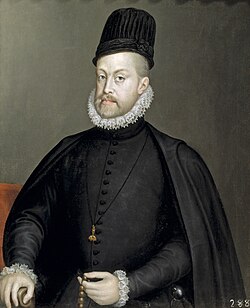
In 1561, Philip II moved the court of the Hispanic Monarchy to Madrid, beginning the city's development as an administrative centre. From fewer than 20,000 inhabitants at the time, the city grew to nearly 100,000 by the end of the 16th century.
Image source: Philip II of Spain
1600 - 1700
% complete
During the 17th century, Madrid grew rapidly and developed an estate-based society, cementing its role as the political heart of the Spanish monarchy despite periodic crises.
1601 - 1606
% complete
During the five-year period when the capital was set in Valladolid (1601–1606), Madrid's population plummeted, reportedly halving, with estimations of roughly 50,000–60,000 people leaving the city before the court returned.
1739
% complete
In 1739, Philip V began constructing new palaces in Madrid, including the Palacio Real de Madrid, a monumental royal residence built on the site of the old Alcázar overlooking the Manzanares.
Image source: Royal Palace of Madrid
1759 - 1788
% complete
It was under Charles III (1716–1788) that Madrid became a truly modern city. Measures included regulating carriage traffic — limiting animals per carriage to reduce speed and eventually banning carriages outright in 1787 — amid rising pedestrian accidents caused by growing numbers of carriages.
Image source: Charles III of Spain
Mar 1766
% complete
Following the enforcement of a ban on traditional Spanish dress (long cape and wide-brimmed hat) intended to help identify criminal suspects, massive riots erupted in March 1766 in Madrid — the so-called Mutiny of Esquilache — during the reign of Charles III.
Image source: Esquilache Riots
Oct 27, 1807
% complete
On 27 October 1807, Charles IV and Napoleon signed the Treaty of Fontainebleau, allowing French troops passage through Spanish territory to join Spanish forces in invading Portugal, which had refused to obey the international blockade against England.
Image source: Treaty of Fontainebleau (October 1807)
Feb 1808 - Mar 1808
% complete
In February 1808, Napoleon used alleged violations of the blockade at Portuguese ports to send a powerful army under General Joachim Murat into Spain. Throughout February and March 1808, cities such as Barcelona and Pamplona remained under French rule.
Image source: Peninsular War
Mar 17, 1808
% complete
On 17 March 1808, the Mutiny of Aranjuez took place, led by Charles IV's own son, crown prince Ferdinand, and directed against his father, further destabilising the Spanish monarchy on the eve of war.
Image source: Tumult of Aranjuez
May 2, 1808
% complete
After Napoleon's troops entered Madrid in May 1808, the Madrileños revolted against the French forces on 2 May 1808. The fighting lasted for hours and is immortalised in Goya's painting The Second of May 1808 (The Charge of the Mamelukes), leaving a lasting impact on France's image in Europe.
Image source: Dos de Mayo Uprising
Aug 12, 1812
% complete
On 12 August 1812, following the defeat of French forces at Salamanca, English and Portuguese troops entered Madrid and surrounded the fortified Retiro district occupied by the French, marking a turning point in the Peninsular War.
Image source: Battle of Salamanca
1814
% complete
After the war of independence ended, Ferdinand VII returned to the throne in 1814, ushering in a period of restored absolutism after years of occupation and conflict.
Image source: Ferdinand VII
1833
% complete
Following the 1833 administrative reforms devised by Javier de Burgos, including the configuration of the current province of Madrid, Madrid was established as the capital of the new liberal state.
Image source: 1833 territorial division of Spain
1835 - 1836
% complete
The reforms of Finance Minister Juan Álvarez Mendizábal in 1835–1836 led to the confiscation of ecclesiastical properties and the demolition of churches, convents and adjacent orchards in Madrid, followed by the widening of streets and squares.
Image source: Ecclesiastical confiscations of Mendizábal
1850 - 1900
% complete
The economy of Madrid further modernized during the second half of the 19th century, consolidating its status as a service and financial centre, with electric power distribution introduced and access to water, rail networks, cheap workforce and financial capital by the century's end.
Jul 1854
% complete
Amid economic and political crisis, following the pronunciamiento of officers commanded by Leopoldo O'Donnell garrisoned at Vicálvaro in June 1854 (the 'Vicalvarada') and the ousting of Luis José Sartorius on 17 July, popular mutiny broke out in Madrid demanding real systemic change.
Image source: Spanish Revolution of 1854
Jun 24, 1858
% complete
1858 was a marked year for Madrid with the arrival of waters from the Lozoya river: the Canal de Isabel II was inaugurated on 24 June 1858, providing the city with a modern water supply system.
Jul 19, 1860
% complete
The plan for the Ensanche de Madrid ('widening of Madrid') designed by Carlos María de Castro was approved through a royal decree issued on 19 July 1860, guiding the city's expansion beyond its historic walls.
Image source: Ensanche de Vallecas
1865
% complete
Student unrest broke out in Madrid in 1865 following a ministerial decree banning expression of ideas against the monarchy and church and the forced removal of the rector of the Universidad Central, who refused to submit.
Image source: What the Day Owes the Night (film)
Sep 1868
% complete
The Glorious Revolution, which resulted in the deposition of Queen Isabella II, started with a pronunciamiento in the bay of Cádiz in September 1868, transforming the political order that governed Madrid.
Image source: Glorious Revolution (Spain)
Dec 27, 1870
% complete
On 27 December 1870, the car in which Prime Minister General Prim was travelling was shot at by unknown hit-men in Turk Street, near the Congress of Deputies in Madrid; Prim died days later.
Image source: Juan Prim
1871
% complete
The creation of the Salamanca–Sol–Pozas tram service in Madrid in 1871 introduced the first collective transportation system in the city, predating the omnibus.
Image source: Trams in Madrid
Apr 1910
% complete
Anticipated in earlier projects, works on the Gran Vía formally started in April 1910 with a ceremony led by King Alfonso XIII. The monumental thoroughfare slit the city centre from top to bottom, requiring demolition of multitudes of housing and small streets.
Image source: Gran Vía, Madrid
1919 - 1920
% complete
In the 1919–1920 biennium, Madrid witnessed the biggest wave of protests seen in the city up to that date, becoming the centre of innumerable strikes. Though surpassed by Barcelona's unrest, this cycle set foundations for the social conflicts of the 1930s.
1919
% complete
In 1919, the Madrid Metro (then called Ferrocarril Metropolitano) inaugurated its first service, running from Sol to Cuatro Caminos, launching one of the world's great metro systems.
Image source: Madrid Metro
Apr 14, 1931
% complete
After the proclamation of the Second Republic on 14 April 1931, Madrileños understood free access to the Casa de Campo — until then enclosed royal property — as a consequence of the fall of the monarchy, informally occupying the area on 15 April. The 1931 Constitution was the first to legislate explicitly on the state capital, setting it in Madrid.
Image source: Second Spanish Republic
May 1931
% complete
Anti-clericalism and Catholicism lived side by side in Madrid; the burning of convents initiated after riots in the city in May 1931 significantly worsened the national political environment.
Image source: Burning of convents in Spain (1931)
1933 - 1942
% complete
Prieto, seeking to turn Madrid into the 'Great Madrid', charged Secundino Zuazo with opening a south–north axis via northward enlargement of the Paseo de la Castellana and building the Nuevos Ministerios complex. Halted by the Civil War, the works finished in 1942; Ciudad Universitaria works begun in 1929 also resumed.
Image source: Nuevos Ministerios
Oct 1934
% complete
The October 1934 insurrection largely failed in Madrid, in contrast to its greater intensity in regions like Asturias and Catalonia.
Image source: Revolution of 1934
Jul 1936
% complete
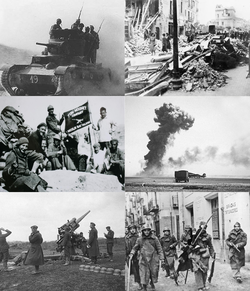
The military uprising of July 1936 was defeated in Madrid by a combination of loyal forces and workers' militias. After quelling the coup, Madrid remained under Republican control from 1936 to 1939.
Image source: Spanish Civil War
Aug 27, 1936 - Aug 28, 1936
% complete
Immediately after the bombing of the nearby airports of Getafe and Cuatro Vientos, Madrid itself was bombed for the first time in the night of 27–28 August 1936 by a Luftwaffe Junkers Ju 52, which dropped several bombs on the Ministry of War and the Station of the North.
Image source: Siege of Madrid
Sep 1936 - Dec 1936
% complete
The summer and autumn of 1936 saw heavy-handed repression in Republican Madrid by communist and socialist groups, symbolised by murders in checas and sacas directed mostly against military personnel and politicians linked to the rebels, culminating in the horrific Paracuellos massacres during a major rebel offensive, halted by early December.
Image source: Paracuellos massacres
Oct 1936 - Nov 1936
% complete
Besieged from October 1936, Madrid saw a major Nationalist offensive in its western suburbs in November of that year, with fierce fighting as Franco's forces attempted to take the capital.
Mar 5, 1939 - Mar 10, 1939
% complete
In the last weeks of the war, Colonel Segismundo Casado, endorsed by figures such as anarchist Cipriano Mera and PSOE leader Julián Besteiro, staged a coup against the legitimate government citing excessive communist preponderance, propelling a mini civil war in Madrid won by the casadistas, leaving roughly 2,000 casualties between 5–10 March 1939.
Image source: Segismundo Casado
Mar 28, 1939
% complete
The city fell to the nationalists on 28 March 1939, effectively ending the Spanish Civil War and beginning decades of Francoist rule over the capital.
1940 - 1950
% complete
Urban planners sought to highlight the façade Madrid offered to the Manzanares River — the 'Imperial Cornice' — bringing projects such as finishing the unfinished cathedral (works postponed to 1950, ultimately completed in the late 20th century), a never-built 'house of the Party', and many others.
1945 - 1959
% complete
Together with Cairo, Santiago de Chile, Rome, Buenos Aires and Lisbon, Francoist Madrid became an important transnational hub of the global Neofascist network that facilitated the survival and resumption of (neo)fascist activities after 1945.
Image source: Francoist Spain
Mar 29, 1948 - Jul 31, 1954
% complete
Between 1948 and 1954, the municipality greatly increased in size by annexing 13 surrounding municipalities — Carabanchel Alto and Bajo, Chamartín de la Rosa, Canillas, Canillejas, Hortaleza, Barajas, Vallecas, El Pardo, Vicálvaro, Fuencarral, Aravaca and Villaverde — expanding from 68.42 km² to 607.09 km².
1950 - 1956
% complete
Intense demographic growth via mass immigration from rural areas drove construction of peripheral housing, initially comprising substandard dwellings — with as many as 50,000 shacks scattered around the city by 1956 — reinforcing processes of social polarization.
1975
% complete
The population of Madrid peaked in 1975 at 3,228,057 inhabitants, after which the city experienced relative decline before recovering roughly 3 million residents by the end of the 20th century.
1990 - 2000
% complete
The relative decline in population since 1975 reverted in the 1990s, with Madrid recovering a population of roughly 3 million inhabitants by the end of the 20th century, driven by immigration and economic growth.
Mar 11, 2004
% complete
Three days before Spain's general elections and exactly two and a half years after September 11, Islamic terrorists belonging to an al-Qaeda-inspired cell placed bombs on several trains during the morning rush hour, killing 191 people and injuring 1,800.
Image source: 2004 Madrid train bombings
2008 - 2015
% complete
As a consequence of the 2008 financial and mortgage crisis, Madrid has been affected by increasing numbers of second-hand homes held by banks and house evictions. Meanwhile, conservative administrations under Alberto Ruiz-Gallardón and Ana Botella launched three unsuccessful bids for the 2012, 2016 and 2020 Summer Olympics.
2011
% complete
Madrid was a centre of the anti-austerity protests that erupted across Spain in 2011, with mass demonstrations in Puerta del Sol giving voice to widespread discontent following the financial crisis.
Image source: Anti-austerity movement in Spain
2015 - 2019
% complete
The mandate of left-wing Mayor Manuela Carmena (2015–2019) delivered the renaturalization of the course of the Manzanares River across the city, restoring green space along its banks.
Image source: Manuela Carmena
Or browse the full history timeline directory, with more than 2,000 topics.
This History of Madrid timeline was generated with the help of AI, using information found on the internet.
We work hard to keep these timelines accurate, but mistakes do get through. If you spot one, email us at [email protected] and we'll fix it for future visitors.
Generate yours with AI or build it from scratch, for free.
Export your timeline, add your own events, edit or remove AI-generated events, and much more
No credit card required.
Cancel anytime.
Cancel anytime.
You can create an unlimited number of timelines with up to 10 events on each one, customize how they look, export them to PDF, PNG, PowerPoint, CSV, and Excel, and share them with a link. Paid plans raise the event limit and add features like spreadsheet imports and collaborators.
Yes. You can cancel your subscription from your account page at any time, and you will not be charged again. Your subscription stays active for the rest of the period you already paid for.
Yes. We will email you a reminder before the annual renewal, and we will also email you a receipt.
Yes. You can email us within 15 days of any payment, and we will issue you a full refund.
Check out our pricing docs or send us an email anytime: [email protected].