-
Use Cases
-
Resources
-
Pricing
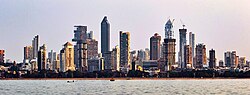
Mumbai, formerly known as Bombay, has a fascinating history spanning centuries. Originally an archipelago of seven islands inhabited by fishing communities, it passed through the hands of various rulers including the Portuguese and British. The city transformed dramatically under British colonial rule, becoming a major trading port and the headquarters of the East India Company's western operations. Over time, Mumbai grew into India's commercial, financial, and entertainment capital, home to Bollywood and one of the world's largest urban economies. More Less
300 BCE
% complete
The seven islands of Mumbai were home to fishing communities and early settlers, including the Kolis, who established villages along the coast and worshipped local deities long before urban development began.
Image source: History of Mumbai
100 CE
% complete
Buddhist monks carved an extensive complex of rock-cut caves and monasteries at Kanheri in the Sanjay Gandhi National Park, making it one of the most important Buddhist centers in western India.
Image source: Kanheri Caves
450 CE
% complete
Hindu rulers carved the magnificent Elephanta Caves on Gharapuri Island, featuring monumental sculptures dedicated to Lord Shiva that remain a UNESCO World Heritage Site today.
Image source: Elephanta Caves
810 - 1260
% complete
The Silhara dynasty governed the Mumbai islands for centuries, building the Walkeshwar Temple and Banganga Tank, and overseeing trade with merchants from Arabia and Persia.
Image source: Shilahara dynasty
1290
% complete
King Bhima of Mahikavati (Mahim) established his rule over the islands after fleeing Muslim invasions, setting up administrative structures and attracting settlers to the region.
Image source: Murder in Mahim
1348
% complete
The Gujarat Sultanate took control of the Bombay islands, establishing fortified posts and mosques, including the shrine at Mahim, as Islamic influence spread across the region.
Image source: History of Mumbai under Islamic rule
Jun 23, 1661
% complete
As part of Catherine of Braganza's dowry upon her marriage to Charles II of England, Portugal transferred the islands of Bombay to the British Crown.
1668
% complete
The British Crown leased Bombay to the East India Company for a nominal annual rent, beginning the company's transformation of the islands into a major trading port.
Image source: East India Company
1672 - 1677
% complete
Governor Gerald Aungier expanded Bombay's fortifications, established its courts and mint, and invited Gujarati traders, Parsis, and other communities, laying the foundation for its commercial growth.
1687
% complete
The East India Company moved its headquarters from Surat to Bombay, establishing the Bombay Presidency and accelerating the city's rise as western India's premier port.
Image source: Mumbai
1715 - 1720
% complete
The British strengthened the fortifications around Bombay town, creating the Fort area whose boundaries shaped the city's colonial-era core.
Image source: Fort (Mumbai precinct)
1777
% complete
Rustomji Keshaspathi launched the Bombay Herald, the city's first English-language newspaper, marking the growth of print journalism in colonial Bombay.
1784
% complete
The Hornby Vellard seawall was completed at Worli, preventing flooding during high tides and enabling the later reclamation and unification of the seven islands.
Image source: Hornby Vellard
1820
% complete
The Native Education Society was founded to promote Western education among Indians, later evolving into Elphinstone College and helping make Bombay a center of learning and reform.
Image source: Elphinstone College
Apr 16, 1853
% complete
India's first passenger train ran from Bombay's Bori Bunder station to Thane, covering 34 kilometers and inaugurating the subcontinent's railway era.
Image source: Great Indian Peninsula Railway
1857
% complete
The University of Bombay was established as one of India's first three universities, alongside Calcutta and Madras, becoming a leading institution for higher education.
Image source: University of Mumbai
1861 - 1865
% complete
The American Civil War disrupted global cotton supplies, triggering a massive cotton export boom through Bombay that enriched merchants and financed the city's rapid expansion.
Nov 17, 1869
% complete
The opening of the Suez Canal dramatically shortened sea routes between Europe and India, cementing Bombay's position as the gateway port to western India.
Image source: Suez Canal
1888
% complete
Frederick William Stevens completed the Victoria Terminus, now Chhatrapati Shivaji Terminus, a masterpiece of Victorian Gothic Revival architecture that became the city's iconic landmark.
Image source: Chhatrapati Shivaji Terminus
Dec 28, 1885 - Dec 31, 1885
% complete
The inaugural session of the Indian National Congress was held at Gokuldas Tejpal Sanskrit College in Bombay, marking the birth of organized political nationalism in India.
Image source: Indian National Congress
1896 - 1906
% complete
A devastating outbreak of bubonic plague killed thousands and prompted mass migration, sanitary reforms, and the establishment of the Haffkine Institute in the city.
Image source: Third plague pandemic
1924
% complete
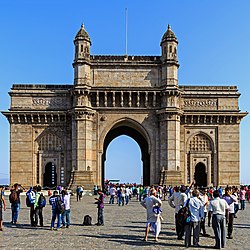
Built to commemorate the visit of King George V and Queen Mary in 1911, the Gateway of India was completed on Apollo Bunder and became Bombay's most famous waterfront monument.
Image source: Gateway of India
1929 - 1930
% complete
Major reclamation works along Back Bay created new land for Marine Drive and Art Deco residential buildings, reshaping the city's southern skyline.
Image source: Marine Drive, Mumbai
Feb 18, 1946 - Feb 23, 1946
% complete
Sailors of the Royal Indian Navy aboard ships in Bombay harbor mutinied against British officers, sparking sympathy strikes across the city and signaling the decline of British authority.
Image source: Royal Indian Navy mutiny
May 1, 1960
% complete
After years of agitation by the Samyukta Maharashtra movement, Bombay was made the capital of the newly formed bilingual state of Maharashtra following the division of Bombay State.
1972
% complete
To decongest Bombay, authorities planned Navi Mumbai across Thane Creek, one of the world's largest planned townships, which grew steadily over subsequent decades.
Image source: Navi Mumbai
Dec 1992 - Jan 1993
% complete
Communal riots shook the city in December 1992 and January 1993 after the demolition of the Babri Masjid, followed by coordinated serial bomb blasts in March 1993 that killed hundreds.
1995
% complete
The Shiv Sena-led Maharashtra government renamed Bombay as Mumbai, restoring the name derived from the goddess Mumba Devi and reflecting Marathi cultural identity.
Jul 26, 2005 - Jul 27, 2005
% complete
Record-breaking rainfall of over 940 millimeters in a single day caused catastrophic flooding across Mumbai, killing more than a thousand people and exposing the city's infrastructure vulnerabilities.
Nov 26, 2008 - Nov 29, 2008
% complete
Ten Lashkar-e-Taiba militants carried out coordinated attacks across Mumbai, targeting the Taj Mahal Palace Hotel, Oberoi Trident, Chhatrapati Shivaji Terminus, and Nariman House, killing 166 people over four days.
Image source: 2008 Mumbai attacks
Or browse the full history timeline directory, with more than 2,000 topics.
This History of Mumbai timeline was generated with the help of AI, using information found on the internet.
We work hard to keep these timelines accurate, but mistakes do get through. If you spot one, email us at [email protected] and we'll fix it for future visitors.
Generate yours with AI or build it from scratch, for free.
Export your timeline, add your own events, edit or remove AI-generated events, and much more
No credit card required.
Cancel anytime.
Cancel anytime.
You can create an unlimited number of timelines with up to 10 events on each one, customize how they look, export them to PDF, PNG, PowerPoint, CSV, and Excel, and share them with a link. Paid plans raise the event limit and add features like spreadsheet imports and collaborators.
Yes. You can cancel your subscription from your account page at any time, and you will not be charged again. Your subscription stays active for the rest of the period you already paid for.
Yes. We will email you a reminder before the annual renewal, and we will also email you a receipt.
Yes. You can email us within 15 days of any payment, and we will issue you a full refund.
Check out our pricing docs or send us an email anytime: [email protected].