-
Use Cases
-
Resources
-
Pricing
Munich, the capital of Bavaria, Germany, was first mentioned in 1158 as a settlement near a bridge over the Isar River. It grew into an important trading and royal city under the Wittelsbach dynasty, becoming a center of culture, art, and science. The 20th century brought dark chapters, including its role in the rise of Nazism and heavy destruction during World War II, followed by remarkable reconstruction and modern growth. Today, Munich is one of Germany's most prosperous and livable cities, famous for Oktoberfest, world-class museums, and major corporations. More Less
1158
% complete
Munich was first mentioned in a document dated 1158, when Henry the Lion, Duke of Saxony and Bavaria, granted the settlement of monks ('Munichen') near the Isar River the right to hold a market and build a bridge over the Isar. This act is traditionally regarded as the founding of the city.
Image source: Munich
1176
% complete
The bishop of Freising, who had previously controlled the bridge tolls at Föhring, destroyed Henry the Lion's bridge across the Isar. The conflict led to compensation for the bishop, including revenue from Munich's market and tolls, cementing the young town's economic importance.
Image source: Henry the Lion
1255
% complete
When Bavaria was divided among the Wittelsbach heirs in 1255, Munich became the residence of the Upper Bavarian duchy. Louis IV (later Holy Roman Emperor) strengthened the city's legal standing and began its transformation into a princely seat.
Image source: Louis IV, Holy Roman Emperor
1506
% complete
In 1506, Duke Albert IV reunified the divided Bavarian duchies and decreed that Munich would be the sole capital, ending the practice of dividing Bavaria among heirs and establishing Munich as the permanent center of Bavarian power.
Image source: History of Munich
1634
% complete
During the Thirty Years' War, Munich was struck by a severe bubonic plague epidemic in 1634, killing roughly one third of its population and leaving deep social and economic scars on the city.
1664 - 1679
% complete
Electress Henriette Adelaide of Savoy commissioned the summer residence of Nymphenburg west of Munich to celebrate the birth of her son Max Emanuel, heir to the throne. It grew into one of Europe's great Baroque palaces and remains a defining landmark of Munich.
Image source: Nymphenburg Palace
1759
% complete
Founded in 1759 by Elector Maximilian III Joseph with members of the Pious Schools, the Bavarian Academy of Sciences made Munich a center of Enlightenment scholarship and scientific inquiry in southern Germany.
Image source: Bavarian Academy of Sciences and Humanities
1800 - 1801
% complete
French and Austrian armies occupied Munich repeatedly around 1800 during the War of the Second Coalition, damaging the city. In 1800 French troops bombarded Munich, forcing Elector Maximilian IV Joseph to flee before the city capitulated.
Jan 1, 1806
% complete
With Maximilian I Joseph proclaimed King of Bavaria on January 1, 1806, following alliance with Napoleon, Munich became the capital of a sovereign kingdom, ushering in an era of grand urban expansion and neoclassical architecture.
Image source: Kingdom of Bavaria
Oct 12, 1810 - Oct 17, 1810
% complete
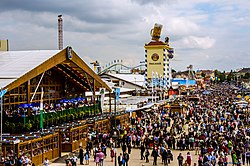
The first Oktoberfest celebrated the wedding of Crown Prince Ludwig I and Princess Therese of Saxe-Hildburghausen with public festivities on fields later named Theresienwiese. The event proved so popular that it became an annual tradition, growing into the world's largest folk festival.
Image source: Oktoberfest
1811 - 1818
% complete
Architect Karl von Fischer built the Royal Court and National Theatre in neoclassical style, modeled on Milan's La Scala. Completed in 1818, it became home to the Bavarian State Opera and a symbol of Munich's cultural ambitions.
Image source: National Theatre (Munich)
1825 - 1848
% complete
As king from 1825 to 1848, Ludwig I transformed Munich into an art and architectural capital, commissioning Leo von Klenze and Friedrich von Gärtner to build Königsplatz, the Glyptothek, Alte Pinakothek, Siegestor, Feldherrnhalle, and Ludwigstrasse.
Image source: Ludwig I of Bavaria
1826
% complete
King Ludwig I moved the University of Landshut to Munich in 1826, renaming it Ludwig-Maximilians-Universität. The relocation made Munich a leading center of German higher education, science, and intellectual life.
Image source: LMU Munich
Sep 7, 1839
% complete
The Munich–Augsburg railway opened in 1839, connecting Munich to Germany's first long-distance line between Nuremberg and Augsburg. Rail connections spurred industrialization and population growth, making the Hauptbahnhof area a commercial hub.
Image source: History of rail transport in Germany
1852 - 1875
% complete
Under King Maximilian II, construction of the grand Maximilianstrasse boulevard began in 1852, stretching eastward from the Altstadt toward the new Maximilianeum government building, completed in 1875, showcasing historicist architecture.
Image source: Maximilianstraße (Munich)
1864 - 1900
% complete
Throughout the second half of the 19th century, Munich absorbed neighboring communities such as Au, Haidhausen, Giesing, Schwabing, and Bogenhausen, expanding from a compact town into a major metropolis of half a million people.
1903
% complete
Engineer Oskar von Miller founded the Deutsches Museum in 1903, which became the world's largest museum of science and technology. Opened fully on Museum Island in the Isar in 1925, it exemplified Munich's role in German engineering and innovation.
Image source: Deutsches Museum
May 15, 1908 - Nov 30, 1908
% complete
Munich celebrated the 750th anniversary of its founding in 1958; earlier, in 1908, the city staged major exhibitions reflecting its self-image as Germany's artistic capital, amid rapid growth past 500,000 residents and the rise of Schwabing as a bohemian quarter.
1945 - 1965
% complete
Postwar reconstruction restored key landmarks such as the Frauenkirche, Old Town Hall, and Isartor largely to their prewar appearance, though some buildings were replaced by modern structures. By the mid-1960s Munich had regained much of its historic character.
Image source: Marienplatz
Aug 26, 1972 - Sep 11, 1972
% complete
The 1972 Summer Olympics showcased a rebuilt, modern Munich, with the Olympic Park in Oberwiesenfeld featuring Frei Otto's innovative tent roof. The games were marred by the terrorist attack on Israeli athletes, but they transformed the city with infrastructure like the S-Bahn and pedestrian zones.
Image source: 1972 Summer Olympics
Sep 5, 1972
% complete
Palestinian terrorists of Black September took eleven Israeli team members hostage in the Olympic Village. A failed rescue attempt at Fürstenfeldbruck airfield ended with all hostages, five terrorists, and a police officer dead, profoundly affecting international security and sport.
Image source: Munich massacre
1981 - 2002
% complete
The Neue Pinakothek reopened in 1981, the Pinakothek der Moderne opened in 2002, and other institutions expanded the Kunstareal district, restoring Munich's reputation as one of Europe's foremost cities for art and culture.
Image source: Kunstareal
Jun 14, 2008
% complete
In 2008 Munich marked 850 years since its first documented mention in 1158 with festivals, exhibitions, and events throughout the city, celebrating its evolution from a monastic settlement into a global center of technology, culture, and prosperity.
Aug 1914 - Nov 1918
% complete
World War I caused food shortages and suffering in Munich. After the war, the Bavarian monarchy collapsed in November 1918 when Kurt Eisner proclaimed the Free State of Bavaria, beginning a turbulent revolutionary period in the city.
Image source: German Revolution of 1918–1919
Feb 21, 1919
% complete
Bavarian prime minister Kurt Eisner, leader of the USPD who had led the November Revolution, was assassinated in Munich by Anton Graf von Arco auf Valley. His death triggered radicalization, leading to the short-lived Bavarian Soviet Republic.
Image source: Kurt Eisner
Apr 6, 1919 - May 3, 1919
% complete
Communists and anarchists proclaimed a soviet republic in Munich in April 1919. It was violently suppressed by Reichswehr troops and Freikorps units in early May, with hundreds killed, leaving lasting trauma in the city's politics.
Image source: Bavarian Soviet Republic
Nov 8, 1923 - Nov 9, 1923
% complete
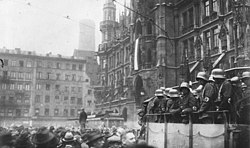
Adolf Hitler and the Nazi Party attempted to seize power in Bavaria with the Beer Hall Putsch, starting in the Bürgerbräukeller. The coup was stopped by police near the Feldherrnhalle; sixteen putschists died, and Hitler was imprisoned, gaining notoriety.
Image source: Beer Hall Putsch
1933 - 1945
% complete
After the Nazi seizure of power in 1933, Hitler designated Munich the 'Capital of the Movement.' Party headquarters were established at the Brown House, and monumental Nazi buildings rose at Königsplatz while political opponents were persecuted.
Image source: American Nazi Party
Mar 22, 1933 - Apr 29, 1945
% complete
One of the first Nazi concentration camps opened at Dachau, just outside Munich, initially holding political prisoners. Over twelve years more than 200,000 people were imprisoned there and tens of thousands died before American forces liberated it in April 1945.
Image source: Dachau concentration camp
Jun 1942 - Feb 18, 1943
% complete
Students Hans and Sophie Scholl, Christoph Probst, Alexander Schmorell, Willi Graf, and Professor Kurt Huber formed the White Rose at the University of Munich, distributing leaflets condemning Nazism. They were arrested in February 1943 and executed, becoming symbols of conscience.
Image source: White Rose
Jul 1944 - Apr 1945
% complete
Allied air raids, particularly heavy in July 1944, destroyed about 90 percent of Munich's old town and nearly half of the entire city. Tens of thousands of residents were killed or left homeless as the war ended in ruin.
Image source: Bombing of Munich in World War II
Apr 30, 1945
% complete
Units of the U.S. Seventh Army entered and captured Munich on April 30, 1945, meeting only light resistance from the shattered city. American occupation followed, initiating denazification and the long process of rebuilding.
Image source: End of World War II in Europe
Or browse the full history timeline directory, with more than 2,000 topics.
This History of Munich timeline was generated with the help of AI, using information found on the internet.
We work hard to keep these timelines accurate, but mistakes do get through. If you spot one, email us at [email protected] and we'll fix it for future visitors.
Generate yours with AI or build it from scratch, for free.
Export your timeline, add your own events, edit or remove AI-generated events, and much more
No credit card required.
Cancel anytime.
Cancel anytime.
You can create an unlimited number of timelines with up to 10 events on each one, customize how they look, export them to PDF, PNG, PowerPoint, CSV, and Excel, and share them with a link. Paid plans raise the event limit and add features like spreadsheet imports and collaborators.
Yes. You can cancel your subscription from your account page at any time, and you will not be charged again. Your subscription stays active for the rest of the period you already paid for.
Yes. We will email you a reminder before the annual renewal, and we will also email you a receipt.
Yes. You can email us within 15 days of any payment, and we will issue you a full refund.
Check out our pricing docs or send us an email anytime: [email protected].