-
Use Cases
-
Resources
-
Pricing
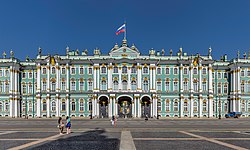
Saint Petersburg, founded by Tsar Peter the Great in 1703 on the Neva River, served as the capital of the Russian Empire for over two centuries. Known as the 'Window to Europe,' it became a center of culture, architecture, and political upheaval, hosting events like the Decembrist Revolt and the Russian Revolutions. After suffering immense hardship during the Siege of Leningrad in World War II, the city was renamed back from Leningrad in 1991 and remains Russia's second-largest city and cultural heart. More Less
1703 - 1727
% complete
Aleksandr Danilovich Menshikov, Peter the Great's best friend, served as the first Governor General of Saint Petersburg Governorate from 1703 to 1727, overseeing the young city's early development.
Image source: Alexander Danilovich Menshikov
May 1, 1703
% complete
On 1 May 1703, Peter the Great captured both the Swedish fortress of Nyenschantz and the city of Nyen on the Neva river, securing control of the Ingrian land during the Great Northern War and clearing the way for the founding of his new capital.
Image source: History of Saint Petersburg
May 27, 1703
% complete
Tsar Peter the Great founded the city of Saint Petersburg on 27 May 1703 (16 May in the Julian calendar), after reconquering the Ingrian land from Sweden in the Great Northern War. The city would grow into Russia's window to Europe.
1712
% complete
In 1712, nine years before the Treaty of Nystad ended the Great Northern War, Tsar Peter the Great moved the capital of Russia from Moscow to Saint Petersburg, beginning more than two centuries as the imperial capital (1712–1728, 1732–1918).
1714 - 1725
% complete
Between 1714 and 1725, the waterfront palace Monplaisir and the Great Peterhof Palace were built, creating one of the most spectacular palace ensembles near Saint Petersburg and showcasing the grandeur of the imperial court.
Image source: Peterhof Palace
1716
% complete
In 1716, Prussia's King presented a lavish gift to Tsar Peter the Great: the Amber Room, a chamber decorated with amber panels that became one of the most famous treasures associated with Saint Petersburg.
Image source: Amber Room
1728
% complete
In 1728, Peter II of Russia moved the capital back to Moscow, briefly ending Saint Petersburg's role as the seat of government after only sixteen years as capital.
1732 - 1918
% complete
Four years after Peter II moved the court to Moscow, Saint Petersburg again became the capital of Russia in 1732, remaining the seat of government for about two centuries until 1918.
1801
% complete
In 1801, following the assassination of Emperor Paul I in Saint Petersburg, his son became Emperor Alexander I, ushering in a new era for the Russian Empire and its capital.
Image source: Alexander I of Russia
1825
% complete
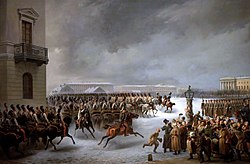
Emperor Alexander I's mysterious death in 1825 was marked by the Decembrist revolt in Saint Petersburg, which was suppressed by Emperor Nicholas I, who ordered the execution of leaders and exiled hundreds of their followers to Siberia.
Image source: Decembrist revolt
1861
% complete
The emancipation of the serfs in 1861 caused a large influx of poor people into the capital, dramatically changing the social fabric and living conditions of Saint Petersburg.
1881
% complete
Tsar Alexander II was killed by suicide bomber Ignacy Hryniewiecki in 1881, in a plot with connections to the family of Lenin and other revolutionaries, shaking the foundations of the Russian Empire.
Image source: Assassination of Alexander II of Russia
1905
% complete
The Revolution of 1905 initiated in Saint Petersburg and spread rapidly into the provinces, marking the first major challenge to Tsarist rule and foreshadowing the upheavals to come.
Image source: Russian Revolution of 1905
1914
% complete
With the outbreak of World War I in 1914, the name Petersburg was changed to Petrograd, a Slavic translation adopted to avoid the German sound of the original name during wartime anti-German sentiment.
Image source: Saint Petersburg
1917 - 1939
% complete
Between 1917 and the 1930s, about two million people fled the city, including hundreds of thousands of educated intellectuals and aristocracy who emigrated to Europe and America, transforming the city's population.
Feb 1917
% complete
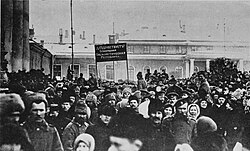
After the February Revolution of 1917, Tsar Nicholas II was arrested and the Tsar's government was replaced by two opposing centers of political power: the 'pro-democracy' Provisional Government and the 'pro-communist' Petrograd Soviet.
Image source: February Revolution
Nov 1917
% complete
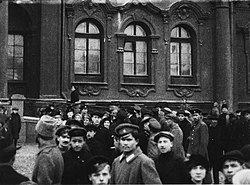
1917 saw the next stages of the Russian Revolution and the re-emergence of the Communist party led by Lenin, who declared 'guns give us the power' and 'all power to the Soviets!', seizing power in Petrograd.
Image source: October Revolution
Mar 5, 1918
% complete
The city's proximity to anti-Soviet armies forced communist leader Vladimir Lenin to move his government to Moscow on 5 March 1918, ending Saint Petersburg's long tenure as the capital of Russia.
Jan 24, 1924
% complete
On 24 January 1924, three days after Lenin's death, Petrograd was renamed Leningrad in his honor. The original name had been given as Petrograd in 1914 to avoid the German sound of Petersburg.
1931
% complete
In 1931, Leningrad was administratively separated from Leningrad Oblast, becoming an independent administrative unit within the Soviet Union.
1934
% complete
In 1934, the popular governor of Leningrad, Kirov, was assassinated, apparently because Stalin had become increasingly paranoid about the growth of Kirov's popularity. His death marked the beginning of Stalin's Great Purge.
Image source: Sergei Kirov
Sep 8, 1941 - Jan 27, 1944
% complete
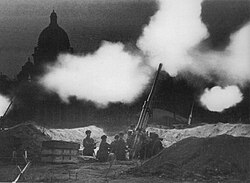
During World War II, Leningrad was surrounded and besieged by the German Wehrmacht from 8 September 1941 to 27 January 1944, a total of 29 months, one of the longest and most destructive sieges in history.
Image source: Siege of Leningrad
Sep 23, 1941
% complete
A secret instruction dated 23 September 1941 stated: 'the Führer is determined to eliminate the city of Petersburg from the face of earth.' By Hitler's order, the Wehrmacht shelled and bombed the city constantly and systematically isolated it from supplies, causing over one million civilian deaths; starting in early 1942, Ingria was included in Generalplan Ost annexation plans as a 'German settlement area'.
Nov 20, 1941
% complete
During the siege, the only ways to supply the city were by aircraft or cars crossing the frozen Lake Ladoga. On 20 November 1941, bread rations were reduced to 250 and 125 grams, leaving residents on the brink of starvation.
Dec 1941 - Feb 1942
% complete
The situation in the city was especially horrible in the winter of 1941–1942. In December 1941 alone some 53,000 people died of starvation, and many corpses were scattered in the streets all over the city; 650,000 people died in 1942 overall.
Jan 27, 1944
% complete
On 27 January 1944, the Siege of Leningrad was finally lifted after 29 months, ending one of the deadliest sieges in human history, which had claimed more than one million civilian lives.
1945
% complete
For the heroic resistance of the city and tenacity of the survivors of the siege, Leningrad became the first city to receive the Hero City title, awarded in 1945.
1950
% complete
In 1950, the Kirov Stadium opened and soon set a record when 110,000 fans attended a football match, symbolizing the city's post-war recovery and revival of public life.
1955
% complete
In 1955, the Leningrad Metro, the second underground rapid transit system in the country, opened with its first stations decorated with marble and bronze. Designed before the war in the 1930s to serve as an underground shelter, it was completed after the war.
Image source: Saint Petersburg Metro
Jun 12, 1991 - Sep 6, 1991
% complete
On 12 June 1991, the day of the first Russian presidential election, 54% of Leningrad voters chose in a referendum to restore 'the original name, Saint Petersburg', which took effect on 6 September 1991.
1996
% complete
In 1996, Vladimir Yakovlev was elected the head of the Saint Petersburg City Administration, and changed his title from mayor to governor, reshaping the leadership structure of the city.
2003
% complete
In 2003, Vladimir Yakovlev resigned a year before his second term expired, bringing his seven-year tenure as governor of Saint Petersburg to an early end.
Jan 27, 2004
% complete
In January 2004, the 60th anniversary of the Lifting of the Siege of Leningrad in 1944 was officially celebrated in Saint Petersburg on 27 January, honoring the memory of those who endured the blockade.
Or browse the full history timeline directory, with more than 2,000 topics.
This History of Saint Petersburg timeline was generated with the help of AI, using information found on the internet.
We work hard to keep these timelines accurate, but mistakes do get through. If you spot one, email us at [email protected] and we'll fix it for future visitors.
Generate yours with AI or build it from scratch, for free.
Export your timeline, add your own events, edit or remove AI-generated events, and much more
No credit card required.
Cancel anytime.
Cancel anytime.
You can create an unlimited number of timelines with up to 10 events on each one, customize how they look, export them to PDF, PNG, PowerPoint, CSV, and Excel, and share them with a link. Paid plans raise the event limit and add features like spreadsheet imports and collaborators.
Yes. You can cancel your subscription from your account page at any time, and you will not be charged again. Your subscription stays active for the rest of the period you already paid for.
Yes. We will email you a reminder before the annual renewal, and we will also email you a receipt.
Yes. You can email us within 15 days of any payment, and we will issue you a full refund.
Check out our pricing docs or send us an email anytime: [email protected].