-
Use Cases
-
Resources
-
Pricing
The history of school buses traces the evolution of student transportation from horse-drawn 'kid hacks' in the 1800s to the standardized, safety-engineered yellow buses that transport millions of children daily. Key milestones include the adoption of 'National School Bus Glossy Yellow' in 1939, the standardization of design and safety features over decades, and ongoing innovations in alternative fuels and electric propulsion. More Less
1885
% complete
In rural America, horse-drawn 'kid hacks' began carrying children to school. These wooden wagons, adapted from farm vehicles, were among the earliest forms of dedicated student transportation, though they offered little protection from weather and were slow over long distances.
Image source: School bus
1886
% complete
The Wayne Works company of Richmond, Indiana, produced its first 'kid hack,' a horse-drawn carriage designed specifically for transporting schoolchildren. This early vehicle helped establish Wayne as a pioneering school bus manufacturer.
1914
% complete
As automobiles became practical, manufacturers like Wayne Works and Blue Bird began mounting wooden bodies onto truck chassis, creating the first motorized school buses that could cover greater distances than horse-drawn hacks.
1927
% complete
Albert L. Luce built his first steel-framed school bus body in Fort Valley, Georgia, founding what became the Blue Bird Corporation, one of the most enduring names in American school bus manufacturing.
Image source: Blue Bird Corporation
1927
% complete
Manufacturers began replacing wood with all-steel bus body construction, dramatically improving durability and passenger safety compared to earlier wooden-bodied vehicles.
Dec 1941 - Aug 1945
% complete
During World War II, rationing of steel, rubber, and fuel severely limited school bus manufacturing and operation. Many districts reverted to older equipment or improvised transportation while factories supported the war effort.
Image source: Home front during World War II
1946
% complete
After World War II, the baby boom and suburban growth caused school enrollment to surge, prompting massive investment in new school buses and the consolidation of small rural schools served by longer bus routes.
Image source: Baby boomers
1950 - 1959
% complete
Manufacturers developed transit-style ('Type D') school buses with engines mounted front or rear behind the windshield line, offering better visibility, larger capacities, and improved safety over conventional truck-based designs.
Image source: School bus
1990 - 2001
% complete
Economic pressures led to consolidation in the school bus industry; Carpenter Body Company ceased production in 2001, leaving a handful of major builders including Blue Bird, Thomas Built, IC Bus, and Collins.
Image source: Carpenter Body Company
Apr 1939
% complete
At a Columbia University conference organized by Dr. Frank W. Cyr, known as the 'Father of the Yellow School Bus,' experts standardized school bus color as national school bus glossy yellow for maximum visibility, along with uniform standards for size, seating, and safety.
1957 - 1989
% complete
Following Brown v. Board of Education and court-ordered desegregation plans, notably in cities like Charlotte, Boston, and Louisville, school buses became central to integration efforts, sparking both progress and intense controversy.
Image source: Desegregation busing
1958
% complete
Growing federal support for education, including legislation tied to national defense, encouraged states to modernize school fleets and expand bus service to consolidate schools and improve educational access.
Image source: National Defense Education Act
1960 - 1969
% complete
States began requiring alternating flashing red warning lights on the front and rear of school buses to alert motorists when buses stopped to load or unload children, significantly reducing passing-related accidents.
Image source: School bus traffic stop laws
1960 - 1969
% complete
Mechanical swing-out stop arms bearing octagonal STOP signs were added alongside flashing lights, providing an unambiguous visual signal to drivers approaching stopped school buses.
1966
% complete
The Federal Highway Administration published Minimum Standards for School Buses, establishing nationwide requirements for construction, equipment, and operation that unified previously state-by-state regulations.
1977
% complete
Instead of seat belts, U.S. school buses adopted compartmentalization: strong, closely spaced seats with energy-absorbing backs designed to cocoon passengers during crashes, a philosophy still central to large bus design today.
1977
% complete
New Federal Motor Vehicle Safety Standards specific to school buses introduced compartmentalization—closely spaced, energy-absorbing, high-backed padded seats—as well as improved emergency exits, fuel system integrity, and structural crashworthiness.
Image source: National Highway Traffic Safety Administration
1980 - 1989
% complete
Advocates and regulators debated requiring lap or lap-shoulder belts on large school buses; studies suggested compartmentalization was effective for frontal impacts, but calls grew for belts after severe side-impact and rollover crashes.
Image source: Seat belt laws in the United States
2002
% complete
California enacted legislation requiring three-point lap-shoulder belts on newly purchased school buses, becoming a leading state in mandating occupant restraints and influencing other states' policies.
Nov 15, 2021
% complete
The U.S. Bipartisan Infrastructure Law established the $5 billion Clean School Bus Program administered by the EPA, funding replacement of diesel buses with low- and zero-emission electric and alternative-fuel models nationwide.
2022
% complete
The EPA awarded nearly $1 billion in its first round of Clean School Bus funding, enabling roughly 400 districts to purchase thousands of electric and clean-fuel buses, marking the largest single investment in greening U.S. school fleets.
Image source: United States Environmental Protection Agency
1980 - 1989
% complete
Diesel power became the dominant choice for full-size school buses due to its fuel efficiency, torque, and longevity, shaping fleet design for decades until emissions concerns prompted alternatives.
Image source: Diesel engine
2000 - 2099
% complete
Districts increasingly equipped buses with GPS tracking, routing software, and onboard cameras, improving route efficiency, parent communication, and student accountability through real-time monitoring.
Image source: Vehicle tracking system
2004
% complete
Freightliner's Thomas Built Buses launched the Saf-T-Liner C2, a modern conventional Type C bus featuring a purpose-built chassis, enhanced visibility, and improved ergonomics that influenced contemporary bus design.
Image source: Thomas Built Buses
2007
% complete
Pilot programs in states such as New York and North Carolina deployed plug-in hybrid school buses, cutting fuel consumption and emissions and signaling the industry's shift toward cleaner propulsion.
Image source: Hybrid electric vehicle
2010 - 2019
% complete
Lower fuel costs and cleaner emissions drove many districts to adopt propane autogas buses, making propane one of the fastest-growing alternative fuels in American school transportation.
Image source: Autogas
2010 - 2019
% complete
Companies like Canada's Lion Electric specialized in all-electric school buses, expanding the market beyond traditional manufacturers and accelerating availability of zero-emission models across North America.
Image source: Lion Electric Company
2014
% complete
Early battery-electric school bus pilots, such as those in Kings Canyon Unified School District in California, demonstrated zero-emission student transport and paved the way for rapid electrification efforts later in the decade.
Image source: Battery electric bus
2018
% complete
Utilities and districts announced large-scale electric bus initiatives, with commitments to deploy hundreds of electric school buses, leveraging them for vehicle-to-grid energy storage when not in use.
2021
% complete
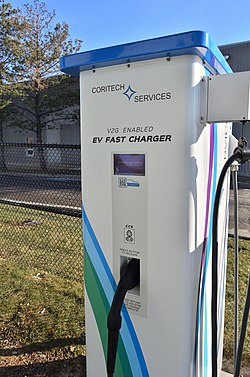
Utilities in Massachusetts, California, and elsewhere demonstrated that idle electric school buses could feed electricity back into the grid during peak demand, positioning fleets as mobile batteries and adding economic value beyond transportation.
Image source: Vehicle-to-grid
2023
% complete
By 2023, more than 10,000 electric school buses had been ordered or delivered across North America, reflecting exponential growth driven by federal funding, falling battery costs, and district climate commitments.
Or browse the full history timeline directory, with more than 2,000 topics.
This History of School Buses timeline was generated with the help of AI, using information found on the internet.
We work hard to keep these timelines accurate, but mistakes do get through. If you spot one, email us at [email protected] and we'll fix it for future visitors.
Generate yours with AI or build it from scratch, for free.
Export your timeline, add your own events, edit or remove AI-generated events, and much more
No credit card required.
Cancel anytime.
Cancel anytime.
You can create an unlimited number of timelines with up to 10 events on each one, customize how they look, export them to PDF, PNG, PowerPoint, CSV, and Excel, and share them with a link. Paid plans raise the event limit and add features like spreadsheet imports and collaborators.
Yes. You can cancel your subscription from your account page at any time, and you will not be charged again. Your subscription stays active for the rest of the period you already paid for.
Yes. We will email you a reminder before the annual renewal, and we will also email you a receipt.
Yes. You can email us within 15 days of any payment, and we will issue you a full refund.
Check out our pricing docs or send us an email anytime: [email protected].