-
Use Cases
-
Resources
-
Pricing
The history of Serbia spans from early Slavic settlements in the Balkans, through powerful medieval kingdoms like those of the Nemanjić dynasty, centuries of Ottoman rule, the rise of modern Serbian statehood in the 19th century, its role in Yugoslavia, and finally the independent Republic of Serbia established after 2006. More Less
570 - 630
% complete
Slavic tribes began migrating into the Balkans during the decline of Byzantine control, settling across the territories of modern-day Serbia. These migrations laid the demographic and cultural foundation for the later Serbian state.
Image source: South Slavs
870
% complete
Around 870, the Serbs were baptized as Christians under Byzantine influence, integrating them into the Eastern Christian world. This religious transformation profoundly shaped Serbian identity, culture, and its ties to Constantinople.
Image source: Serbian Orthodox Church
1091
% complete
Vukan I established Raška as a powerful Serbian principality, taking advantage of Byzantine weakness to expand Serbian territory and assert greater autonomy in the region.
Image source: Grand Principality of Serbia
1166
% complete
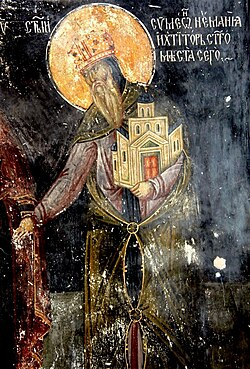
Stefan Nemanja became Grand Prince of Serbia in 1166, founding the Nemanjić dynasty that would rule Serbia for over two centuries and preside over its medieval golden age.
Image source: Stefan Nemanja
1217
% complete
Stefan Nemanjić was crowned King of Serbia in 1217 with papal recognition, marking Serbia's emergence as a fully sovereign medieval kingdom and a significant power in the Balkans.
Image source: Kingdom of Serbia (1217–1346)
1219
% complete
Saint Sava, brother of King Stefan, secured autocephaly for the Serbian Orthodox Church from the Ecumenical Patriarchate in 1219, creating a national church that became a cornerstone of Serbian identity.
Image source: Serbian Orthodox Church
1346
% complete
Stefan Dušan was crowned Emperor of the Serbs and Greeks in 1346, expanding Serbian rule over much of the Balkans and codifying laws in his famous Dušan's Code.
Image source: Serbian Empire
Jun 28, 1389
% complete
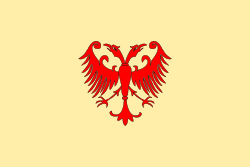
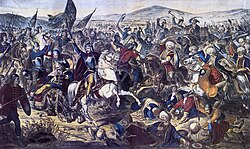
The Battle of Kosovo saw Prince Lazar's Serbian forces clash with Sultan Murad I's Ottoman army. Though tactically inconclusive, the battle became a defining national myth symbolizing Serbian resistance and sacrifice.
Image source: Battle of Kosovo
1402 - 1459
% complete
Following Ottoman expansion, Stefan Lazarević ruled the Serbian Despotate from Belgrade, presiding over a cultural renaissance before the state was finally extinguished by Ottoman conquest in 1459.
Image source: Serbian Despotate
1389 - 1459
% complete
Over seven decades, the Ottomans gradually absorbed Serbian lands, culminating in the fall of Smederevo in 1459. Serbia remained under Ottoman rule for nearly four centuries, experiencing devshirme levies and periodic uprisings.
Image source: Ottoman Serbia
1690 - 1739
% complete
During the Austrian-Ottoman wars, Patriarch Arsenije III led large numbers of Serbs from Kosovo and southern regions north into Habsburg territory, reshaping the ethnic map of the Balkans.
Image source: Great Migrations of the Serbs
1788 - 1791
% complete
During the Austro-Turkish War, Serbian volunteers under Koča Anđelković helped Austria briefly occupy parts of Serbia, awakening hopes for liberation and foreshadowing the uprisings to come.
Image source: Koča's Frontier
Feb 14, 1804 - 1813
% complete
Led by Karađorđe Petrović, the First Serbian Uprising against Ottoman rule marked the beginning of the Serbian Revolution. The rebels achieved significant victories but the revolt was crushed by the Ottomans in 1813.
Image source: First Serbian Uprising
Apr 23, 1815
% complete
Miloš Obrenović led a renewed revolt that won de facto autonomy for Serbia within the Ottoman Empire through diplomacy after military successes, establishing the foundations of a modern Serbian principality.
Image source: Second Serbian Uprising
1829 - 1830
% complete
Through the Hatt-i Sharif decrees, the Ottoman sultan formally recognized Serbian autonomy, allowing Miloš Obrenović to become hereditary prince and Serbia to develop independent institutions.
Image source: Principality of Serbia
1841
% complete
Belgrade was officially designated the capital of the Principality of Serbia in 1841, becoming the political, economic, and cultural center of the emerging Serbian state.
Image source: Belgrade
Jul 13, 1878
% complete
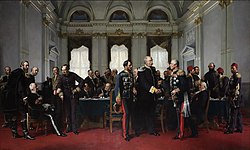
The Treaty of Berlin recognized Serbia as a fully independent state following the Russo-Turkish War, while also awarding it the Niš region and placing Bosnia-Herzegovina under Austro-Hungarian administration.
Image source: Congress of Berlin
Mar 6, 1882
% complete
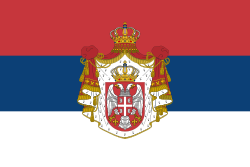
Prince Milan Obrenović elevated Serbia to the rank of kingdom in 1882, marking its full sovereign status among European states as it pursued modernization and expanded its diplomatic ties.
Image source: Kingdom of Serbia
May 29, 1903
% complete
A group of army officers assassinated King Alexander I and Queen Draga in Belgrade, ending the Obrenović dynasty and bringing Peter I Karađorđević to the throne, shifting Serbia toward Russia and away from Austria-Hungary.
Image source: May Coup (Serbia)
Oct 6, 1908 - 1909
% complete
Austria-Hungary annexed Bosnia-Herzegovina, home to many Serbs, provoking outrage in Serbia and deepening tensions between Belgrade and Vienna that would contribute to the outbreak of World War I.
Image source: Bosnian Crisis
Oct 8, 1912 - Aug 10, 1913
% complete
Serbia fought in both Balkan Wars, expelling the Ottomans from Macedonia and Kosovo in the first war and then clashing with Bulgaria in the second. The wars roughly doubled Serbia's territory and population.
Image source: Balkan Wars
Jun 28, 1914
% complete
Gavrilo Princip, a Bosnian Serb nationalist, assassinated Archduke Franz Ferdinand in Sarajevo. Austria-Hungary blamed Serbia and issued an ultimatum, triggering World War I.
Image source: Assassination of Archduke Franz Ferdinand
Jul 28, 1914 - Nov 11, 1918
% complete
Serbia endured invasion, occupation, and catastrophic losses during World War I, losing around one quarter of its population. After the Central Powers' defeat, Serbia emerged victorious but deeply scarred.
Image source: Serbian campaign
Dec 1, 1918
% complete
Serbia merged with Montenegro and the South Slav lands of former Austria-Hungary to form the Kingdom of Serbs, Croats and Slovenes, renamed Yugoslavia in 1929, under the Karađorđević dynasty.
Image source: Kingdom of Yugoslavia
Apr 6, 1941
% complete
Germany and its allies invaded Yugoslavia on April 6, 1941, bombing Belgrade and quickly defeating the royal army. Serbia was placed under German occupation, while puppet regimes administered parts of the country.
Image source: Invasion of Yugoslavia
Jul 7, 1941 - 1944
% complete
Serbian partisans led by Josip Broz Tito and Chetniks loyal to the government-in-exile rose against German occupation. Rivalry between the movements shaped a brutal civil conflict alongside the anti-fascist struggle.
Image source: Uprising in Serbia (1941)
Nov 29, 1945
% complete
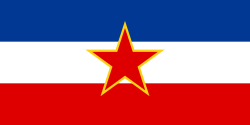
Tito's Partisans liberated Yugoslavia with Allied support and proclaimed the socialist Federal People's Republic of Yugoslavia, in which Serbia was one of six federal republics ruled by the Communist Party.
Image source: Socialist Federal Republic of Yugoslavia
Feb 21, 1974
% complete
The new Yugoslav constitution gave Serbia's provinces of Vojvodina and Kosovo near-equal standing with the republics, weakening central authority in Belgrade and fueling Serbian nationalist resentment.
Image source: 1974 Yugoslav Constitution
1987
% complete
Milošević exploited Kosovo grievances to dominate Serbian politics, curbing provincial autonomy in 1989 and championing Serbian nationalism, which accelerated Yugoslavia's disintegration into ethnic conflict.
Image source: Slobodan Milošević
1991 - 2001
% complete
Slovenia, Croatia, Bosnia-Herzegovina, and Macedonia declared independence, leading to devastating wars. Serbia and Montenegro supported Bosnian and Croatian Serbs; sanctions, hyperinflation, and international isolation ravaged the economy.
Image source: Breakup of Yugoslavia
Mar 24, 1999 - Jun 10, 1999
% complete
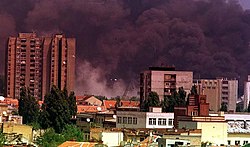
NATO launched a 78-day air campaign against Yugoslavia to halt repression of Albanians in Kosovo, ending with Yugoslav withdrawal and UN administration of Kosovo under Resolution 1244.
Image source: NATO bombing of Yugoslavia
Oct 5, 2000
% complete
Mass protests in Belgrade forced Milošević to concede defeat to Vojislav Koštunica in presidential elections, opening the way for democratic reforms and eventual extradition of Milošević to The Hague.
Image source: Overthrow of Slobodan Milošević
Feb 4, 2003 - Jun 3, 2006
% complete
Federal Yugoslavia was reconstituted as the loose union of Serbia and Montenegro, which lasted until Montenegro's referendum for independence dissolved the union in June 2006.
Image source: Serbia and Montenegro
Feb 17, 2008
% complete
Kosovo unilaterally declared independence from Serbia, which rejected the move. The dispute remains unresolved, though many countries including the United States and most EU members recognize Kosovo.
Image source: 2008 Kosovo declaration of independence
Mar 1, 2012
% complete
The European Council granted Serbia official EU candidate status, rewarding progress on reform and dialogue with Kosovo, and formalizing Serbia's long-term aspiration to join the European Union.
Image source: Accession of Serbia to the European Union
Jan 21, 2014
% complete
Serbia formally began EU membership negotiations, embarking on extensive legal and institutional reforms required for accession, though progress has been slow amid regional tensions and domestic politics.
Or browse the full history timeline directory, with more than 2,000 topics.
This History of Serbia timeline was generated with the help of AI, using information found on the internet.
We work hard to keep these timelines accurate, but mistakes do get through. If you spot one, email us at [email protected] and we'll fix it for future visitors.
Generate yours with AI or build it from scratch, for free.
Export your timeline, add your own events, edit or remove AI-generated events, and much more
No credit card required.
Cancel anytime.
Cancel anytime.
You can create an unlimited number of timelines with up to 10 events on each one, customize how they look, export them to PDF, PNG, PowerPoint, CSV, and Excel, and share them with a link. Paid plans raise the event limit and add features like spreadsheet imports and collaborators.
Yes. You can cancel your subscription from your account page at any time, and you will not be charged again. Your subscription stays active for the rest of the period you already paid for.
Yes. We will email you a reminder before the annual renewal, and we will also email you a receipt.
Yes. You can email us within 15 days of any payment, and we will issue you a full refund.
Check out our pricing docs or send us an email anytime: [email protected].