-
Use Cases
-
Resources
-
Pricing
The history of the Federal Reserve traces America's central bank from its creation in 1913 following recurring financial panics to its evolution into one of the world's most influential monetary institutions. This timeline covers key legislation, crises, leadership changes, and policy shifts that have shaped U.S. monetary policy over more than a century. More Less
1791 - 1811
% complete
The First Bank of the United States was established with a 20-year charter, serving as the nation's first central bank. Its charter expired in 1811 and was not renewed, leaving the country without a central banking institution.
Image source: First Bank of the United States
1817 - 1836
% complete
The Second Bank of the United States received a 20-year charter in 1817, following the War of 1812. Like its predecessor, it functioned as a quasi-central bank for the young nation until its charter lapsed in 1836.
Image source: Second Bank of the United States
1832
% complete
President Andrew Jackson fiercely opposed rechartering the Second Bank, declaring that 'the many millions which this act proposes to bestow on the stockholders of the existing bank must come directly or indirectly out of the earnings of the American people.'
Mar 1837
% complete
Andrew Jackson's second term in office ended in March 1837 without the Second Bank of the United States' charter being renewed, effectively ending the era of national central banking for decades.
1863
% complete
In 1863, as a means to help finance the Civil War, a system of national banks was instituted by the National Currency Act, creating a uniform national currency backed by government securities.
Image source: National Bank Act
1864
% complete
The National Currency Act was totally revised in 1864 and later named the National-Bank Act, or National Banking Act, as it is popularly known, shaping American banking structure for half a century.
1875 - 1900
% complete
Because of the crescendo effect of banks lending more than their assets could cover, the United States experienced a series of financial panics during the last quarter of the 19th century, exposing weaknesses in the fragmented banking system.
Image source: Panic of 1907
1907
% complete
Prior to a particularly severe panic in 1907, there had been motivation for renewed demands for banking and currency reform. The crisis itself intensified calls across the political spectrum to overhaul the nation's financial architecture.
1910
% complete
The secret participants were trying to plan a mechanism that would correct the weaknesses of the banking system as revealed under the strains and pressures of the panic of 1907, drafting ideas that influenced future legislation.
Image source: Jekyll Island
Nov 1910
% complete
In 1910, Senator Nelson Aldrich met in secret with executives representing the banks of J.P. Morgan on Jekyll Island. Aldrich later admitted he was 'as secretive, indeed, as furtive as any conspirator' during the gathering.
1911 - 1912
% complete
The 1911–12 Republican plan was proposed by Aldrich to solve the banking dilemma, a goal supported by the American Bankers' Association, though it ultimately failed to pass Congress.
Image source: Benjamin Strong Jr.
1912
% complete
Seen as a 'Money Trust' plan, the Aldrich Plan was opposed by the Democratic Party in its 1912 campaign platform, which nevertheless supported revising banking laws to protect the public from panics and the domination of the Money Trust. Democrats took control of the presidency and Congress in the 1912 election.
1913
% complete
Senator Robert Owen of Oklahoma eventually relented to speak in favor of the bill, arguing that the nation's currency was already under too much control by New York elites, who he alleged had singlehandedly conspired to cause the 1907 Panic.
Image source: Robert L. Owen
1913
% complete
To get the Federal Reserve Act passed, Wilson needed the support of populist William Jennings Bryan, who had ensured Wilson's nomination at the 1912 convention and had long championed agrarian causes since his famous 'Cross of Gold Speech' at the 1896 Democratic convention.
Image source: William Jennings Bryan
1913
% complete
Newly elected President Woodrow Wilson was committed to banking and currency reform, but it took a great deal of his political influence to get an acceptable plan passed as the Federal Reserve Act in 1913.
Image source: Woodrow Wilson
Oct 1913
% complete
Ironically, two months before enactment, Frank Vanderlip proposed before the Senate Banking Committee his own competing plan featuring a single central bank controlled by the Federal government, which almost derailed the legislation already passed by the House.
Dec 22, 1913 - Dec 23, 1913
% complete
After months of hearings, amendments, and debates, the Federal Reserve Act passed the Senate on December 23, 1913 — one day after clearing another chamber vote on December 22 — by a vote of 43 to 25, completing its passage through Congress in December 1913.
Dec 23, 1913
% complete
When President Woodrow Wilson signed the Federal Reserve Act on December 23, 1913, he expressed gratitude for having had a part 'in completing a work' of lasting importance, officially creating the Federal Reserve System.
1914
% complete
The 1914 report of the Reserve Bank Organization Committee laid out the rationale for establishing Reserve Bank districts, showing the decisions were based almost entirely upon current correspondent banking relationships.
Image source: Federal Reserve Board of Governors
Nov 1914
% complete
World War I broke out just before the Federal Reserve had finished setting up its 12 Reserve Banks, which opened for business in mid-November 1914, marking the start of operations for America's new central bank.
Image source: Federal Reserve Bank
1915
% complete
Wilson named Paul Warburg and other prominent experts to direct the new system, which began operations in 1915 and played a major role in financing the Allied and American war efforts during World War I.
Image source: Paul Warburg
1916
% complete
Despite meeting in secret from both the public and the government, the importance of the Jekyll Island meeting was revealed three years after the Federal Reserve Act passed, when journalist Bertie Charles Forbes wrote an article about the so-called 'hunting trip.'
Image source: B. C. Forbes
1917 - 1918
% complete
US military spending was massive even before America officially entered World War I in 1917. Federal spending increased fifteen-fold from 1916 to 1918 as the US lent enormous funds to allies and mobilized militarily, with the new Fed facilitating war finance.
Image source: United States home front during World War I
1923
% complete
In 1923, a recession prompted Benjamin Strong, head of the New York Fed, to aggressively use open market operations in purchasing government securities to stem the downturn, pioneering modern monetary policy tools.
1924 - 1927
% complete
The Federal Reserve made substantial open-market purchases in 1924 and 1927, continuing the active use of securities transactions to manage credit conditions in the booming 1920s economy.
Image source: Open market operation
1928
% complete
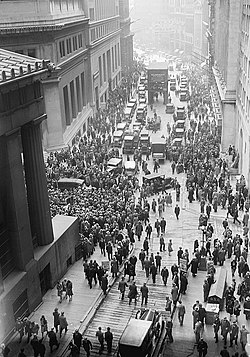
As a stock market bubble became apparent, the Federal Reserve increased discount rates, sold securities, and set guidelines prohibiting banks that made stock market loans from borrowing from the Fed.
Image source: Wall Street Crash of 1929
1956
% complete
The Bank Holding Company Act of 1956 named the Federal Reserve as the regulator of bank holding companies that owned more than one bank, expanding the Fed's supervisory role.
Image source: Bank holding company
1978
% complete
The Humphrey-Hawkins Act of 1978 required the Fed chairman to report to Congress regularly, formalizing congressional oversight of monetary policy goals including employment and price stability.
Image source: Humphrey–Hawkins Full Employment Act
Jul 1979
% complete
In July 1979, President Jimmy Carter nominated Paul Volcker as Chairman of the Federal Reserve Board amid roaring double-digit inflation, tasking him with restoring price stability.
Image source: Paul Volcker
Oct 1979
% complete
In October 1979, the Federal Reserve announced a policy of targeting money aggregates and bank reserves in its struggle with double-digit inflation. Volcker tightened the money supply, and by 1986 inflation had fallen sharply.
Image source: Paul Volcker
Jan 1987
% complete
With retail inflation at only 1%, the Federal Reserve announced it would no longer use money-supply aggregates such as M2 as guidelines for controlling inflation, ending the approach used since 1979. Before 1980, interest rates had been used as guidelines during severe inflation.
Aug 1987
% complete
Paul Volcker served as chairman until August 1987, whereupon Alan Greenspan assumed the mantle, seven months after monetary aggregate policy had changed, beginning a long era of Fed leadership focused on interest rate management.
Image source: Alan Greenspan
2001 - Jun 2003
% complete
From early 2001 to mid-2003, the Federal Reserve lowered interest rates 13 times, from 6.25% to 1.00%, to fight recession. Rates were cut to 1.75% in November 2002, with many rates falling below inflation, and on June 25, 2003 the federal funds rate reached 1.00%, its lowest nominal level since July 1958.
Jun 2004 - 2006
% complete
Starting at the end of June 2004, the Federal Reserve raised the target federal funds rate and continued doing so 17 more times, gradually normalizing rates from historic lows.
Image source: History of Federal Open Market Committee actions
Feb 2006
% complete
In February 2006, President George W. Bush appointed Ben Bernanke as chairman of the Federal Reserve, succeeding Alan Greenspan just as housing market stresses were building.
Mar 2006
% complete
In March 2006, the Federal Reserve ceased making public the M3 money supply measure, because the costs of collecting this data outweighed the benefits.
Image source: Money supply
Sep 2007
% complete
Due to a credit crunch caused by the subprime mortgage crisis in September 2007, the Federal Reserve deployed broad-based programs and assisted individual institutions to stabilize financial markets.
Image source: Subprime mortgage crisis
Dec 11, 2007
% complete
After its December 11, 2007 meeting, the Fed began cutting the federal funds rate by only 0.25%, disappointing investors who expected a bigger cut; the Dow Jones Industrial Average dropped nearly 300 points that day.
Image source: Federal funds rate
Jan 22, 2008 - Jan 30, 2008
% complete
The Fed slashed the rate by 0.75% in an emergency action on January 22, 2008 to reverse a significant market slide influenced by weakening international markets, then lowered rates again by 0.50% eight days later on January 30, 2008.
Image source: 2007–2008 financial crisis
Dec 2008 - Dec 2015
% complete
Zero interest-rate policy ran from December 2008 to December 2015, as the Federal Reserve held rates near zero for seven years in response to the global financial crisis and slow recovery.
Image source: Zero interest-rate policy
Aug 25, 2009
% complete
On August 25, 2009, President Barack Obama announced he would nominate Ben Bernanke to a second term as chairman of the Federal Reserve, citing his leadership through the financial crisis.
Image source: Ben Bernanke
Oct 2013
% complete
In October 2013, President Obama nominated Janet Yellen to succeed Ben Bernanke as chairman of the Federal Reserve, making her the first woman to lead the institution when confirmed.
Image source: Janet Yellen
2017 - Sep 2019
% complete
The Federal Reserve conducted quantitative tightening from 2017 to September 2019, shrinking its balance sheet accumulated during the post-crisis quantitative easing programs.
Image source: Quantitative tightening
Mar 2020
% complete
The Federal Reserve attempted to counteract COVID's economic effects with a return to zero interest-rate policy and quantitative easing in March 2020, flooding markets with liquidity to support the economy.
Image source: COVID-19 pandemic
Mar 2022 - Jul 2023
% complete
Interest rates rose from March 2022 to July 2023 as the Fed transitioned back to quantitative tightening in June 2022, but inflation surged over 22% due to lack of Federal Reserve control over pricing power in the U.S. economy.
Image source: 2021–2023 inflation surge
1929
% complete
The Great Depression started in 1929 as a result of this monetary contraction; however, the Federal Reserve took basically no action, a failure widely criticized as worsening the economic catastrophe.
Image source: Great Depression
1933
% complete
In reaction to the Great Depression, Congress passed the Glass-Steagall Act in 1933, established the FDIC to insure bank deposits, and required bank holding companies to be examined by the Federal Reserve.
Image source: Glass–Steagall legislation
Apr 1933
% complete
Roosevelt issued Executive Order 6102 in 1933, outlawing the holding of more than $100 of gold or gold certificates among other related decrees, fundamentally changing the monetary gold framework underlying the dollar.
Image source: Executive Order 6102
1935
% complete
The Banking Act of 1935 created the Federal Open Market Committee along with restructuring the Federal Reserve, establishing its modern institutional structure that persists today.
Image source: Banking Act of 1935
1946
% complete
After WWII, the Employment Act of 1946 added the goal of maximum employment as a responsibility of the Federal Reserve, expanding its mandate beyond price stability.
1947 - 1950
% complete
The Fed continued to support government borrowing after the war ended, despite CPI rising 14% in 1947 and 8% in 1948 while the economy was in recession. In 1948, Truman replaced Chairman Marriner Eccles with Thomas B. McCabe, deepening tensions over monetizing the deficit.
Mar 1951
% complete
The reluctance of the Federal Reserve to continue monetizing the deficit grew so great that President Truman invited the entire FOMC to the White House, resulting in the 1951 Accord between the Treasury and the Fed, freeing the Fed to pursue independent monetary policy.
Or browse the full history timeline directory, with more than 2,000 topics.
This History of the Federal Reserve timeline was generated with the help of AI, using information found on the internet.
We work hard to keep these timelines accurate, but mistakes do get through. If you spot one, email us at [email protected] and we'll fix it for future visitors.
Generate yours with AI or build it from scratch, for free.
Export your timeline, add your own events, edit or remove AI-generated events, and much more
No credit card required.
Cancel anytime.
Cancel anytime.
You can create an unlimited number of timelines with up to 10 events on each one, customize how they look, export them to PDF, PNG, PowerPoint, CSV, and Excel, and share them with a link. Paid plans raise the event limit and add features like spreadsheet imports and collaborators.
Yes. You can cancel your subscription from your account page at any time, and you will not be charged again. Your subscription stays active for the rest of the period you already paid for.
Yes. We will email you a reminder before the annual renewal, and we will also email you a receipt.
Yes. You can email us within 15 days of any payment, and we will issue you a full refund.
Check out our pricing docs or send us an email anytime: [email protected].