-
Use Cases
-
Resources
-
Pricing
The Grand Canyon, one of the world's most iconic natural wonders, was carved by the Colorado River over millions of years. Its history spans ancient geological formation, thousands of years of Native American habitation by tribes such as the Havasupai and Hopi, European exploration beginning with Spanish conquistadors in 1540, American expeditions led by John Wesley Powell in 1869, and its protection as a National Park in 1919 under President Woodrow Wilson. More Less
10500 BC
% complete
Clovis and Folsom Paleo-Indian hunters occupied the Grand Canyon region more than 10,000 years ago, leaving behind stone tools and evidence of big-game hunting near the canyon's rim and river corridors.
Image source: Paleo-Indians
2000 BC - 1000 BC
% complete
Archaic peoples living in the canyon crafted distinctive split-twig figurines, often shaped like deer or bighorn sheep, from single willow twigs; hundreds have been found in canyon caves such as those at Walhalla Glades and Stanton's Cave.
Image source: Split-twig figurine
500 AD - 1300
% complete
Ancestral Puebloan farmers built dwellings and granaries along the canyon rims and within side canyons, growing corn, beans, and squash. Notable sites include Tusayan Ruin on the South Rim and granaries at Nankoweap Creek.
Image source: Ancestral Puebloans
700 AD - 1150
% complete
The Cohonina people inhabited the area around the western Grand Canyon, particularly near the Coconino Plateau, leaving behind pottery, lithic scatters, and rock art before their apparent disappearance around AD 1150, likely due to drought.
1300
% complete
The Havasupai ('people of the blue-green water') settled Cataract (Havasu) Canyon, a tributary of the Grand Canyon, farming its fertile floodplain and living beside the famous turquoise waterfalls for centuries.
Image source: Havasupai
1300
% complete
Following the departure of the Ancestral Puebloans, ancestors of the Havasupai, Hualapai, and Southern Paiute peoples moved into and around the canyon, developing lifeways adapted to the canyon environment that continue today.
Image source: Southern Paiute people
1975
% complete
The 1975 enlargement legislation restored about 185,000 acres of ancestral land to the Havasupai Tribe, correcting decades of dispossession and expanding their reservation to include the plateau above Havasu Canyon.
Image source: Havasupai Indian Reservation
Sep 1540
% complete
Sent by Francisco Vázquez de Coronado, García López de Cárdenas and his men became the first Europeans to see the Grand Canyon, viewing it from the South Rim but failing to reach the Colorado River below.
Image source: García López de Cárdenas
1776
% complete
Franciscan missionaries Francisco Atanasio Domínguez and Silvestre Vélez de Escalante led an expedition that crossed the Colorado River upstream of the Grand Canyon at the Crossing of the Fathers, providing some of the earliest European descriptions of the region.
Image source: Domínguez–Escalante expedition
1826 - 1827
% complete
American fur trapper James Ohio Pattie led one of the first American expeditions down parts of the Colorado River through the canyon country, though his account exaggerated the navigability of the river's rapids.
Image source: James Ohio Pattie
1851 - 1852
% complete
Captain Lorenzo Sitgreaves led a U.S. Army topographical survey across northern Arizona, providing early scientific documentation of the region south of the Grand Canyon following the Mexican–American War and the Treaty of Guadalupe Hidalgo.
Image source: Sitgreaves Expedition
1853 - 1854
% complete
Lieutenant Amiel Weeks Whipple led a Pacific Railroad survey route along the 35th parallel south of the Grand Canyon, gathering geographic and scientific data that aided future exploration of the region.
Image source: Circles of latitude between the 30th parallel north and the 35th parallel north
1858
% complete
Lieutenant Joseph Christmas Ives' expedition aboard the steamboat Explorer ascended the Colorado River and traveled overland to become the first party of European descent to reach the bottom of the Grand Canyon via Diamond Creek.
May 24, 1869 - Aug 30, 1869
% complete
One-armed Civil War veteran John Wesley Powell led a nine-man crew in wooden boats from Green River, Wyoming through the canyons of the Green and Colorado Rivers, completing the first recorded passage through the Grand Canyon despite losing boats, supplies, and three men who abandoned the trip.
Image source: Powell Geographic Expedition of 1869
1870 - 1890
% complete
Prospectors staked claims throughout the canyon seeking copper, lead, zinc, asbestos, and even silver, but most mines proved unprofitable. Remnants include the Last Chance Mine and trails such as the New Hance Trail built by prospector John Hance.
Image source: Grand Canyon
1871 - 1872
% complete
Powell's second expedition made detailed maps, photographs, and scientific observations of the Grand Canyon region, including the first accurate survey of the canyon and important ethnographic work among Indigenous communities.
1875
% complete
Powell's account of his expeditions captivated the American public and brought national attention to the grandeur of the Grand Canyon, stimulating tourism and scientific interest in the region.
1884
% complete
Former miner John Hance built a cabin near the South Rim, constructed the Old Hance Trail into the canyon, and began guiding visitors, becoming celebrated as the Grand Canyon's first tourist entrepreneur and permanent non-Native resident.
Image source: John Hance
1901
% complete
The Atchison, Topeka and Santa Fe Railway completed a spur line from Williams, Arizona to the South Rim, dramatically increasing visitation and spurring development of hotels and services at Grand Canyon Village.
Image source: Grand Canyon Railway
Jan 1905
% complete
The Fred Harvey Company opened the elegant El Tovar Hotel just steps from the South Rim, designed by architect Charles Whittlesey, establishing luxury tourism at the canyon and hosting presidents and celebrities.
Image source: El Tovar Hotel
Nov 28, 1906
% complete
Roosevelt designated over 1,800 square miles surrounding the canyon as a federal game preserve, an early step in his campaign to protect the canyon, famously urging Americans: 'Leave it as it is... keep it for your children and your children's children.'
Image source: Grand Canyon National Park
1908
% complete
Federal lands on the Kaibab Plateau north of the canyon were consolidated into the Kaibab National Forest, protecting forests and wildlife habitat adjacent to the monument lands.
Image source: Kaibab National Forest
Jan 11, 1908
% complete
Using the Antiquities Act, Roosevelt proclaimed over 800,000 acres of the canyon a national monument after Congress repeatedly declined to make it a national park, shielding it from mining and commercial exploitation pending full park status.
Image source: Grand Canyon National Park
Feb 26, 1919
% complete
After years of advocacy, Congress passed legislation signed by President Woodrow Wilson creating Grand Canyon National Park, protecting roughly 1,900 square miles encompassing much of the canyon's length within Arizona.
1922
% complete
Architect Mary Colter designed Phantom Ranch at the confluence of Bright Angel Creek and the Colorado River, creating rustic overnight accommodations accessible only by foot, mule, or raft.
Image source: Phantom Ranch
1932
% complete
Fred Harvey architect Mary Jane Colter completed the 70-foot Desert View Watchtower on the South Rim, inspired by ancestral Puebloan architecture and decorated inside with murals by Hopi artist Fred Kabotie.
Image source: Desert View Watchtower
1933 - 1942
% complete
CCC enrollees built trails, walls, buildings, and roads throughout the park during the Great Depression, including major improvements to the North Rim facilities and trail systems still used by millions today.
Image source: Civilian Conservation Corps
1936
% complete
Completion of Hoover Dam downstream regulated the lower Colorado River, reducing the catastrophic floods that historically reshaped the canyon's rapids and marking the beginning of large-scale river engineering affecting the Grand Canyon ecosystem.
Image source: Hoover Dam
Jun 30, 1956
% complete
Two airliners collided above the canyon, killing all 128 people aboard—the deadliest commercial aviation disaster in America at the time. The tragedy spurred creation of the modern air traffic control system and FAA oversight.
Image source: 1956 Grand Canyon mid-air collision
1963 - 1968
% complete
Proposals by the Bureau of Reclamation to build hydroelectric dams in Marble and Bridge Canyons sparked fierce opposition led by conservationists including David Brower and the Sierra Club; the dams were defeated when Congress rejected funding in 1968, a landmark victory for the environmental movement.
Image source: Marble Canyon
1963 - 1966
% complete
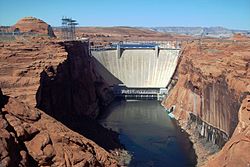
Glen Canyon Dam, just upstream of the park, impounded Lake Powell, permanently changing the temperature, sediment load, and flow regime of the Colorado River entering the Grand Canyon, transforming its aquatic ecosystems and sandbar dynamics.
Image source: Glen Canyon Dam
Jan 3, 1975
% complete
Signed by President Gerald Ford, the act nearly doubled the park's size to over 1.2 million acres, incorporating Grand Canyon National Monument, Marble Canyon National Monument, and portions of Lake Mead National Recreation Area and Havasupai lands.
Oct 26, 1979
% complete
The United Nations Educational, Scientific and Cultural Organization inscribed Grand Canyon National Park on the World Heritage List, recognizing its outstanding universal value for both geology and natural beauty.
Image source: List of World Heritage Sites in the United States
1996
% complete
Following the landmark 1992 Grand Canyon Protection Act, court decisions and scientific programs forced adaptive management of Glen Canyon Dam releases, including experimental controlled floods to rebuild beaches and protect native fish like the humpback chub.
Image source: Glen Canyon Dam
Mar 20, 2007
% complete
The Hualapai Tribe opened a horseshoe-shaped glass skywalk extending 70 feet beyond the rim of the canyon's west end on tribal land, drawing international attention and new tourism revenue for the tribe.
Image source: Grand Canyon Skywalk
Or browse the full history timeline directory, with more than 2,000 topics.
This History of the Grand Canyon timeline was generated with the help of AI, using information found on the internet.
We work hard to keep these timelines accurate, but mistakes do get through. If you spot one, email us at [email protected] and we'll fix it for future visitors.
Generate yours with AI or build it from scratch, for free.
Export your timeline, add your own events, edit or remove AI-generated events, and much more
No credit card required.
Cancel anytime.
Cancel anytime.
You can create an unlimited number of timelines with up to 10 events on each one, customize how they look, export them to PDF, PNG, PowerPoint, CSV, and Excel, and share them with a link. Paid plans raise the event limit and add features like spreadsheet imports and collaborators.
Yes. You can cancel your subscription from your account page at any time, and you will not be charged again. Your subscription stays active for the rest of the period you already paid for.
Yes. We will email you a reminder before the annual renewal, and we will also email you a receipt.
Yes. You can email us within 15 days of any payment, and we will issue you a full refund.
Check out our pricing docs or send us an email anytime: [email protected].