-
Use Cases
-
Resources
-
Pricing
The Sahara Desert, the world's largest hot desert, has undergone dramatic transformations over millions of years. Once a fertile savanna teeming with life, it gradually became the vast arid expanse we know today. Its history includes ancient human settlements, rock art civilizations, trans-Saharan trade empires, and ongoing environmental changes that continue to shape North Africa's landscape and peoples. More Less
12500 BCE
% complete
Moister Saharan conditions began about 12,500 BCE, as the Intertropical Convergence Zone extended northward during northern hemisphere summers, bringing wet conditions and a savanna climate to the Sahara. Apart from a short dry spell associated with the Younger Dryas, these conditions peaked during the Holocene thermal maximum around 4000 BCE.
8000 BCE - 6000 BCE
% complete
The end of the glacial period brought more rain to the Sahara from about 8000 BCE to 6000 BCE, perhaps because of low pressure areas over the collapsing ice sheets to the north, transforming the desert into a greener landscape capable of supporting life.
6000 BCE - 2500 BCE
% complete
It has been proposed that humans accelerated the drying-out period from 6000 to 2500 BCE, as pastoralists overgrazed the available grassland, contributing to the Sahara's desertification alongside natural climate change.
5000 BCE
% complete
Sometime before 5000 BCE, Lake Mega-Chad reached its largest extent. It was the largest of four Saharan paleolakes and is estimated to have covered an area of 350,000 km2, dwarfing today's Lake Chad.
Image source: Lake Chad
4200 BCE
% complete
By around 4200 BCE, the monsoon retreated south to approximately where it is today, leading to the gradual desertification of the Sahara and ending thousands of years of humid conditions.
Image source: African humid period
4000 BCE
% complete
The moist Saharan climate peaked during the Holocene thermal maximum at 4000 BCE, when mid-latitude temperatures seem to have been between 2 and 3 degrees warmer than in the recent past, sustaining the green Sahara.
3400 BCE
% complete
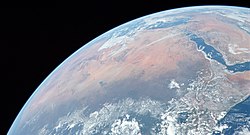
By 3400 BCE, the Sahara was as dry as it is today, due to reduced precipitation and higher temperatures resulting from a shift in Earth's orbit, completing its transformation into the world's largest hot desert.
Image source: Sahara
2700 BCE - 2100 BCE
% complete
The desertification of the Sahara is linked to a marked decline in the scale of the Nile floods between 2700 and 2100 BCE, as reduced rainfall across North Africa diminished the river's flow.
Image source: Nile
Feb 1979
% complete
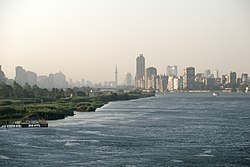
One of the rare instances of snowfall in the Sahara occurred in February 1979 in the town of Ain Sefra, Algeria, known as the gateway to the desert — an extraordinary event in one of Earth's hottest regions.
1981
% complete
The idea that changes in insolation caused by long-term changes in Earth's orbit are a controlling factor for monsoon patterns was first suggested by Rudolf Spitaler in the late nineteenth century and formally proposed and tested by meteorologist John Kutzbach in 1981. The hypothesis was later named the 'Orbital Monsoon Hypothesis' by Ruddiman in 2001.
Dec 2016
% complete
Snowfall was recorded again in December 2016 in Ain Sefra, Algeria, delighting observers worldwide as images of sand dunes dusted with snow circulated globally.
Image source: Aïn Séfra
9500 BCE
% complete
During the Neolithic Era, before the onset of desertification around 9500 BCE, the central Sudan had been a rich environment supporting a large population ranging across what is now barren desert, including the Wadi el-Qa'ab region.
6000 BCE
% complete
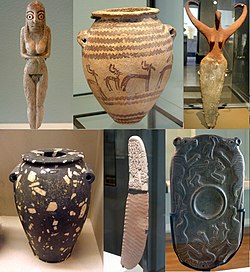
By 6000 BCE, predynastic Egyptians in the southwestern corner of Egypt were herding cattle and constructing large buildings, taking advantage of the still-fertile Saharan environment.
Image source: Prehistoric Egypt
5000 BCE - 2700 BCE
% complete
Uan Muhuggiag, a rock shelter in Libya, appears to have been inhabited from at least the 6th millennium BCE to about 2700 BCE, although not necessarily continuously, serving as home to Saharan pastoral peoples.
4700 BCE
% complete
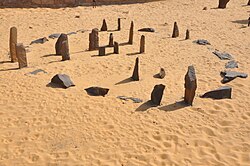
Archaeologist Fekri Hassan indicated in 2002 that the megalithic monuments in the Saharan region of Niger and the Eastern Sahara, which developed as early as 4700 BCE, may have served as antecedents for the mastabas and pyramids of ancient Egypt.
Image source: Nabta Playa
4600 BCE
% complete
The post-Kiffian desiccation lasted until around 4600 BCE, when the earliest artefacts associated with the Tenerians have been dated, marking a new chapter of human occupation at the Gobero site in Niger's Ténéré Desert.
Image source: Gobero
4000 BCE
% complete
In 4000 BCE, sophisticated social structures, such as the trade of cattle as valued assets, developed among herders amid the Pastoral Period of the Sahara, marking an important stage in the region's economic history.
Image source: Pastoral period
3300 BCE
% complete
The most interesting find at Gobero is a triple burial, dated to 5300 years ago (around 3300 BCE), of an adult female and two children, estimated through their teeth as being five and eight years old, hugging each other.
2200 BCE - 200 BCE
% complete
The Tichitt Tradition of eastern Mauritania dates from 2200 BCE to 200 BCE, representing one of the oldest known urbanized societies in West Africa, with stone-built settlements along escarpments.
Image source: Tichitt tradition
1800 BCE
% complete
By 1800 BCE, Saharan pastoral culture expanded throughout the Saharan and Sahelian regions, spreading herding lifeways across a vast area even as the desert grew more arid.
1300 BCE - 400 BCE
% complete
After its decline in Mauritania, the Tichitt Tradition spread to the Middle Niger region of Mali, where it developed into and persisted as Faïta Facies ceramics between 1300 BCE and 400 BCE, alongside rammed earth architecture and iron metallurgy which developed after 900 BCE.
2018
% complete
A 2018 study on the epipalaeolithic Taforalt remains from Morocco identified Y-DNA haplogroup EM35 common in northeastern Africa but characterised mtDNA haplogroups U6 and M1 as 'Eurasian', questioning this classification given their localised, long-established presence in ancient African populations.
Image source: Taforalt
2025
% complete
A 2025 study sequenced individuals from Takarkori (7,000 years ago) and discovered that most of their ancestry came from an unknown ancestral North African lineage, related to the African admixture component found in Iberomaurusians, reshaping understanding of Saharan population history.
Image source: Takarkori
1200 BCE - 800 BCE
% complete
The people of Phoenicia, who flourished from 1200 to 800 BCE, created a chain of settlements along the coast of North Africa and traded extensively with the Sahara's inhabitants, linking the desert to Mediterranean commerce.
Image source: Phoenicia
500 BC
% complete
The Periplus of the Phoenician navigator Hanno, who lived sometime in the 5th century BCE, claims that he founded settlements along the Atlantic coast of Africa, possibly including the Western Sahara.
100 BCE - 300
% complete
Between the first century BCE and the fourth century CE, several Roman expeditions into the Sahara were conducted by groups of military and commercial units of Romans, probing deep into the desert for trade routes and exploration.
Image source: Romans in sub-Saharan Africa
400 - 700
% complete
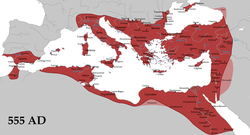
The Byzantine Empire ruled the northern shores of the Sahara from the 5th to the 7th centuries, controlling the coastal fringe between the Mediterranean and the great desert before the Arab conquests.
Image source: Byzantine Empire
650 - 750
% complete
After the Muslim conquest of Arabia, specifically the Arabian peninsula, the Muslim conquest of North Africa began in the mid-7th to early 8th centuries, and Islamic influence expanded rapidly on the Sahara, reshaping the region's culture and politics.
Image source: Muslim conquest of the Maghreb
900 - 1900
% complete
It has been estimated that from the 10th to 19th centuries some 6,000 to 7,000 slaves were transported north each year across the Sahara, forming a tragic component of the trans-Saharan trade networks.
Image source: Trans-Saharan slave trade
1500 - 1600
% complete
In the 16th century the northern fringe of the Sahara, such as coastal regencies in present-day Algeria and Tunisia, as well as some parts of present-day Libya, together with the semi-autonomous kingdom of Egypt, were occupied by the Ottoman Empire.
Image source: Ottoman Empire
1517
% complete
From 1517 Egypt was a valued part of the Ottoman Empire, ownership of which provided the Ottomans with control over the Nile Valley, the east Mediterranean and North Africa.
Image source: Ottoman Egypt
1600 - 1700
% complete
After the Char Bouba war of the 17th century, the Beni Ḥassān and other nomadic Arab tribes dominated the Sanhaja Berber tribes of the western Sahara, reshaping the social hierarchy of the region.
Image source: Char Bouba war
1900
% complete
By the beginning of the 20th century, the trans-Saharan trade had clearly declined because goods were moved through more modern and efficient means, such as airplanes, rather than across the desert by camel caravan.
Image source: Trans-Saharan trade
1933
% complete
A remarkable film shot by famous aviator Captain René Wauthier in 1933 documents the first crossing by a large truck convoy from Algiers to Tchad across the Sahara, heralding a new age of mechanized desert travel.
1936
% complete
Egypt became independent of Britain in 1936, although the Anglo-Egyptian treaty allowed Britain to keep troops in Egypt and maintain the British-Egyptian condominium in the Sudan.
Image source: Anglo-Egyptian treaty of 1936
1951 - 1962
% complete
Most of the Saharan states achieved independence after World War II: Libya in 1951; Morocco, Sudan, and Tunisia in 1956; Chad, Mali, Mauritania, and Niger in 1960; and Algeria in 1962.
Image source: Decolonisation of Africa
1954
% complete
British military forces were withdrawn from Egypt in 1954, marking the end of direct British military presence and paving the way for full Egyptian sovereignty.
Image source: History of Egypt under the British
1975
% complete
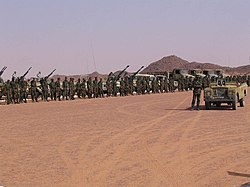
Spain withdrew from Western Sahara in 1975, and the territory was partitioned between Mauritania and Morocco, igniting a long-running conflict over its status.
Image source: Western Sahara conflict
1979
% complete
Mauritania withdrew from Western Sahara in 1979, leaving Morocco to continue holding the entire disputed territory, a situation persisting into the modern era.
2012
% complete
Tuareg people in Mali rebelled several times during the 20th century before finally forcing the Malian armed forces to withdraw below the line demarcating Azawad from southern Mali during the 2012 rebellion.
Image source: Tuareg rebellion (2012)
1820 - 1823
% complete
Egypt, under Muhammad Ali and his successors, conquered Nubia in 1820–22 and founded Khartoum in 1823, extending Egyptian control southward along the Nile toward the Saharan interior.
Image source: Muhammad Ali dynasty
1830
% complete
European colonialism in the Sahara began in the 19th century when France conquered the regency of Algiers from the Ottomans in 1830, after which French rule spread south from French Algeria and eastwards from Senegal into the upper Niger.
Image source: French conquest of Algeria
1868
% complete
To promote the Roman Catholic religion in the desert, Pope Pius IX appointed a delegate Apostolic of the Sahara and the Sudan in 1868; later in the 19th century his jurisdiction was reorganized into the Vicariate Apostolic of Sahara.
Image source: Diocese of Laghouat
1874
% complete
Spain captured present-day Western Sahara after 1874, although Rio del Oro remained largely under Sahrawi influence, beginning decades of Spanish colonial presence in the territory.
Image source: Spanish West Africa
1881 - 1912
% complete
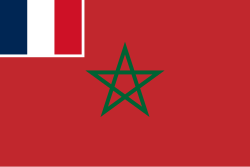
French colonial expansion across the Sahara included Tunisia in 1881 and Morocco in 1912, completing French dominance over much of the northern and western Sahara alongside its West African territories.
Image source: French protectorate in Morocco
1882 - 1898
% complete
Egypt and Britain lost control of the Sudan from 1882 to 1898 as a result of the Mahdist War, in which Mahdist forces established an independent state before being defeated by Anglo-Egyptian troops.
Image source: Mahdist War
1882
% complete
Egypt, including Sudan, became a British protectorate in 1882, bringing much of the Nile Valley and adjacent Saharan lands under British imperial administration.
Image source: Sultanate of Egypt
1893
% complete
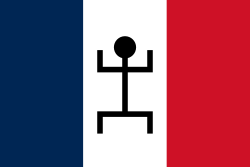
As French rule spread eastwards from Senegal into the upper Niger, France captured Timbuktu in 1893, incorporating it into French Sudan as colonial powers carved up the Sahara and the Sahel.
Image source: French Sudan
1898
% complete
After its capture by British troops in 1898, the Sudan became an Anglo-Egyptian condominium, jointly administered by Britain and Egypt until Sudanese independence decades later.
Image source: Anglo-Egyptian Sudan
1902
% complete
In 1902, the French penetrated the Hoggar Mountains and defeated the Ahaggar Tuareg at the battle of Tit, breaking Tuareg resistance and consolidating French control over the central Sahara.
Image source: Tit, Tamanrasset
1912
% complete
In 1912, Italy captured parts of what was to be named Libya from the Ottomans, establishing Italian colonial rule over the Saharan territory following the Italo-Turkish War.
Image source: Italian colonization of Libya
Or browse the full history timeline directory, with more than 2,000 topics.
This History of the Sahara Desert timeline was generated with the help of AI, using information found on the internet.
We work hard to keep these timelines accurate, but mistakes do get through. If you spot one, email us at [email protected] and we'll fix it for future visitors.
Generate yours with AI or build it from scratch, for free.
Export your timeline, add your own events, edit or remove AI-generated events, and much more
No credit card required.
Cancel anytime.
Cancel anytime.
You can create an unlimited number of timelines with up to 10 events on each one, customize how they look, export them to PDF, PNG, PowerPoint, CSV, and Excel, and share them with a link. Paid plans raise the event limit and add features like spreadsheet imports and collaborators.
Yes. You can cancel your subscription from your account page at any time, and you will not be charged again. Your subscription stays active for the rest of the period you already paid for.
Yes. We will email you a reminder before the annual renewal, and we will also email you a receipt.
Yes. You can email us within 15 days of any payment, and we will issue you a full refund.
Check out our pricing docs or send us an email anytime: [email protected].