-
Use Cases
-
Resources
-
Pricing
HMS Victory is a 104-gun first-rate ship of the line of the Royal Navy, best known as Vice-Admiral Horatio Nelson's flagship at the Battle of Trafalgar in 1805. Launched in 1765, she played a decisive role in British naval history and is now preserved in Portsmouth as the world's oldest naval ship still in commission. More Less
1756 - 1763
% complete
The Seven Years' War placed enormous demands on the Royal Navy, highlighting the need for powerful first-rate ships of the line. This strategic pressure led to the design and ordering of HMS Victory at Chatham Dockyard.
Image source: Seven Years' War
Jul 3, 1758
% complete
The Admiralty approved the construction of twelve new first-rate ships, including what would become HMS Victory, designed by naval architect Sir Thomas Slade as a 100-gun ship of the line.
Image source: HMS Victory
Jul 23, 1759
% complete
The keel of HMS Victory was laid down at Chatham Dockyard on Old Single Dock, beginning one of the most famous warships ever constructed in Britain. Around 6,000 trees were used to build her oak hull.
Image source: Chatham Dockyard
May 7, 1765
% complete
HMS Victory was launched from Chatham Dockyard after six years of construction. She was fitted out and masted before being placed in ordinary (reserve) due to the end of the Seven Years' War.
1788 - 1793
% complete
Between 1788 and 1793 Victory underwent extensive repairs and modernisation at Chatham, emerging as a 104-gun first rate with improved copper sheathing and updated armament.
Feb 6, 1778
% complete
France's entry into the American Revolutionary War brought Britain into a wider conflict, prompting the Royal Navy to commission ships like HMS Victory for active service.
Image source: Anglo-French War (1778–1783)
Mar 1778
% complete
HMS Victory was commissioned into active service with Captain John Lindsay in command, later serving as flagship to Admiral Augustus Keppel, commander of the Channel Fleet.
Jul 27, 1778
% complete
Flying Keppel's flag, HMS Victory fought in an inconclusive engagement against a French fleet off Ushant. The battle sparked controversy over command decisions that led to courts-martial of British officers.
Image source: Battle of Ushant (1778)
1780 - 1781
% complete
During the crisis with Spain over Gibraltar, Victory served as flagship in the Channel Fleet, helping deter a potential Franco-Spanish invasion attempt against Britain.
Oct 20, 1782
% complete
Under Admiral Richard Kempenfelt, Victory participated in the indecisive action off Cape Spartel against a combined Franco-Spanish fleet escorting supply convoys toward Gibraltar.
Image source: Battle of Cape Spartel
Feb 1, 1793
% complete
Revolutionary France declared war on Britain, beginning more than two decades of near-continuous naval warfare in which HMS Victory would play a central role.
Image source: War of the First Coalition
Apr 1793 - 1795
% complete
As flagship of Admiral Lord Hood, Victory led operations in the Mediterranean, including the occupation of Toulon and actions along the French coast during the early Revolutionary Wars.
Image source: Samuel Hood, 1st Viscount Hood
Mar 13, 1795
% complete
While serving in the Mediterranean fleet under Vice-Admiral William Hotham, Victory was present during engagements with French fleets in the Ligurian Sea, though she played a limited role.
Image source: Battle of Genoa (1795)
Feb 18, 1800
% complete
Under Captain Thomas Troubridge, Victory helped capture the French 74-gun ship Généreux, a survivor of the Battle of the Nile, off the coast of Sicily.
Image source: French ship Généreux (1785)
Mar 1800 - 1801
% complete
Serving in the Baltic supporting the Northern League against Denmark and Sweden, Victory took part in blockading duties and captured several French vessels, including the Généreux.
Image source: Russian Second League
May 16, 1803
% complete
Britain declared war on France again, and Victory was rapidly recommissioned as flagship of the Mediterranean Fleet under Admiral Lord Nelson, who hoisted his flag aboard on May 20, 1803.
Image source: Napoleonic Wars
May 20, 1803
% complete
Vice-Admiral Horatio Nelson made Victory his flagship and commanded the blockade of Toulon, pursuing the French fleet across the Atlantic and back in a famous chase during 1805.
Image source: Horatio Nelson, 1st Viscount Nelson
Apr 11, 1805 - Aug 20, 1805
% complete
Nelson led Victory and a squadron across the Atlantic to the West Indies chasing Admiral Villeneuve's combined Franco-Spanish fleet, then returned to Europe, foiling Napoleon's invasion plans.
Image source: Trafalgar campaign
Oct 21, 1805
% complete
In Britain's most celebrated naval victory, Nelson's Victory broke the enemy line off Cape Trafalgar, destroying the combined Franco-Spanish fleet. Nelson was mortally wounded by a musket ball and died aboard Victory, uttering 'England expects that every man will do his duty.'
Image source: Battle of Trafalgar
1783 - 1787
% complete
After the end of the American Revolutionary War, Victory was placed in ordinary at Portsmouth, remaining largely inactive until rising tensions with France prompted recommissioning.
Oct 16, 1799
% complete
Returning from the Mediterranean convoy duty, Victory narrowly escaped disaster when she struck rocks near the Scilly Isles; quick action saved the ship, which required temporary repairs.
Image source: Isles of Scilly
Mar 25, 1802
% complete
The short-lived peace between Britain and France saw Victory paid off and placed in reserve, but hostilities resumed in May 1803, returning the veteran ship to front-line duties.
Image source: Treaty of Amiens
Dec 4, 1805
% complete
Badly damaged at Trafalgar, Victory towed by Neptune reached England after a stormy voyage, carrying Nelson's preserved body in a cask of spirits. He received a state funeral in London.
Image source: State funeral of Horatio Nelson
1808 - 1812
% complete
Repaired at Portsmouth, Victory served as flagship of Rear-Admiral James Saumarez in the Baltic, protecting British trade convoys against Danish privateers during the Gunboat War.
Image source: Gunboat War
Nov 1812
% complete
With the Napoleonic wars winding down, Victory was paid off at Portsmouth in December 1812 after 34 years of active service, never again to fire her guns in anger.
1824
% complete
Though still officially in commission, Victory began serving as a harbour ship and flagship for the port admiral at Portsmouth, marking the start of her long ceremonial role.
Image source: Portsmouth
1831
% complete
When the Admiralty ordered Victory broken up, public outcry — famously including a plea attributed to First Sea Lord Sir Thomas Hardy's wife — led to the order being reversed, preserving the ship for posterity.
1903
% complete
A fire caused by a workman's lamp severely damaged parts of Victory while she served as a school and signal training ship at Portsmouth, requiring substantial restoration work.
1922 - 1928
% complete
A national fundraising campaign moved Victory into dry dock No. 2 at Portsmouth and restored her as closely as possible to her Trafalgar-era appearance, completed in time for the centenary in 1928.
Oct 21, 1928
% complete
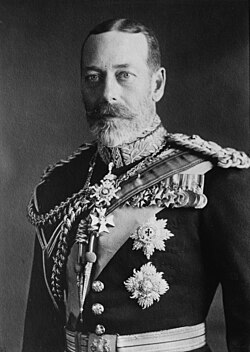
On the anniversary of Trafalgar, King George V formally marked the completion of the restoration by unveiling a plaque commemorating Nelson and the ship's famous victory.
Image source: George V
1941
% complete
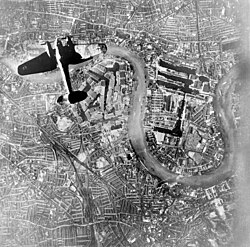
A German bomb dropped during an air raid on Portsmouth struck Victory, damaging part of her structure. Repairs were undertaken after the war to restore the historic ship.
Image source: The Blitz
Jan 2012 - 2026
% complete
Today HMS Victory rests in dry dock at Portsmouth Historic Dockyard as the oldest commissioned warship in the world, undergoing continuous multi-million-pound conservation to preserve her for future generations.
Image source: Portsmouth Historic Dockyard
Or browse the full history timeline directory, with more than 2,000 topics.
This HMS Victory timeline was generated with the help of AI, using information found on the internet.
We work hard to keep these timelines accurate, but mistakes do get through. If you spot one, email us at [email protected] and we'll fix it for future visitors.
Generate yours with AI or build it from scratch, for free.
Export your timeline, add your own events, edit or remove AI-generated events, and much more
No credit card required.
Cancel anytime.
Cancel anytime.
You can create an unlimited number of timelines with up to 10 events on each one, customize how they look, export them to PDF, PNG, PowerPoint, CSV, and Excel, and share them with a link. Paid plans raise the event limit and add features like spreadsheet imports and collaborators.
Yes. You can cancel your subscription from your account page at any time, and you will not be charged again. Your subscription stays active for the rest of the period you already paid for.
Yes. We will email you a reminder before the annual renewal, and we will also email you a receipt.
Yes. You can email us within 15 days of any payment, and we will issue you a full refund.
Check out our pricing docs or send us an email anytime: [email protected].