-
Use Cases
-
Resources
-
Pricing
The Los Angeles Lakers are one of the most storied and successful franchises in NBA history. Originally founded in Minneapolis in 1947, the team moved to Los Angeles in 1960. With legendary players such as George Mikan, Magic Johnson, Kareem Abdul-Jabbar, Shaquille O'Neal, and Kobe Bryant, the Lakers have won 17 NBA championships and built rivalries with the Boston Celtics that define the league's history. More Less
1946
% complete
The franchise that would become the Lakers was founded in 1946 as the Detroit Gems of the National Basketball League. The team struggled in its lone season in Detroit before being purchased and relocated to Minneapolis, where it would take on its iconic name.
Image source: History of the Los Angeles Lakers
1947
% complete
In 1947, the Gems were bought by a group of Minnesota investors and moved to Minneapolis, where they were renamed the Lakers in honor of Minnesota's nickname, the 'Land of 10,000 Lakes.' The team joined the Basketball Association of America (BAA), a forerunner to the NBA.
1958
% complete
The Lakers selected forward Elgin Baylor with the first overall pick in the 1958 NBA draft. Baylor's acrobatic style revolutionized the small forward position, and he won Rookie of the Year while instantly revitalizing the struggling franchise.
Image source: Elgin Baylor
1960
% complete
In 1960, owner Bob Short moved the financially struggling Lakers to Los Angeles, making them the NBA's first West Coast team. The move marked the birth of the Los Angeles Lakers and began the franchise's transformation into a global brand.
1947
% complete
Center George Mikan joined the Lakers in 1947 and became professional basketball's first dominant big man. His scoring prowess and dominance under the basket helped establish the Lakers as a powerhouse and forced rule changes such as the widening of the lane.
Image source: George Mikan
1949
% complete
Led by George Mikan, the Minneapolis Lakers won the 1949 BAA championship, defeating the Washington Capitols. This title marked the beginning of one of the first great dynasties in professional basketball history.
1952 - 1954
% complete
Behind George Mikan, Vern Mikkelsen, Jim Pollard, and Slater Martin, the Minneapolis Lakers won three straight NBA titles from 1952 to 1954, cementing themselves as the NBA's first dynasty. The streak ended with Mikan's retirement due to injuries.
1960
% complete
The Lakers drafted guard Jerry West out of West Virginia University in 1960. West would become one of the greatest players in NBA history, known as 'Mr. Clutch,' and his silhouette later inspired the NBA logo.
Image source: Jerry West
Jul 1968
% complete
The Lakers acquired dominant center Wilt Chamberlain from the Philadelphia 76ers in 1968. Alongside Jerry West and Elgin Baylor, Chamberlain formed one of the most talented trios in league history.
Image source: Wilt Chamberlain
Nov 5, 1971 - Jan 7, 1972
% complete
The 1971–72 Lakers, coached by Bill Sharman and featuring Wilt Chamberlain, Jerry West, and Gail Goodrich, won an unprecedented 33 consecutive games, a record that still stands in major American professional sports.
May 7, 1972
% complete
Capping their historic 69-win season, the Lakers defeated the New York Knicks in five games to win the 1972 NBA championship. It was the franchise's first title since moving to Los Angeles and the first of Jerry West's career.
1979
% complete
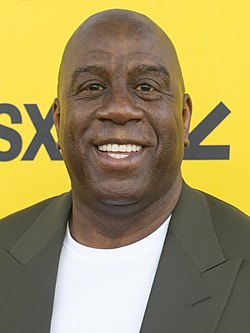
After winning a coin flip with the New Orleans Jazz, the Lakers selected Earvin 'Magic' Johnson Jr. with the first pick of the 1979 NBA draft. Magic's arrival ushered in the fast-paced, flashy era of basketball known as 'Showtime.'
Image source: Magic Johnson
1979
% complete
Dr. Jerry Buss purchased the Lakers, along with the NHL's Los Angeles Kings and The Forum, from Jack Kent Cooke for $67 million in 1979. Buss's vision of entertainment-driven basketball transformed the Lakers into the NBA's marquee franchise.
Image source: Jerry Buss
May 16, 1980
% complete
With Kareem Abdul-Jabbar injured for Game 6, rookie Magic Johnson started at center and scored 42 points to lead the Lakers past the Philadelphia 76ers for the 1980 NBA title. At age 20, Magic became the youngest player ever to win Finals MVP.
Image source: 1980 NBA Finals
Nov 1981
% complete
Pat Riley took over as head coach of the Lakers during the 1981–82 season after Paul Westhead's dismissal. Riley led the team to four championships and became famous for guaranteeing a repeat title in 1987.
Image source: Pat Riley
Apr 5, 1984
% complete
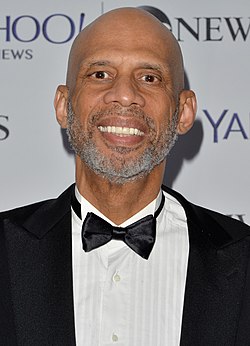
Playing for the Lakers, Kareem Abdul-Jabbar surpassed Wilt Chamberlain's career scoring mark with his signature skyhook against the Utah Jazz. He finished his career with 38,387 points, a record that stood for nearly four decades.
Image source: Kareem Abdul-Jabbar
Jun 1987 - Jun 1988
% complete
The Showtime Lakers, featuring Magic Johnson, Kareem Abdul-Jabbar, and James Worthy, defeated the Boston Celtics in 1987 and the Detroit Pistons in a grueling seven-game 1988 series, becoming the first team in two decades to win consecutive championships.
Image source: 1988 NBA Finals
Nov 7, 1991
% complete
Magic Johnson stunned the world by announcing he had contracted HIV and would retire immediately before the 1991–92 season. He made a brief comeback in 1996 but his initial retirement ended the Showtime era and left the Lakers searching for a new identity.
Feb 1, 2008
% complete
The Lakers acquired Spanish star Pau Gasol from the Memphis Grizzlies in a trade widely praised as a steal. Gasol gave Kobe Bryant the elite supporting piece he needed, and the pair reached three straight NBA Finals.
Image source: Pau Gasol
Jun 14, 2009
% complete
Kobe Bryant captured his first championship without Shaquille O'Neal as the Lakers defeated the Orlando Magic in five games in the 2009 NBA Finals. Bryant was named Finals MVP, silencing critics who questioned whether he could win as the undisputed leader.
Jun 17, 2010
% complete
In a dramatic Game 7 rematch of the storied 2008 Finals, the Lakers beat the Boston Celtics 83–79 to claim their 16th NBA championship. Kobe Bryant won his fifth ring and second consecutive Finals MVP.
Image source: 2010 NBA Finals
Apr 13, 2016
% complete
In his farewell NBA game, Kobe Bryant scored an astonishing 60 points against the Utah Jazz, including the go-ahead basket in the final minute. The performance capped a legendary 20-year career spent entirely with the Lakers.
Image source: Kobe Bryant
Jul 9, 2018
% complete
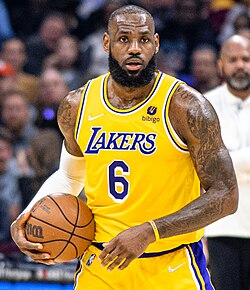
Four-time MVP LeBron James signed a four-year contract with the Lakers, bringing the biggest star in basketball to Los Angeles. His arrival restored the franchise's status as a premier destination and set up a future championship run.
Image source: LeBron James
Jul 6, 2019
% complete
The Lakers landed All-Star big man Anthony Davis from the New Orleans Pelicans in a blockbuster trade involving Lonzo Ball, Brandon Ingram, Josh Hart, and multiple draft picks. Davis and James immediately formed one of the NBA's most feared duos.
Image source: Anthony Davis
Oct 11, 2020
% complete
Played in the isolated 'Bubble' at Walt Disney World following the COVID-19 shutdown, the Lakers defeated the Miami Heat in six games to win their 17th NBA championship, tying the Boston Celtics for the most in league history. It was the franchise's first title since 2010 and came months after Kobe Bryant's death.
Image source: 2020 NBA Finals
Jul 1996
% complete
As a free agent, superstar center Shaquille O'Neal signed with the Lakers in the summer of 1996. Paired soon after with rookie Kobe Bryant, O'Neal formed the core of the Lakers' next great run of dominance.
Image source: Shaquille O'Neal
Jul 1, 1996
% complete
The Charlotte Hornets selected 17-year-old Kobe Bryant 13th overall in the 1996 NBA draft and traded him to the Lakers for Vlade Divac. Bryant would spend his entire 20-year career in purple and gold, becoming a Lakers legend.
Jun 1999
% complete
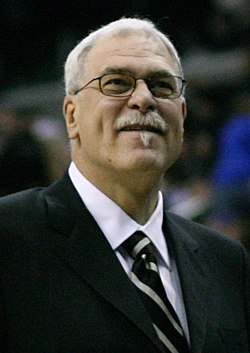
The Lakers hired Phil Jackson, architect of six Chicago Bulls championships, as head coach in 1999. Jackson implemented the triangle offense and immediately turned the talented but underachieving Shaq-Kobe duo into champions.
Image source: Phil Jackson
Jun 19, 2000
% complete
The Lakers defeated the Indiana Pacers in six games in the 2000 NBA Finals, capturing the franchise's first title since 1988. It was the start of a new Lakers dynasty built around Shaquille O'Neal and Kobe Bryant.
Image source: 2000 NBA Finals
Jun 15, 2001
% complete
Coming off a dominant 15-1 playoff run, the Lakers beat the Philadelphia 76ers in five games to win the 2001 NBA championship. Shaquille O'Neal earned Finals MVP honors for the second consecutive year.
Image source: 2001 NBA Finals
Jun 12, 2002
% complete
The Lakers swept the New Jersey Nets to win their third consecutive NBA championship, completing a three-peat. The achievement matched the Showtime-era feat of back-to-back-to-back titles and solidified the Shaq-and-Kobe dynasty.
Or browse the full history timeline directory, with more than 2,000 topics.
This Los Angeles Lakers timeline was generated with the help of AI, using information found on the internet.
We work hard to keep these timelines accurate, but mistakes do get through. If you spot one, email us at [email protected] and we'll fix it for future visitors.
Generate yours with AI or build it from scratch, for free.
Export your timeline, add your own events, edit or remove AI-generated events, and much more
No credit card required.
Cancel anytime.
Cancel anytime.
You can create an unlimited number of timelines with up to 10 events on each one, customize how they look, export them to PDF, PNG, PowerPoint, CSV, and Excel, and share them with a link. Paid plans raise the event limit and add features like spreadsheet imports and collaborators.
Yes. You can cancel your subscription from your account page at any time, and you will not be charged again. Your subscription stays active for the rest of the period you already paid for.
Yes. We will email you a reminder before the annual renewal, and we will also email you a receipt.
Yes. You can email us within 15 days of any payment, and we will issue you a full refund.
Check out our pricing docs or send us an email anytime: [email protected].