-
Use Cases
-
Resources
-
Pricing
Mount Sinai, also known as Jebel Musa, is a mountain in Egypt's Sinai Peninsula traditionally identified as the biblical site where Moses received the Ten Commandments from God. It has been a major destination for pilgrimage, religious study, and historical scholarship for thousands of years. More Less
1300 BC
% complete
According to the Book of Exodus, Moses ascended Mount Sinai, where God delivered the Ten Commandments and established the covenant between God and the Israelites. This event, traditionally dated to around the 13th century BC, forms the foundational moment of Jewish law and identity.
Image source: Mount Sinai (Bible)
1300 BC
% complete
The biblical narrative describes the Israelites arriving at the wilderness of Sinai three months after leaving Egypt. They camped before the mountain, which was enveloped in smoke, thunder, and lightning as a sign of divine presence.
1290 BC
% complete
While still encamped near Mount Sinai, the Israelites built the Tabernacle, the portable sanctuary described in detail in Exodus chapters 25–31, which became the center of Israelite worship during their desert wanderings.
Image source: Tabernacle
850 BC
% complete
The prophet Elijah fled to Mount Horeb, often identified with Mount Sinai, where he experienced God not in wind, earthquake, or fire, but in a 'still small voice,' renewing his prophetic mission as recorded in 1 Kings 19.
Image source: Elijah
300 AD
% complete
By late antiquity, Christian tradition had settled upon Jabal Musa in the southern Sinai Peninsula as the biblical Mount Sinai, establishing it as a destination for hermits and pilgrims seeking the mountain of Moses.
Image source: Mount Sinai
330
% complete
Empress Helena, mother of Constantine the Great, is credited with ordering the construction of a chapel at the site identified as the Burning Bush, marking the beginning of organized Christian presence at Mount Sinai.
Image source: Saint Catherine's Monastery
500 - 600
% complete
During the sixth century, the monastic community around Mount Sinai grew significantly, attracting ascetics from across the Byzantine world and becoming an important spiritual center of Eastern Christianity.
548 - 565
% complete
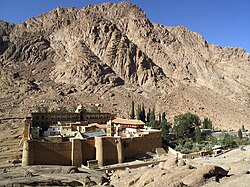
The Byzantine Emperor Justinian I commissioned Saint Catherine's Monastery at the base of Mount Sinai, enclosing the earlier Chapel of the Burning Bush. It remains one of the oldest continuously inhabited Christian monasteries in the world.
600
% complete
John Climacus, abbot of Saint Catherine's Monastery, composed 'The Ladder of Divine Ascent,' a classic of Christian spirituality describing thirty steps of monastic perfection that remains influential in Orthodox Christianity.
Image source: John Climacus
632
% complete
With the rise of Islam, Mount Sinai came to be revered in the Quran as 'Tur Sina' and 'Tur al-Tur' (the Mount), where Moses received divine revelation, adding Islamic veneration to the mountain's sacred status.
Image source: Mount Sinai
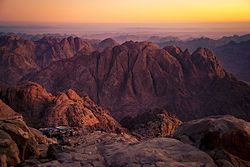
1100
% complete
A small mosque was constructed at the summit of Jebel Musa, reflecting the site's importance to Muslims and its shared veneration among Christians, Muslims, and Jews over the centuries.
383 - 384
% complete
The Gallic nun Egeria traveled to Mount Sinai and recorded one of the earliest surviving detailed accounts of Christian pilgrimage, describing liturgical practices and holy sites that shaped later pilgrimage traditions.
Image source: Egeria (pilgrim)
1183
% complete
Despite the Crusades being fought largely in the Levant, European pilgrims continued to reach Mount Sinai, and travel accounts from this era helped establish the monastery as a key stop on eastern pilgrimage routes.
1844 - 1859
% complete
Biblical scholar Constantin von Tischendorf discovered portions of the Codex Sinaiticus, a fourth-century manuscript of the Greek Bible, at Saint Catherine's Monastery, one of the most important finds in the history of biblical scholarship.
Image source: Codex Sinaiticus
1856
% complete
Dean Arthur Penrhyn Stanley published 'Sinai and Palestine, in Connection with Their History,' a widely read travel narrative that popularized Mount Sinai among Victorian audiences and stimulated scholarly and tourist interest in the region.
Image source: Sinai and Palestine campaign
1868 - 1869
% complete
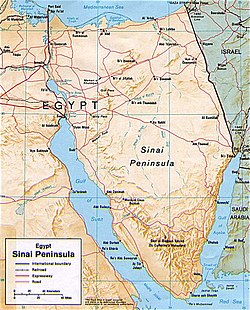
The British Ordnance Survey of the Sinai Peninsula, led by Captain Edward Henry Palmer and Charles Wilson, produced the first accurate maps of the region, including detailed documentation of Mount Sinai and its surroundings.
Image source: Sinai Peninsula
1882
% complete
Following Britain's occupation of Egypt, the Sinai Peninsula fell under nominal Anglo-Egyptian administration, bringing increased European exploration, mapping, and archaeological attention to Mount Sinai.
Image source: History of Egypt under the British
1904 - 1905
% complete
The pioneering archaeologist Flinders Petrie led expeditions into the Sinai Peninsula, documenting ancient mining sites, inscriptions, and topography, laying groundwork for modern archaeological study of the region.
Image source: Flinders Petrie
1915 - 1918
% complete
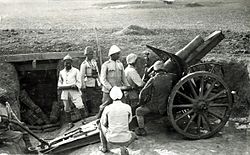
During World War I, the Sinai Peninsula became a battleground between Ottoman forces and the British Empire, with campaigns crossing the desert near Mount Sinai before the British advance into Palestine.
Image source: Sinai and Palestine campaign
1922
% complete
Egypt's partial independence from Britain in 1922 brought the Sinai Peninsula, including Mount Sinai, more firmly under Egyptian sovereignty, though British influence persisted for decades.
1948 - 1949
% complete
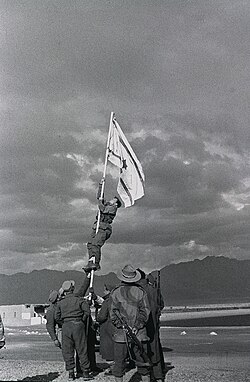
The first Arab-Israeli war saw fighting along the borders of the Sinai Peninsula, foreshadowing the region's central role in subsequent Middle East conflicts involving Egypt and Israel.
Image source: 1948 Arab–Israeli War
Oct 29, 1956 - Nov 6, 1956
% complete
Israeli forces invaded the Sinai Peninsula in coordination with Britain and France after Egypt nationalized the Suez Canal. International pressure forced a withdrawal, but the crisis reshaped Middle Eastern geopolitics.
Image source: Suez Crisis
1957 - 1967
% complete
After the Suez Crisis, UNEF peacekeepers were stationed in the Sinai Peninsula to buffer Egyptian and Israeli forces, maintaining relative calm until their withdrawal on the eve of the Six-Day War.
Image source: United Nations Emergency Force
1967 - 1970
% complete
Following the Six-Day War, Egypt and Israel engaged in a protracted War of Attrition along the Suez Canal and across occupied Sinai, marked by artillery duels, air battles, and commando raids.
Image source: War of Attrition
Jun 5, 1967 - Jun 10, 1967
% complete
During the Six-Day War, Israeli forces rapidly conquered the entire Sinai Peninsula from Egypt, occupying territory that included Mount Sinai and dramatically altering the strategic balance of the region.
Image source: Six-Day War
Oct 6, 1973 - Oct 25, 1973
% complete
Egyptian forces launched a surprise attack across the Suez Canal into occupied Sinai on Yom Kippur, initially breaking through Israeli defenses before the conflict ended with a ceasefire and eventual disengagement agreements.
Image source: Yom Kippur War
Sep 4, 1975
% complete
Egypt and Israel signed the Second Disengagement Agreement, withdrawing forces further apart in Sinai and expanding UN buffer zones, an important step toward the eventual return of the peninsula to Egypt.
Sep 17, 1978
% complete
Brokered by U.S. President Jimmy Carter, the Camp David Accords between Anwar Sadat and Menachem Begin set out a framework for Egyptian-Israeli peace, including the staged withdrawal of Israel from the Sinai Peninsula.
Image source: Camp David Accords
Apr 25, 1980 - 1982
% complete
Under the 1979 peace treaty, Israel completed its withdrawal from the Sinai Peninsula by April 1982, returning Mount Sinai to Egyptian control and establishing demilitarized zones monitored by international forces.
Image source: Egypt–Israel peace treaty
2002
% complete
UNESCO inscribed the Saint Catherine Area, encompassing Saint Catherine's Monastery, Mount Sinai, and surrounding landscapes, as a World Heritage Site, recognizing its outstanding religious, cultural, and natural significance.
Image source: Saint Catherine's Monastery
Or browse the full history timeline directory, with more than 2,000 topics.
This Mount Sinai timeline was generated with the help of AI, using information found on the internet.
We work hard to keep these timelines accurate, but mistakes do get through. If you spot one, email us at [email protected] and we'll fix it for future visitors.
Generate yours with AI or build it from scratch, for free.
Export your timeline, add your own events, edit or remove AI-generated events, and much more
No credit card required.
Cancel anytime.
Cancel anytime.
You can create an unlimited number of timelines with up to 10 events on each one, customize how they look, export them to PDF, PNG, PowerPoint, CSV, and Excel, and share them with a link. Paid plans raise the event limit and add features like spreadsheet imports and collaborators.
Yes. You can cancel your subscription from your account page at any time, and you will not be charged again. Your subscription stays active for the rest of the period you already paid for.
Yes. We will email you a reminder before the annual renewal, and we will also email you a receipt.
Yes. You can email us within 15 days of any payment, and we will issue you a full refund.
Check out our pricing docs or send us an email anytime: [email protected].