-
Resources
-
Pricing
The Open Door Policy was a U.S. diplomatic initiative beginning in 1899 that sought equal commercial access to China and preservation of Chinese territorial integrity. More Less
Build a timeline like this one in minutes, for free. Start Yours →
1839 - 1842
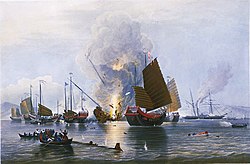
The theory behind the Open Door Policy originated in British commercial practice after the First Opium War. Treaties concluded with Qing China included most favored nation provisions intended to prevent any single country from gaining an exclusive advantage.
Image source: First Opium War
1885
The concept associated with an open door was also visible at the Berlin Conference, where the participating powers declared that no power could levy preferential duties in the Congo.
Image source: Berlin Conference
1894 - 1895
China's defeat created an imminent threat that imperial powers would partition and colonize the country. France, Germany, Britain, Italy, Japan, and Russia all had a presence or growing influence in China.
Image source: First Sino-Japanese War
1898
After winning the Spanish–American War, the United States acquired the Philippine Islands and increased its Asian presence, strengthening its expectation of pursuing commercial and political interests in China.
Image source: Spanish–American War
Sep 6, 1899
U.S. Secretary of State John Hay's Open Door Note established the policy by calling for equal trade and investment opportunities while seeking to preserve China's territorial and administrative integrity.
Sep 6, 1899
Hay sent notes to France, Germany, Britain, Italy, Japan, and Russia asking them to affirm that they would uphold China's territorial and administrative integrity and allow free use of treaty ports within their spheres of influence.
1900
As the powers considered intervention to suppress the violently anti-foreign Boxer uprising, the future of China's territorial integrity and foreign access became an urgent international issue.
Image source: Boxer Rebellion
Jul 1900
John Hay circulated a Second Open Door Note affirming the principles of the policy during the Boxer crisis. By July, he announced that each of the major powers had consented in principle.
Image source: Open Door Policy
1900
Although treaties after 1900 referred to the Open Door Policy, competition among foreign powers continued over railroad rights, mining rights, loans, foreign trade ports, and other special concessions in China.
Oct 6, 1900
Britain and Germany signed the Yangtze Agreement to oppose partitioning China into competing spheres of influence, reinforcing the diplomatic language associated with the Open Door.
1902
The U.S. government protested Russia's continued incursion into Manchuria after the Boxer Rebellion, arguing that it violated the principles of the Open Door Policy.
Image source: Russian invasion of Manchuria
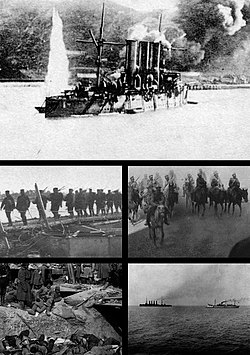
1904 - 1905
After the Russo-Japanese War, Japan replaced Russia in southern Manchuria. The Japanese and American governments pledged to maintain a policy of equality in Manchuria.
Image source: Russo-Japanese War
1905 - 1907
Japan made overtures to enlarge its sphere of influence to include Fujian, demonstrating the continuing tension between formal equality and competition for special influence in China.
1909
American efforts to preserve the Open Door in financial affairs contributed to the formation of an international banking consortium for Chinese railroad loans.
1917
The United States and Japan agreed to another exchange of notes in 1917 concerning Chinese railroad loans, reflecting continuing attempts to manage competition under the Open Door framework.
1917
A series of secret treaties between Japan and the Allied Triple Entente promised Japan the German possessions in China after a successful World War I. These arrangements further weakened the Open Door principle.
Image source: Twenty-One Demands
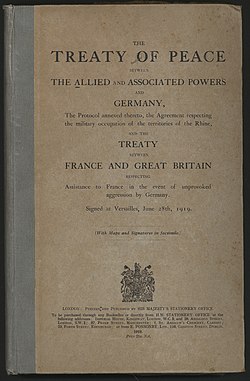
1919
The promise of German possessions in China was realized in the Versailles Treaty. The decision angered the Chinese public because it appeared to disregard China's territorial interests and the principle of equal treatment.
Image source: Treaty of Versailles
1919
Public anger over the Versailles settlement sparked the May Fourth Movement, a major Chinese protest against the diplomatic outcome and foreign privilege.
Image source: May Fourth Movement
1922
The Nine-Power Treaty expressly reaffirmed the Open Door Policy, offering a multilateral statement in favor of China's territorial integrity and equal commercial opportunity.
Image source: Nine-Power Treaty
1931
The policy collapsed in practical terms when Japan seized and retained Manchuria despite international disapproval, demonstrating that diplomatic commitments could not prevent unilateral interference.
Image source: Japanese invasion of Manchuria
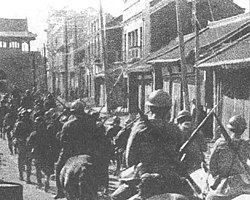
1931
The Manchurian Incident marked the first major Japanese interference cited as evidence that the Open Door could not protect China. American investments remained considerable but did not reach major proportions.
Image source: Mukden Incident
1937 - 1945
The Second Sino-Japanese War further demonstrated the inability of the Open Door Policy to protect China against Japanese interference. Chinese leaders sought American aid but were unwilling to accept the passive role implied by the policy.
Image source: Second Sino-Japanese War
1949
The United States State Department issued the China White Paper, a selection of official documents covering United States-China relations from 1900 to 1949.
1949
The term Open Door Policy is technically applicable only to the period before the founding of the People's Republic of China in 1949.
1977
Mao Zedong's handpicked successor initiated a transitional period and introduced an Open Door policy in 1977, preparing the way for China's later economic opening.
Image source: Chinese economic reform
1978 - 1989
China was ranked 32nd in the world by export volume in 1978. By 1989, it had doubled its world trade and become the 13th-largest exporter.
1978 - 1990
China's average annual rate of trade expansion exceeded 15 percent between 1978 and 1990. The country moved from a negligible export position toward a much larger role in world trade.
1978 - 1987
The opening policy laid the groundwork for Deng Xiaoping's reforms and was incorporated in 1987 under the Four Modernizations, which expanded foreign investment, agriculture, industry, science and technology, and national defense.
1978
After Deng Xiaoping took power, Open Door referred to China's policy of opening to foreign businesses willing to invest. The policy set in motion the economic transformation of modern China.
1980
Special Economic Zones were established in 1980 to attract foreign direct investment, modernize Chinese industry, and boost the economy.
Image source: Special economic zones of China
1980
The first four Special Economic Zones were Shenzhen, Zhuhai, and Shantou in Guangdong, and Xiamen in Fujian.
1981 - 1993
Shenzhen showed the most rapid growth among the initial zones, averaging approximately 40 percent annual growth between 1981 and 1993, compared with 9.8 percent average GDP growth for China as a whole.
Image source: Shenzhen
1998
Despite the transformation initiated by the Open Door policy, China's share of the world market remained below 2 percent in 1998, following its negligible share in 1978.
Image source: Economy of China
2010
By 2010, China held a 10.4 percent share of the world market according to the World Trade Organization, with merchandise export sales exceeding $1.5 trillion, the highest in the world.
2013
In 2013, China overtook the United States as the world's biggest trading nation in goods, with total imports and exports valued at $4.16 trillion for the year.
Jul 21, 2020
Chinese Communist Party general secretary Xi Jinping delivered a speech in Beijing to a group of public and private business leaders at the entrepreneur forum.
Image source: Xi Jinping
Build a timeline like this one in minutes, for free. Start Yours →
Or browse the full history timeline directory, with more than 2,500 topics.
This Open Door Policy timeline was generated with the help of AI, using information found on the internet.
We work hard to keep these timelines accurate, but mistakes do get through. If you spot one, email us at [email protected] and we'll fix it for future visitors.
Generate yours with AI or build it from scratch, for free.
Export your timeline, add your own events, edit or remove AI-generated events, and much more
No credit card required.
15-day money-back guarantee.
You can create an unlimited number of timelines with up to 10 events on each one, customize how they look, export them to PDF, PNG, PowerPoint, CSV, and Excel, and share them with a link. Timelines made with Timeline Maker AI keep every event the generator created, and you can add up to 5 events of your own. Paid plans remove the event limit, add spreadsheet imports and hide Preceden's branding, and the higher-priced plan also adds collaborators, a custom logo and a custom domain.
Yes. You can cancel your subscription from your account page at any time, and you will not be charged again. Your subscription stays active for the rest of the period you already paid for.
Yes. We email you a reminder 15 days before your annual renewal, and we email you a receipt after every payment.
Yes. You can email us within 15 days of any payment, and we will issue you a full refund.
Check out our pricing docs or send us an email anytime: [email protected].