-
Use Cases
-
Resources
-
Pricing
Rutherford B. Hayes was the 19th President of the United States, serving from 1877 to 1881. A lawyer and Union Army general, he won the highly contested election of 1876 through the Compromise of 1877, which ended Reconstruction. His presidency focused on civil service reform, reconciliation after the Civil War, and modernizing America. More Less
Oct 4, 1822
% complete
Rutherford Birchard Hayes was born in Delaware, Ohio, to Rutherford Hayes Jr. and Sophia Birchard. His father died ten weeks before his birth, leaving his mother to raise him along with the help of her brother Sardis Birchard, who became a father figure to young Rutherford.
Image source: Rutherford B. Hayes
Aug 1842
% complete
Hayes graduated as valedictorian of his class at Kenyon College in Gambier, Ohio, after excelling in his studies of classical languages and philosophy, setting the foundation for a distinguished legal and political career.
Jan 1845
% complete
Hayes graduated from Harvard Law School after studying under prominent legal scholars, including Supreme Court Justice Joseph Story. He was admitted to the Ohio bar later that year and began practicing law in Lower Sandusky (now Fremont), Ohio.
Image source: Harvard Law School
1849
% complete
Hayes relocated his law practice to Cincinnati, where he built a successful career representing clients including fugitive slaves. His work defending escaped slaves earned him a reputation for integrity and sympathy toward abolitionist causes.
Image source: Cincinnati
Dec 30, 1852
% complete
Hayes married Lucy Webb, whom he had met through family connections in Ohio. Lucy became known as an intelligent, progressive woman who opposed slavery and supported temperance. Their marriage produced eight children, five of whom survived to adulthood.
Image source: Lucy Webb Hayes
1858 - 1861
% complete
Hayes was elected city solicitor of Cincinnati by the city council, marking his first public office. He served two terms, handling the city's legal affairs while building political connections within the Republican Party.
Jun 27, 1861
% complete
After the outbreak of the Civil War, Hayes accepted a commission as a major in the 23rd Ohio Volunteer Infantry. The regiment also included William McKinley as a private, making it notable for producing two future presidents.
Sep 14, 1862
% complete
While leading a charge against Confederate positions during the Battle of South Mountain, Maryland, Hayes was struck by a bullet that shattered his left arm near the elbow. Despite his serious wound, he continued directing his troops until he collapsed.
Image source: Battle of South Mountain
Oct 19, 1864
% complete
Hayes received a promotion to brigadier general for gallant service, notably for his actions during the Shenandoah Valley Campaign. He distinguished himself leading troops against Confederate forces under Jubal Early in Virginia.
Image source: Battle of Cedar Creek
Mar 3, 1865
% complete
Hayes received a brevet promotion to major general in recognition of his meritorious service throughout the war. By the conflict's end, he had been wounded four times and had horses shot out from under him on multiple occasions.
Oct 1864 - Mar 3, 1867
% complete
While still serving in the Union Army, Hayes was elected to Congress from Ohio's Second District but declined to leave active military service until the war ended. He took his seat in December 1865 and served one term focused on Reconstruction issues.
Image source: United States House of Representatives
Nov 1867 - Jan 1872
% complete
Hayes won election as governor of Ohio, campaigning on issues including African American suffrage and support for President Andrew Johnson's impeachment. He proved a capable administrator, winning reelection in 1869 before retiring briefly from politics.
Image source: Governor of Ohio
Jan 13, 1876 - Mar 2, 1877
% complete
After a brief retirement, Hayes returned to politics and won a third term as governor in 1875. His reputation as a moderate reformer and war hero made him an appealing national candidate heading into the presidential election of 1876.
Jun 16, 1876
% complete
At the Republican National Convention in Cincinnati, Hayes emerged as a compromise candidate on the seventh ballot, chosen partly because his record lacked major scandals. He faced Democrat Samuel J. Tilden, governor of New York, in the general election.
Image source: 1876 Republican National Convention
Nov 7, 1876 - Mar 2, 1877
% complete
The election between Hayes and Samuel Tilden produced conflicting results in Florida, Louisiana, Oregon, and South Carolina, with both candidates claiming victory. Tilden won the popular vote, but 20 electoral votes were contested, throwing the outcome to Congress.
Image source: 1876 United States presidential election
1877 - 1881
% complete
First Lady Lucy Hayes supported her husband's temperance convictions and prohibited alcoholic beverages at White House functions, earning her the nickname 'Lemonade Lucy.' Her stance made the Hayes administration a symbol of Victorian morality.
Feb 26, 1877 - Mar 2, 1877
% complete
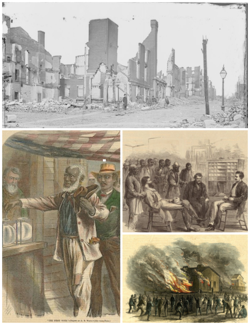
An informal deal between Republicans and southern Democrats awarded the disputed electoral votes to Hayes in exchange for the withdrawal of federal troops from the South, effectively ending Reconstruction and ushering in the Jim Crow era.
Image source: Compromise of 1877
Mar 5, 1877
% complete
Because March 4 fell on a Sunday, Hayes took the oath of office privately in the White House Red Room on March 3 and publicly on March 5 at the Capitol. He pledged civil service reform, sound money, and reconciliation between North and South.
Image source: Inauguration of Rutherford B. Hayes
Apr 1877
% complete
Honoring the Compromise of 1877, Hayes ordered the remaining federal garrisons removed from South Carolina and Louisiana, effectively ending federal enforcement of Reconstruction policies and leaving Black citizens' rights unprotected in the former Confederacy.
Image source: Reconstruction era
Jun 22, 1877
% complete
Hayes issued an executive order barring federal officeholders from managing party campaigns, targeting the powerful New York Custom House run by Senator Roscoe Conkling's machine. This set the stage for future merit-based reforms like the Pendleton Act.
Image source: Civil service reform in the United States
Jul 14, 1877 - Aug 1877
% complete
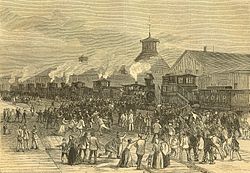
When nationwide railroad strikes erupted over wage cuts, Hayes sent federal troops to restore order, marking the first use of federal soldiers to break a labor strike. The violent suppression damaged his standing with organized labor.
Image source: Great Railroad Strike of 1877
1878
% complete
The Hayeses opened the White House lawn to children for egg rolling games after Congress banned the activity on Capitol grounds, establishing a beloved annual White House tradition that continues to this day.
Image source: Egg rolling
Feb 28, 1878
% complete
Hayes vetoed legislation requiring the Treasury to purchase and coin silver dollars, fearing inflation, but Congress overrode him. The act marked a partial victory for free silver advocates and reflected growing monetary debates of the Gilded Age.
Image source: Bland–Allison Act
Jun 25, 1878
% complete
Hayes revoked an executive order by President Grant that would have expelled members of the Church of Jesus Christ of Latter-day Saints from Utah Territory, though he continued supporting anti-polygamy measures through other means.
Image source: Mormons
Jul 11, 1878
% complete
As part of his reform campaign, Hayes dismissed Collector of Customs Chester A. Arthur, whose position had been used for partisan patronage. Ironically, Arthur later became vice president under James Garfield and succeeded him as president.
Image source: United States Custom House (New York City)
Feb 15, 1879
% complete
Hayes signed legislation permitting qualified women attorneys to practice before the U.S. Supreme Court. Belva Lockwood became the first woman to argue a case there in 1879, advancing women's professional opportunities in American law.
Image source: Lisa Marie Presley
1880
% complete
Having promised to serve only one term, Hayes honored his pledge not to run again. His decision reflected both his reform ideals about the presidency and recognition of lingering bitterness over the disputed 1876 election.
Image source: 1880 United States presidential election
1880
% complete
During his final year in office, Hayes undertook an unprecedented cross-country tour to California and the Pacific Northwest aboard the new transcontinental railroad, promoting national unity, economic development, and railroad expansion.
Mar 4, 1881
% complete
Hayes retired to Spiegel Grove, his estate in Fremont, Ohio, after a single term. Though criticized during his presidency, historians have since praised his commitment to civil service reform, sound money, and education for all Americans.
1882 - 1893
% complete
Hayes served as the first president of the John F. Slater Fund, which financed industrial and normal schools for African Americans in the post-Reconstruction South. He championed educational opportunity as essential to national progress.
Image source: Slater Fund
Jun 25, 1889
% complete
Lucy Hayes suffered a stroke and died at Spiegel Grove at age 57. Devastated, Hayes wrote movingly of their long partnership. She had been widely admired as a gracious and intellectually engaged First Lady.
Jan 17, 1893
% complete
Hayes died of complications from heart disease at his home in Fremont, Ohio, at age 70, reportedly after remarking 'I know that I'm going where Lucy is.' His estate, Spiegel Grove, is now preserved as the Hayes Presidential Library and Museums.
Or browse the full history timeline directory, with more than 2,000 topics.
This Rutherford B. Hayes timeline was generated with the help of AI, using information found on the internet.
We work hard to keep these timelines accurate, but mistakes do get through. If you spot one, email us at [email protected] and we'll fix it for future visitors.
Generate yours with AI or build it from scratch, for free.
Export your timeline, add your own events, edit or remove AI-generated events, and much more
No credit card required.
Cancel anytime.
Cancel anytime.
You can create an unlimited number of timelines with up to 10 events on each one, customize how they look, export them to PDF, PNG, PowerPoint, CSV, and Excel, and share them with a link. Paid plans raise the event limit and add features like spreadsheet imports and collaborators.
Yes. You can cancel your subscription from your account page at any time, and you will not be charged again. Your subscription stays active for the rest of the period you already paid for.
Yes. We will email you a reminder before the annual renewal, and we will also email you a receipt.
Yes. You can email us within 15 days of any payment, and we will issue you a full refund.
Check out our pricing docs or send us an email anytime: [email protected].