-
Use Cases
-
Resources
-
Pricing
Simone de Beauvoir (1908–1986) was a French writer, philosopher, and social theorist whose landmark work The Second Sex became foundational to modern feminism. A leading figure of 20th-century existentialism alongside Jean-Paul Sartre, she explored themes of freedom, gender oppression, and the human condition in her philosophical essays, novels, and memoirs. More Less
Jan 9, 1908
% complete
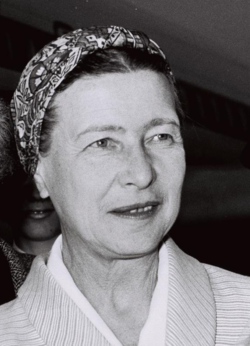
Simone Lucie Ernestine Marie Bertrand de Beauvoir was born on 9 January 1908 in Montparnasse in the 6th arrondissement of Paris, in a quality but poorly furnished apartment. She would become a French existentialist philosopher, writer, social theorist, and feminist activist.
Image source: Simone de Beauvoir
Jun 6, 1910
% complete
Simone's sister Hélène de Beauvoir was born on 6 June 1910. The family was historically bourgeois; their aristocratic ancestor had been given his title in 1786 and was killed during the revolution in 1790.
1919
% complete
In 1919, the family moved to a small fifth floor apartment with no central heating, running water, or bathroom, reflecting the decline of the family's fortunes.
1925
% complete
After passing baccalaureate exams in mathematics and philosophy at the age of seventeen in 1925, she studied mathematics at the Institut Catholique de Paris and literature/languages at the Institut Sainte-Marie.
1928
% complete
She studied philosophy at the Sorbonne and after completing her degree in 1928, wrote her Diplôme d'études supérieures spécialisées (roughly equivalent to an M.A. thesis) on Leibniz for Léon Brunschvicg in 1929.
1929 - 1943
% complete
From 1929 through 1943, Beauvoir taught at the lycée level until she could support herself solely on the earnings of her writings. She taught at the Lycée Montgrand (Marseille), the Lycée Jeanne-d'Arc (Rouen), and the Lycée Molière (Paris) (1936–39).
1929
% complete
In 1929, the jury for the agrégation narrowly awarded Sartre first place and gave second to Beauvoir. That same year Sartre critiqued her intellectual capacity when she told him about her ideas on pluralistic ethics.
1941 - 1945
% complete
Sorokine's mother filed a complaint against Beauvoir in 1941 which resulted in a one-and-a-half-year-long investigation. Her license was reinstated in 1945, but she would not teach again, dedicating herself fulltime to writing.
1929
% complete
In 1929 Beauvoir became friends and possibly lovers with René Maheu, who was friends with Sartre.
Oct 1929 - 1980
% complete
In October 1929, Jean-Paul Sartre and Beauvoir became a couple for the next 51 years, until his death in 1980. Their open relationship became one of the most famous intellectual partnerships of the twentieth century.
1938
% complete
In 1938, Simone introduced her student Bianca to Sartre, and Bianca was impressed by him and also began a relationship with him.
1939
% complete
According to Lamblin (Natalie Sorokine), before she met Sartre in 1938 she had only been friends with Beauvoir; per Lamblin, the relationship would become romantic and sexual in 1939.
1947
% complete
Beauvoir met Algren in Chicago in 1947 while on a four-month 'exploration' trip of the United States using various means of transport: automobile, train, and Greyhound. She wrote to him as 'my beloved husband'; Algren won the National Book Award for The Man with the Golden Arm in 1950, and appears as Lewis Brogan in The Mandarins.
Image source: Nelson Algren
1952 - 1959
% complete
Beauvoir lived with Claude Lanzmann from 1952 to 1959 in Montparnasse near her childhood home.
Image source: Claude Lanzmann
1980
% complete
In 1980, Beauvoir, 72, legally adopted Sylvie Le Bon, who was in her late thirties, by which point they had already been in an intimate relationship for decades.
1980
% complete
Sartre died in 1980 after 51 years together with Beauvoir. After his death, Beauvoir published his letters to her with edits to spare the feelings of people in their circle who were still living.
Image source: Jean-Paul Sartre
1943
% complete
Beauvoir published her first novel She Came to Stay in 1943, one of her most famous novels, drawing on her experiences with her circle of friends.
Image source: She Came to Stay
1944
% complete
Beauvoir wrote her first philosophical essay on existentialist ethics titled Pyrrhus et Cinéas (1944), marking her entry into formal philosophical publishing.
Oct 1, 1945
% complete
Sartre wrote the purpose of Les Temps Modernes in the Preface of the first issue published on 1 October 1945. From 1941 to 1946 Beauvoir helped found the journal and wrote some of her most important works including The Blood of Others (1945) and All Men are Mortal (1946).
1946
% complete
Beauvoir defended her advocacy of Brasillach's execution in her 1946 essay 'An Eye for an Eye', engaging seriously with questions of punishment, justice, and revenge.
1947
% complete
Post-war, Beauvoir began travels including North Africa to lecture, then made a long trip to the United States where she met Dolors Vanetti and kept a diary published in France in 1948 as America Day by Day.
Image source: America Day by Day
1947
% complete
Beauvoir continued her exploration of existentialism through her second essay The Ethics of Ambiguity (1947), following Pyrrhus et Cinéas (1944).
1949
% complete
The Second Sex (Le Deuxième Sexe), first published in 1949, is a detailed analysis of women's oppression and a foundational tract of contemporary feminism. It turns the existentialist mantra that existence precedes essence into a feminist one: 'One is not born, but rather becomes, woman.' Betty Friedan said reading it in the early 1950s led her to her original analysis of women's existence.
Image source: The Second Sex
Jun 1949
% complete
Chapters of The Second Sex were originally published in Les Temps Modernes beginning in June 1949, before the book's full publication later that year.
1954
% complete
Published in 1954, The Mandarins won France's highest literary prize, the Prix Goncourt. Written in 1954, Les Inséparables also describes her first love, Elisabeth Lacoin ('Zaza'), who died before age 22 of viral encephalitis.
Image source: The Mandarins
1957
% complete
Her 1955 travels in China were the basis of her 1957 travelogue The Long March, in which she praised the efforts of the Chinese communists to emancipate women.
Image source: Long March
1958 - 1963
% complete
From 1958 to 1963, Beauvoir published her autobiography in three volumes, though a fourth volume would be released in 1974. Her memoirs, notably the first volume, Mémoires d'une jeune fille rangée (1958), are considered her most enduring contribution to literature.
Image source: Simone de Beauvoir
1964
% complete
In 1964 Beauvoir published a novella-length autobiography, A Very Easy Death, covering the time she spent visiting her aging mother, who was dying of cancer. She also wrote short stories including The Woman Destroyed, dealing with ageing.
1967 - 1968
% complete
Beauvoir would publish Misunderstanding in Moscow in 1967–68, coming at a time when she revoked her former support for the Soviets due to freedoms concerns.
1970
% complete
Beauvoir wrote The Coming of Age in 1970, which offered a difficult account of aging and associated oppression in western capitalism.
Image source: Coming of age
1981
% complete
In 1981, she wrote La Cérémonie des adieux (A Farewell to Sartre), a painful account of Sartre's last years.
Image source: Jean-Paul Sartre
2020 - 2021
% complete
Beauvoir's early novel Les Inséparables, long suppressed, was published in French in 2020 and two different English translations in 2021, by Sandra Smith in the US and Lauren Elkin in the UK.
Image source: Les Inséparables
1945
% complete
During the trial of Robert Brasillach in 1945, Beauvoir was among a small number of prominent intellectuals advocating for his execution for the 'intellectual crimes' of supporting Fascism and the genocide of Jewish people. After the war, Bianca would seek out Beauvoir, complaining of deep unhappiness, with her psychologist Jacques Lacan agreeing they had harmed her.
Image source: Robert Brasillach
1955
% complete
In 1955 she published Les Temps Moderne in support of Algerian independence and three essays called Privileges questioning how the privileged can question their situation, stating the privileged must not be ignorant of hierarchies in order to address them.
1971
% complete
She wrote and signed the Manifesto of the 343 in 1971, a manifesto that included a list of famous women who claimed to have had an abortion, then illegal in France. In 1974, abortion was legalized in France.
1972
% complete
Beauvoir publicly declared herself a feminist in 1972 in an interview with Le Nouvel Observateur, at which point she joined other Marxist feminists in founding the Questions Féministes journal.
1982
% complete
In 1982, François Mitterrand offered her the Legion of Honor, but she refused it, consistent with her lifelong anti-establishment principles.
Image source: Legion of Honour
1984
% complete
She contributed the piece 'Feminism – Alive, Well, and in Constant Danger' to the 1984 anthology Sisterhood Is Global: The International Women's Movement Anthology, edited by Robin Morgan.
Image source: Sisterhood Is Global
1975
% complete
Beauvoir received the 1975 Jerusalem Prize. In a 1975 interview with Betty Friedan about supporting a minimum wage for women who do housework, Beauvoir answered: 'No, we don't believe that any woman should have this choice.'
Image source: Jerusalem Prize
1978
% complete
Beauvoir received the 1978 Austrian State Prize for European Literature, adding to her international recognition alongside the Prix Goncourt and Jerusalem Prize.
Apr 14, 1986
% complete
Beauvoir died of pneumonia on 14 April 1986 in Paris, aged 78. Her legacy includes the journal Simone de Beauvoir Studies founded in 1983 and the International Simone de Beauvoir Society.
1997
% complete
When Beauvoir's letters to Algren were published in 1997, it created an uproar about the truth of her memoirs.
1999
% complete
Her play was stage read in 1999 in Chicago, reflecting renewed interest in her dramatic work.
2008
% complete
Beauvoir published a series of letters Sartre sent to her and kept student-era diaries, not published in English until 2008, along with letters to Claude Lanzmann which were not available until 2018.
2009
% complete
Only in 2009 was there a second translation of The Second Sex, to mark the 60th anniversary of the original publication.
2010
% complete
Constance Borde and Sheila Malovany-Chevallier produced the first integral translation in 2010, reinstating a third of the original work.
2018
% complete
In 2018, the manuscript pages of The Second Sex were published. There was also a new expanded edition of her biographies in France with additional letters and materials, including critiques of her belittlement next to Sartre.
2019
% complete
In 2019, Time created 89 new covers to celebrate women of the year starting from 1920; it chose Beauvoir for 1949.
Image source: Time (magazine)
Or browse the full history timeline directory, with more than 2,000 topics.
This Simone de Beauvoir timeline was generated with the help of AI, using information found on the internet.
We work hard to keep these timelines accurate, but mistakes do get through. If you spot one, email us at [email protected] and we'll fix it for future visitors.
Generate yours with AI or build it from scratch, for free.
Export your timeline, add your own events, edit or remove AI-generated events, and much more
No credit card required.
Cancel anytime.
Cancel anytime.
You can create an unlimited number of timelines with up to 10 events on each one, customize how they look, export them to PDF, PNG, PowerPoint, CSV, and Excel, and share them with a link. Paid plans raise the event limit and add features like spreadsheet imports and collaborators.
Yes. You can cancel your subscription from your account page at any time, and you will not be charged again. Your subscription stays active for the rest of the period you already paid for.
Yes. We will email you a reminder before the annual renewal, and we will also email you a receipt.
Yes. You can email us within 15 days of any payment, and we will issue you a full refund.
Check out our pricing docs or send us an email anytime: [email protected].