
-
Resources
-
Pricing
The Spinning Mule was a revolutionary textile machine invented by Samuel Crompton in 1779. It combined features of the spinning jenny and water frame to produce fine, strong cotton yarn efficiently. More Less
Build a timeline like this one in minutes, for free. Start Yours →
1775 - 1779
The spinning mule was developed by Samuel Crompton between 1775 and 1779, establishing the hybrid spinning technology that would dominate cotton yarn production.
Image source: Spinning mule
1779
The machine was called a mule because it was a hybrid of the water frame and spinning jenny, analogous to a mule being the product of a female horse and a male donkey.
1779 - 1900
Over roughly the century and a half following its invention, improvements to the mule contributed to the production of stronger yarn.
1779 - 1900
Development over the next century and a half led to an automatic mule and enabled the production of finer and stronger yarn.
1779
Samuel Crompton invented the spinning mule in 1779. The machine combined features of Richard Arkwright's water frame and James Hargreaves's spinning jenny.
1790
In 1790, William Kelly of Glasgow used a new method to assist the draw stroke of the spinning mule.
1793
In 1793, John Kennedy addressed the problem of producing fine counts on the spinning mule.
1818
In 1818, William Eaton improved the winding of thread by using two faller wires and performing a backing off at the end of the outward traverse.
1825
Richard Roberts took out his first patent relating to the mule in 1825. This patent covered the development of the self-acting mule.
Image source: Spinning mule
1825
Richard Roberts patented the self-acting, or automatic, mule in 1825, reducing the need for manual control of the spinning cycle.
1830
Richard Roberts took out a second patent relating to the mule in 1830, continuing the development of automatic operation.
1779 - 1900
From the late eighteenth to the early twentieth century, spinning mules were used extensively in Lancashire and elsewhere.
1790 - 1900
The mule was the most common spinning machine from 1790 until about 1900.
1790
From 1790, the mule became the most common spinning machine, a position it retained until about 1900.
1790 - 1900
Mules were used extensively in the mills of Lancashire and elsewhere from the late eighteenth century through the early twentieth century.
1890
In 1890, a typical cotton mill had more than 60 spinning mules.
1890
In 1890, each mule in a typical cotton mill had 1,320 spindles.
1890
In 1890, the mules in a typical cotton mill operated for 56 hours a week.
1900
Around 1900, a high incidence of scrotal cancer was detected in former mule spinners.
1900 - 1980
Although its general dominance declined after about 1900, the mule continued to be used for fine yarns until the early 1980s.
1790
The 1790 mule was operated by brute force. A spinner drew and pushed the frame while attending to each spindle.
1825 - 1900
The development of the self-acting mule made more of the machine's operation automatic, building on the earlier manually operated design.
1825 - 1830
Development of the automatic mule advanced through Richard Roberts's patent work, including his first patent in 1825 and a second patent in 1830.
1885
In 1885, Marsden described the processes involved in setting up and operating a spinning mule.
1890
A typical mule in 1890 operated four times a minute.
1900
The mule jenny allowed the spinning process to use a gentler action than earlier operation methods.
1900 - 1980
Later mules used two driving speeds to make the machine's motion more gentle and controlled.
1900 - 1980
Some later mules used three driving speeds, adding further control to the machine's motion.
1900 - 1980
In the twentieth century, additional mechanisms were added to make the mule's motion more gentle.
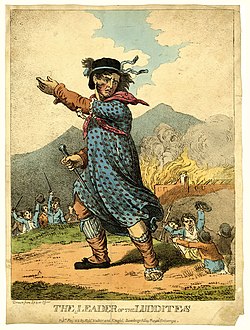
1800 - 1810
Some spinners and handloom weavers opposed the perceived threat that mechanized spinning posed to their livelihoods. This opposition included frame-breaking riots.
Image source: Luddite
1811 - 1813
The Luddite riots of 1811–13 formed part of worker resistance to machinery and industrial changes associated with textile production, including the spinning mule.
1870
The first national union associated with the mule-spinning workforce was formed in 1870.
Build a timeline like this one in minutes, for free. Start Yours →
Or browse the full history timeline directory, with more than 3,000 topics.
This Spinning Mule timeline was generated with the help of AI, using information found on the internet.
We work hard to keep these timelines accurate, but mistakes do get through. If you spot one, email us at [email protected] and we'll fix it for future visitors.
Generate yours with AI or build it from scratch, for free.
Export your timeline, add your own events, edit or remove AI-generated events, and much more
No credit card required.
15-day money-back guarantee.
You can create an unlimited number of timelines with up to 10 events on each one, customize how they look, export them to PDF, PNG, PowerPoint, CSV, and Excel, and share them with a link. Timelines made with Timeline Maker AI keep every event the generator created, and you can add up to 5 events of your own. Paid plans remove the event limit, add spreadsheet imports and hide Preceden's branding, and the higher-priced plan also adds collaborators, a custom logo and a custom domain.
Yes. You can cancel your subscription from your account page at any time, and you will not be charged again. Your subscription stays active for the rest of the period you already paid for.
Yes. We email you a reminder 15 days before your annual renewal, and we email you a receipt after every payment.
Yes. You can email us within 15 days of any payment, and we will issue you a full refund.
Check out our pricing docs or send us an email anytime: [email protected].