-
Resources
-
Pricing
The steam turbine converts thermal energy from high-pressure steam into rotary mechanical energy, driving generators, ships, pumps, and industrial machinery. More Less
Build a timeline like this one in minutes, for free. Start Yours →
1551
In Ottoman Egypt, Taqi al-Din described a steam turbine whose practical application was rotating a spit.
Image source: Taqi ad-Din Muhammad ibn Ma'ruf
1629
The Italian engineer Giovanni Branca described a steam turbine in 1629, contributing to the early development of steam-powered rotary devices.
Image source: Giovanni Branca
1648
John Wilkins described a steam turbine in England in 1648, extending European interest in using steam to produce rotary motion.
Image source: John Wilkins
1672
Ferdinand Verbiest designed a small toy car driven by an impulse turbine. The device demonstrated the possibility of converting steam energy into vehicle motion.
Image source: Ferdinand Verbiest
1775
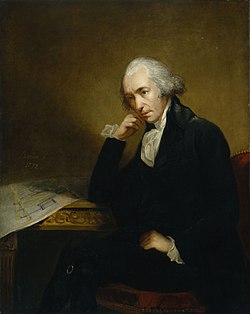
James Watt designed a reaction turbine in 1775. The machine was used at the Soho Manufactory.
Image source: James Watt
1780
An unknown German mechanic produced a more modern version of the turbine-driven toy car sometime in the late eighteenth century.
Image source: Steam turbine
1807
Polikarp Zalesov designed and constructed an impulse turbine in 1807 and used it to operate a fire pump.
1827
The French engineers Real and Pichon patented and constructed a compound impulse turbine in 1827.
1884
Sir Charles Parsons invented the modern form of the steam turbine in 1884. His invention revolutionized marine propulsion and navigation.
Image source: Charles Algernon Parsons
1884
Charles Parsons's first modern steam-turbine model was connected to a dynamo that generated 7.5 kilowatts, or 10.1 horsepower, of electricity.
1887 - 1897
Auguste Rateau taught at the École des mines de Saint-Étienne for a decade, until 1897. He later founded a successful company that was incorporated into Alstom after his death.
1896
Auguste Rateau developed a pressure-compounded impulse turbine using the de Laval principle as early as 1896.
1903
Auguste Rateau obtained a United States patent for his pressure-compounded impulse turbine in 1903.
Image source: Auguste Rateau
1903
Rateau's work Die Dampfturbinen und ihre Aussichten als Wärmekraftmaschinen, translated as The Steam Turbine and its prospective use as a Heat Engine, was published in Berlin in 1903.
1905
By 1905, engineers had determined that one or more Curtis wheels were desirable at the beginning of a multistage turbine, where steam pressure was highest, followed by reaction stages. The arrangement is illustrated by a 1905 AEG marine steam turbine.
1922
A further book by Rateau, Dampf und Gas-Turbinen, or Steam and Gas Turbines, was published in 1922.
1894
In 1894, efficient reduction gears were not available for the high powers required by ships, making direct drive necessary for early marine steam turbines.
Image source: Marine steam engine
1894 - 1935
From 1894 to 1935, the development of steam-turbine marine propulsion focused on reconciling the turbine's high efficient speed with the lower efficient speed of a ship's propeller while remaining cost-competitive with reciprocating engines.
1904
In 1904, Auguste Rateau applied his turbine technology to a French torpedo boat, demonstrating its marine propulsion potential.
1905
By 1905, steam turbines were coming into use on fast ships such as HMS Dreadnought and in land-based power applications.
1906
The British used exclusively turbine-powered warships from 1906, reflecting the importance they placed on speed and steam-turbine propulsion.
1908 - 1916
Because of its overseas territories and limited coaling-station network, the United States had an especially strong need for fuel economy from 1900 to 1940. Various cruising solutions were therefore fitted on United States destroyers launched from 1908 to 1916.
1909
After adopting turbines for the Delaware-class battleships launched in 1909, the United States later altered its policy between reciprocating and turbine machinery as propulsion requirements evolved.
Image source: Delaware-class battleship
1909
USS Smith, one of the first United States turbine-powered destroyers, was launched in 1909. Its direct-drive turbines turned three shafts at 724 rpm while the ship reached 28.35 knots.
Image source: USS Smith (DD-17)
1911
Reduction gears became available around 1911. Some ships, including USS Nevada, used them on cruising turbines while retaining direct-drive main turbines.
Image source: Reduction drive
1911
RMS Olympic, launched in 1911, retained triple-expansion engines on its two outboard shafts, with both exhausting to a low-pressure turbine on the center shaft. RMS Titanic and HMHS Britannic used the same arrangement.
Image source: Olympic-class ocean liner
1912
Some Queen Elizabeth-class battleships were fitted with cruising turbines from 1912 onward, following earlier experimental installations, because long cruising range was desirable for the Royal Navy's worldwide operations.
Image source: Queen Elizabeth-class battleship
1914
After using reciprocating machinery on the New York-class battleships of 1912, the United States Navy returned to turbines with USS Nevada in 1914.
Image source: USS Nevada (BB-36)
1915
Beginning in 1915, all new Royal Navy destroyers had fully geared turbines. The United States followed in 1917.
1916
The Battle of Jutland in mid-1916 showed the Royal Navy that excessive armor sacrifices had been made in pursuit of speed. Before then, speed had been a dominant priority in British warship design.
Image source: Battle of Jutland
1917
Turbo-electric drive was introduced on the battleship USS New Mexico, launched in 1917.
Image source: USS New Mexico (BB-40)
1927
When the United States designed treaty cruisers beginning with USS Pensacola, launched in 1927, it used geared turbines to conserve weight. Geared turbines remained standard for later fast steam-powered ships.
Image source: USS Pensacola (CA-24)
1931 - 1933
USS New Mexico was refitted with geared turbines between 1931 and 1933, although other United States turbo-electric ships retained their systems throughout their careers.
1934
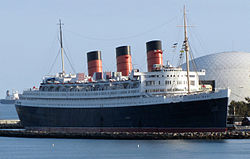
RMS Queen Mary, launched in 1934, used a later marine arrangement in which each shaft was powered by four turbines in series connected to the ends of the two input shafts of a single-reduction gearbox.
Image source: RMS Queen Mary
1935 - 1936
The United States Navy's Mahan-class destroyers, launched in 1935 and 1936, introduced double-reduction gearing.
Image source: Mahan-class destroyer
1945 - 2001
Amphibious and auxiliary ships continued to use 600 psi steam after World War II. USS Iwo Jima, launched in 2001, was possibly the last non-nuclear steam-powered ship built for the United States Navy.
Image source: USS Iwo Jima (LHD-7)
2002
The Royal Navy decommissioned its last conventional steam-powered surface warship class, the Fearless-class landing platform docks, in 2002.
Image source: Fearless-class landing platform dock
2006
The Italian Navy decommissioned its last conventional steam-powered surface warships, the Audace-class destroyers, in 2006.
Image source: Audace-class destroyer (1971)
2013
The French Navy ended its steam era in 2013 with the decommissioning of its last Tourville-class frigate.
Image source: Tourville-class frigate
2020
As of 2020, the Mexican Navy operated four steam-powered former United States Knox-class frigates.
Image source: Knox-class frigate
1908
The first steam turbine rail locomotive was built in 1908 for Officine Meccaniche Miani Silvestri Grodona Comi in Milan, Italy.
Image source: Steam turbine locomotive
1924 - 1929
Krupp built the steam turbine locomotive T18 001 in 1924. It became operational in 1929 for Deutsche Reichsbahn.
1988 - 2011
Steam-turbine performance testing is addressed by ASME PTC 6S-1988, Procedures for Routine Performance Test of Steam Turbines; ASME PTC 6-2004, Steam Turbines; and ASME PTC 6.2-2011, Steam Turbines in Combined Cycles.
2001
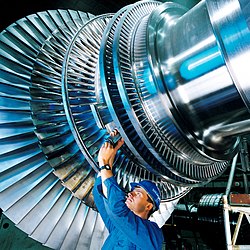
Modern steam-turbine fabrication uses advanced metalworking to form high-grade steel alloys into precision parts, relying on technologies that first became available in the twentieth century. Continued improvements in durability and efficiency remain central to twenty-first-century energy economics.
2001
Steam turbines are manufactured in sizes ranging from units under 0.75 kilowatts, used as mechanical drives for pumps, compressors, and other shaft-driven equipment, to 1,500-megawatt turbines used for electricity generation.
2022
About 42 percent of all electricity generation in the United States in 2022 was produced using steam turbines.
Build a timeline like this one in minutes, for free. Start Yours →
Or browse the full history timeline directory, with more than 3,000 topics.
This Steam Turbine timeline was generated with the help of AI, using information found on the internet.
We work hard to keep these timelines accurate, but mistakes do get through. If you spot one, email us at [email protected] and we'll fix it for future visitors.
Generate yours with AI or build it from scratch, for free.
Export your timeline, add your own events, edit or remove AI-generated events, and much more
No credit card required.
15-day money-back guarantee.
You can create an unlimited number of timelines with up to 10 events on each one, customize how they look, export them to PDF, PNG, PowerPoint, CSV, and Excel, and share them with a link. Timelines made with Timeline Maker AI keep every event the generator created, and you can add up to 5 events of your own. Paid plans remove the event limit, add spreadsheet imports and hide Preceden's branding, and the higher-priced plan also adds collaborators, a custom logo and a custom domain.
Yes. You can cancel your subscription from your account page at any time, and you will not be charged again. Your subscription stays active for the rest of the period you already paid for.
Yes. We email you a reminder 15 days before your annual renewal, and we email you a receipt after every payment.
Yes. You can email us within 15 days of any payment, and we will issue you a full refund.
Check out our pricing docs or send us an email anytime: [email protected].