
-
Use Cases
-
Resources
-
Pricing
Teotihuacan, located in the Valley of Mexico, was one of the largest and most influential cities of pre-Columbian Mesoamerica. Famous for its massive Pyramid of the Sun, Pyramid of the Moon, and Temple of Quetzalcoatl, it thrived as a major political, religious, and economic center before its mysterious decline centuries before the Aztecs arrived. More Less
1500 BC
% complete
Small agricultural communities began cultivating maize, beans, and squash in the Basin of Mexico. Villages such as Cuicuilco and later settlements in the Teotihuacan Valley laid the demographic and technological foundations for the rise of the great metropolis.
700 BC
% complete
Cuicuilco grew into one of the most important early ceremonial centers of the Basin of Mexico, featuring a large circular pyramid. Its eventual destruction by the eruption of the Xitle volcano around 100 AD redirected population and political power toward Teotihuacan.
Image source: Cuicuilco
600 BC
% complete
Archaeological evidence indicates permanent villages were established in the Teotihuacan Valley by around 600 BC. The site benefited from fertile land, abundant springs, and obsidian resources from nearby Cerro de las Navajas, fueling its growth.
100 AD
% complete
The eruption of Xitle devastated Cuicuilco and surrounding farmland with lava flows. Refugees migrated northward to Teotihuacan, dramatically accelerating its population growth and helping transform it into the region's dominant urban center.
Image source: Xitle
100 AD
% complete
Following regional upheavals and volcanic disasters, Teotihuacan rapidly expanded, absorbing populations from across the Basin of Mexico. Its planned grid layout, controlled by a powerful elite, marked the transition from village life to true urban civilization.
Image source: Teotihuacan
100 AD - 200 AD
% complete
The Pyramid of the Sun, the largest structure at Teotihuacan, was built over an earlier tunnel-and-cave complex aligned with astronomical features. Standing about 65 meters tall on a base of roughly 223 meters per side, it became the symbolic heart of the city.
Image source: Pyramid of the Sun
100 AD - 250 AD
% complete
Teotihuacan's planners created a grand north-south boulevard over four kilometers long, aligning major temples and palaces along it. The Aztecs would later name it Miccotli or the Avenue of the Dead because they mistook its flanking platforms for tombs.
Image source: Teotihuacan
200 AD - 450 AD
% complete
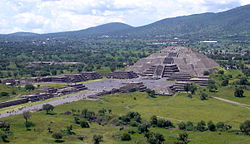
Facing south down the Avenue of the Dead and backed by the sacred mountain Cerro Gordo, the Pyramid of the Moon was enlarged through successive construction phases. It hosted burials of sacrificed individuals and elaborate offerings, suggesting state rituals tied to warfare and fertility.
Image source: Pyramid of the Moon
200 AD - 500 AD
% complete
Teotihuacan's signature building style, combining sloping talud bases with framed tablero panels, spread widely across Mesoamerica. Its appearance as far away as Kaminaljuyú and Tikal reflects Teotihuacan's cultural and political influence throughout the region.
Image source: Talud-tablero
200 AD - 250 AD
% complete
Within the Ciudadela compound, the Temple of Quetzalcoatl (Feathered Serpent Pyramid) was adorned with alternating sculptural heads of the Feathered Serpent and War Serpent. Beneath it, archaeologists uncovered more than 200 sacrificial burials of warriors, evidence of state-sponsored ritual violence.
200 AD - 300 AD
% complete
The Ciudadela, a massive walled enclosure east of the Avenue of the Dead, may have housed the ruler's palace and served administrative functions. Its scale underscores the centralized authority that directed Teotihuacan's monumental projects.
Image source: Parc de la Ciutadella
200 AD - 300 AD
% complete
Across from the Ciudadela, the Great Compound likely functioned as the city's main market and distribution hub. It anchored the economic engine that sustained a population that eventually exceeded 100,000 people.
200 AD - 550 AD
% complete
Control of the Pachuca green obsidian sources allowed Teotihuacan to mass-produce blades, eccentrics, and ornaments for export. Workshop districts within the city employed thousands of artisans, making obsidian trade a pillar of the state's wealth and influence.
Image source: Obsidian use in Mesoamerica
300 AD - 550 AD
% complete
Unlike most ancient cities, Teotihuacan housed the majority of its residents in multi-family stone apartment compounds such as Tetitla and Tepantitla. These complexes featured murals, drainage systems, and courtyards, indicating a remarkably organized urban society.
300 AD - 500 AD
% complete
The famous murals of the Tepantitla compound portray the 'Paradise of Tlaloc,' a flowering realm of streams, butterflies, and playing figures. They offer rare insight into Teotihuacan religious beliefs and everyday imagery of abundance.
Image source: Great Goddess of Teotihuacan
350 AD - 550 AD
% complete
Excavations of the Merchants' Barrio revealed a neighborhood of immigrants from Monte Albán who retained Oaxacan burial customs and pottery styles. Their presence attests to Teotihuacan's role as a cosmopolitan magnet drawing people from distant regions.
379 AD
% complete
In January 378 AD, a warlord associated with Teotihuacan named Siyaj Kʼakʼ arrived at Tikal, and the new king Yax Nuun Ahiin II took the throne. Maya monuments depict these rulers with Teotihuacan weapons and regalia, marking dramatic intervention in the Maya lowlands.
379 AD
% complete
Yax Nuun Ahiin, son or protégé of a Teotihuacan figure called Spearthrower Owl, ruled Tikal with strong Central Mexican symbolism. This episode demonstrates that Teotihuacan projected political power hundreds of kilometers beyond its core territory.
Image source: Tikal
400 AD - 500 AD
% complete
At its height, Teotihuacan was among the largest cities in the world, covering about 20 square kilometers. Its multiethnic population included enclaves of Zapotec migrants from Oaxaca and merchants from the Gulf lowlands, reflecting far-reaching exchange networks.
426 AD
% complete
The founder of Copán's dynasty, K'inich Yax K'uk' Mo', is depicted with Teotihuacan-style goggles and weapons, having arrived via Teotihuacan-linked routes. The event shows the metropolis's ideology reshaping royal legitimacy deep in southeastern Mesoamerica.
Image source: Kʼinich Yax Kʼukʼ Moʼ
450 AD - 500 AD
% complete
During the fifth century, Teotihuacan dominated trade routes for obsidian, cacao, jade, and quetzal feathers, and its iconography appeared from Guatemala to western Mexico. Whether through conquest, alliance, or commerce, its cultural footprint spanned much of Mesoamerica.
450 AD - 500 AD
% complete
This elite residence, named after carved quetzal-butterfly pillars, showcases fine craftsmanship with intricate reliefs and painted murals. It exemplifies the luxurious lifestyle of Teotihuacan's ruling class at the city's zenith.
Image source: Quetzalpapálotl
535 AD - 600 AD
% complete
Climate episodes linked to global events around 536 AD brought cooler, drier conditions that reduced harvests. Combined with ecological stress, these droughts likely undermined the food supply sustaining Teotihuacan's enormous population.
Image source: Volcanic winter of 536
550 AD - 750 AD
% complete
After centuries of growth, Teotihuacan's population dwindled as trade networks frayed and elite institutions failed. Possible contributing factors include drought, soil degradation, resource depletion, and the loss of tributary relationships.
550 AD - 600 AD
% complete
Around the mid-sixth century, key structures including the Temple of Quetzalcoatl were deliberately burned, likely signaling internal revolt or the collapse of central authority. The targeted destruction suggests popular uprising against elites rather than foreign invasion.
650 AD - 750 AD
% complete
By the eighth century the metropolis had lost its dominant role; power shifted to centers like Cacaxtla, Xochicalco, and El Tajín during the Epiclassic period. Small groups continued living among the ruins, but the era of Teotihuacan greatness had ended.
Image source: Mesoamerican Epiclassic Period
900 AD
% complete
The Toltec capital of Tula adopted architectural motifs and legends connecting itself to Teotihuacan. Later Mesoamerican peoples revered the ruined city as the mythical Tollan, the place where gods and civilization originated.
Image source: Tula (Mesoamerican site)
1400
% complete
Arriving in the Basin of Mexico, the Mexica encountered the vast abandoned city and named it Teotihuacan, meaning 'the place where the gods were created.' They incorporated it into their origin mythology and made pilgrimages to its pyramids.
1905 - 1910
% complete
Mexican archaeologist Leopoldo Batres led the first systematic excavations, restoring parts of the Pyramid of the Sun for the centennial of Mexican independence. His controversial restorations nonetheless brought international attention to the site.
1917 - 1922
% complete
Manuel Gamio pioneered scientific stratigraphic archaeology at Teotihuacan, mapping the Avenue of the Dead and clarifying the site's chronology. His work established the foundation for all subsequent research at the ancient metropolis.
Image source: Manuel Gamio
Dec 8, 1987
% complete
UNESCO inscribed the Pre-Hispanic City of Teotihuacan as a World Heritage Site, recognizing its universal value as one of Mesoamerica's greatest achievements. The designation supports conservation and draws millions of visitors each year.
Image source: World Heritage Site
2003
% complete
Heavy rainstorms exposed a sinkhole revealing a sealed tunnel running under the Feathered Serpent Pyramid. INAH archaeologist Sergio Gómez Chávez launched a painstaking exploration of the passage and its chambers of ritual offerings.
2013 - 2015
% complete
Robots and careful manual excavation revealed liquid mercury pools, jade figurines, shells, and rubber balls inside the tunnel, interpreted as a recreation of the underworld. The discoveries suggested a possible royal tomb may still lie undiscovered below the pyramid.
Or browse the full history timeline directory, with more than 2,000 topics.
This Teotihuacan Pyramids timeline was generated with the help of AI, using information found on the internet.
We work hard to keep these timelines accurate, but mistakes do get through. If you spot one, email us at [email protected] and we'll fix it for future visitors.
Generate yours with AI or build it from scratch, for free.
Export your timeline, add your own events, edit or remove AI-generated events, and much more
No credit card required.
Cancel anytime.
Cancel anytime.
You can create an unlimited number of timelines with up to 10 events on each one, customize how they look, export them to PDF, PNG, PowerPoint, CSV, and Excel, and share them with a link. Paid plans raise the event limit and add features like spreadsheet imports and collaborators.
Yes. You can cancel your subscription from your account page at any time, and you will not be charged again. Your subscription stays active for the rest of the period you already paid for.
Yes. We will email you a reminder before the annual renewal, and we will also email you a receipt.
Yes. You can email us within 15 days of any payment, and we will issue you a full refund.
Check out our pricing docs or send us an email anytime: [email protected].