-
Use Cases
-
Resources
-
Pricing
1958
A study comparing desert-dwelling Pitjantjatjara people with Europeans found different cooling adaptations and reported that the Aboriginal participants could sleep more soundly through a cold desert night.
Image source: Pitjantjatjara
2001
Blood samples were collected from some Warlpiri people in the Northern Territory for genetic research. The sample was not representative of all Aboriginal peoples in Australia.
Image source: Warlpiri language
2011
Morten Rasmussen and colleagues extracted genetic data from an early-twentieth-century lock of Aboriginal hair, concluding that Aboriginal ancestors probably migrated through South Asia and Maritime Southeast Asia into Australia, where they remained.
2013
The Max Planck Institute for Evolutionary Anthropology conducted a study using large-scale genotyping data from Aboriginal Australians, New Guineans, island Southeast Asians and Indians.
2014
A Cambridge study found a beneficial mutation in two genes regulating thyroxine, a hormone involved in metabolism, that helps regulate body temperature in response to fever.
Image source: Indigenous Australians
2016
A 2016 Current Biology study by Anders Bergström and colleagues examined evidence concerning possible South Asian genetic connections and the population history of Aboriginal Australians.
2016
The 2016 study concluded that its findings did not disprove Holocene gene flow or non-genetic South Asian influences, but that the overall evidence was consistent with no gene flow and pointed to indigenous origins for technological and linguistic changes.
2016
The 2016 analysis identified the appearance of the dingo as strong evidence for external contacts, while distinguishing that contact from evidence of substantial human gene flow.
Image source: Dingo
2017
A 2017 analysis reported that the bifurcation of Eastern and Western Eurasians dates to at least 45,000 years ago and placed Indigenous Australians within the Eastern Eurasian clade.
2018
Anders Bergström's 2018 doctoral thesis suggested that, apart from relatively recent admixture, Sahul populations had been genetically independent from the rest of the world since their divergence around 50,000 years ago.
2021
A 2021 study found that Philippine Negrito populations split from the common ancestor of Aboriginal Australians and Papuans before those two populations diverged, but after their ancestor separated from the ancestor of East Asian peoples.
Image source: Negrito
2021
Researchers analyzed the Holocene hunter-gatherer sample known as Leang Panninge from South Sulawesi. It shared substantial genetic drift with Aboriginal Australians and Papuans.
2016
Genomic studies have placed the arrival of Aboriginal ancestors in Australia as late as 43,000 years ago, illustrating continuing debate over the timing of settlement.
2016
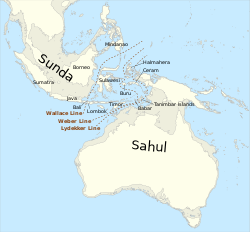
A University of Cambridge study suggested that Aboriginal peoples reached Sahul, the supercontinent comprising present-day Australia, New Guinea and surrounding islands, about 50,000 years ago.
2021
Researchers mapped likely migration routes across the Australian continent toward its southern reaches, including Tasmania, which was then connected to the mainland.
2025
The 2025 long chronology suggested that Sahul was settled by approximately 60,000 years ago through two migration routes.
Image source: Sahul
2025
A 2025 study proposed that the peopling of Australia occurred around 60,000 years ago through two distinct migration routes, presenting a long chronology for the settlement of Sahul.
2018 - 2019
The National Indigenous Languages Survey for 2018–19 found that more than 120 Indigenous language varieties were in use or being revived, although 70 of those in use were endangered.
2021
The 2021 census recorded 3,399 speakers of Pitjantjatjara.
2021
The 2021 census recorded 3,839 speakers of Djambarrpuyngu, one of the classifiable Aboriginal languages with the most speakers.
2021
According to the 2021 census, Kriol had 7,403 speakers, making it the classifiable Aboriginal language with the largest number of speakers.
2021
The 2021 census found that 167 Indigenous languages were spoken at home by 76,978 Indigenous Australians.
Image source: Australian Aboriginal languages
2021
As of 2021, 84% of Aboriginal and Torres Strait Islander people reported speaking only English at home.
2021
The 2021 census recorded 2,592 speakers of Warlpiri.
2021
The 2021 census recorded 2,063 speakers of Murrinh Patha.
2021
The 2021 census recorded 2,053 speakers of Tiwi.
2021
In 2021, 51% of Indigenous people stated that they held a secular or other spiritual belief or had no religious affiliation.
2021
The 2021 census reported that 41% of Indigenous people were affiliated with Christianity.
Image source: Religion in Australia
2021
The 2021 census reported that 1% of Indigenous people were affiliated with a traditional Aboriginal religion.
2021
The 25.2% increase was lower than the increases recorded between 2011 and 2016, which were 39.0%, and between 2006 and 2011, which were 38.7%.
2021
Explanations for the increase included changes in individuals' identification as Aboriginal or Torres Strait Islander between censuses and people completing a census form in 2021 but not in 2016.
2021
The census attributed 76.2% of the increase to people aged 0–19: 52.5% to children aged 0–4 and 23.7% to those aged 5–19.
2021
Initial 2021 census counts indicated that the Aboriginal and Torres Strait Islander population grew by 25.2% compared with the 2016 census.
2021
The 2021 census showed that there were 944,171 Aboriginal people, comprising 3.7% of Australia's population.
2021
The 2021 census counted 901,655 Aboriginal Australians and 42,516 people who identified as both Aboriginal Australian and Torres Strait Islander.
Or browse the full history timeline directory, with more than 2,500 topics.
This Aboriginal Australian History timeline was generated with the help of AI, using information found on the internet.
We work hard to keep these timelines accurate, but mistakes do get through. If you spot one, email us at [email protected] and we'll fix it for future visitors.
Generate yours with AI or build it from scratch, for free.
Export your timeline, add your own events, edit or remove AI-generated events, and much more
No credit card required.
Cancel anytime.
Cancel anytime.
You can create an unlimited number of timelines with up to 10 events on each one, customize how they look, export them to PDF, PNG, PowerPoint, CSV, and Excel, and share them with a link. Paid plans raise the event limit and add features like spreadsheet imports and collaborators.
Yes. You can cancel your subscription from your account page at any time, and you will not be charged again. Your subscription stays active for the rest of the period you already paid for.
Yes. We will email you a reminder before the annual renewal, and we will also email you a receipt.
Yes. You can email us within 15 days of any payment, and we will issue you a full refund.
Check out our pricing docs or send us an email anytime: [email protected].