
-
Use Cases
-
Resources
-
Pricing
Arsenal Football Club is a professional football club based in Islington, London. Founded in 1886 by workers at the Royal Arsenal in Woolwich, the club has grown into one of England's most successful and popular teams, known for its attacking style of play, legendary managers like Arsène Wenger, and a record number of FA Cup victories. More Less
Dec 1, 1886
% complete
Arsenal Football Club was founded by workers at the Royal Arsenal armaments factory in Woolwich, southeast London, initially playing under the name Dial Square before adopting Royal Arsenal.
Image source: Arsenal F.C.
Jan 1, 1891
% complete
In 1891 the club turned professional and adopted the name Woolwich Arsenal, becoming one of the first professional clubs in southern England and joining the Football League two years later.
Aug 24, 1913
% complete
Facing financial difficulties in Woolwich, the club relocated to Arsenal Stadium in Highbury, north London, beginning a new era that would eventually see it dubbed 'the Home of Football' for Arsenal fans.
Image source: Arsenal Stadium
Apr 23, 1927
% complete
Arsenal reached its first FA Cup final in 1927 but lost to Cardiff City, becoming the first London club to appear in an FA Cup final at Wembley Stadium.
Image source: 1927 FA Cup final
Jun 1, 1925
% complete
Herbert Chapman joined Arsenal from Huddersfield Town, revolutionizing the club with modern training methods, tactical innovations like the WM formation, and a string of marquee signings that transformed Arsenal into a powerhouse.
Image source: Herbert Chapman
Jan 6, 1934
% complete
Herbert Chapman died suddenly of pneumonia aged 55, but the foundations he built carried Arsenal to further triumphs under his successors Joe Shaw and George Allison.
Jun 1, 1966
% complete
Former physiotherapist Bertie Mee was surprisingly appointed Arsenal manager in 1966, a move that would soon deliver the club's greatest period since the 1930s.
Image source: Bertie Mee
May 14, 1986
% complete
Former player George Graham returned as Arsenal manager in May 1986, ushering in a disciplined, defensively formidable era that restored the club to the top of English football.
Image source: George Graham
Oct 1, 1996
% complete
The relatively unknown Frenchman Arsène Wenger took charge at Highbury, introducing revolutionary approaches to diet, fitness, and scouting that would transform Arsenal into one of Europe's most stylish teams.
Image source: Arsène Wenger
Dec 22, 2019
% complete
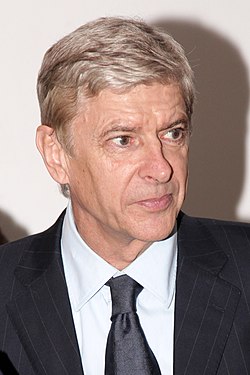
Manchester City assistant Mikel Arteta returned to Arsenal as head coach, beginning a rebuild centered on young talent that would return the Gunners to the upper echelons of English football.
Image source: Mikel Arteta
Apr 26, 1930
% complete
Arsenal won its first major trophy by defeating Chapman's former club Huddersfield Town 2–0 in the 1930 FA Cup final, launching the club's first golden era.
Image source: 1930 FA Cup final
May 3, 1931
% complete
Arsenal claimed its first league championship in 1930–31, scoring a then-record number of goals and establishing itself as England's dominant club of the decade.
Image source: 1930–31 Football League
May 1, 1935 - May 7, 1938
% complete
Arsenal dominated English football in the 1930s, winning five league titles including consecutive championships in 1932–33, 1933–34, and 1934–35, plus another in 1937–38.
Image source: History of Arsenal F.C. (1886–1966)
Apr 25, 1936
% complete
Arsenal beat Sheffield United 1–0 in the 1936 FA Cup final at Wembley, adding a second cup to their growing trophy cabinet during the interwar golden era.
Image source: 1936 FA Cup final
May 15, 1948
% complete
Under manager Tom Whittaker, Arsenal won its sixth league title in 1947–48, powered by stars such as Joe Mercer, Ronnie Rooke, and captain Leslie Compton.
Apr 29, 1950
% complete
Arsenal defeated Burnley 2–0 in the 1950 FA Cup final, completing Tom Whittaker's collection of both major domestic trophies as manager.
Image source: 1950 FA Cup final
May 9, 1953
% complete
Arsenal edged out Preston North End on goal average to win the 1952–53 league championship, its last major trophy for nearly two decades.
May 5, 1971
% complete
Arsenal completed its first League and FA Cup double, beating Liverpool 2–1 after extra time in the FA Cup final thanks to Charlie George's iconic winning goal.
May 1, 1979
% complete
Arsenal beat Manchester United 3–2 in the famous 'five-minute final', conceding twice late before Alan Sunderland's last-gasp winner sealed the FA Cup.
Image source: 1979 FA Cup final
Apr 26, 1987
% complete
Graham's Arsenal rallied from two goals down to beat Luton Town 3–2 in the 1987 League Cup final, securing the club's first silverware in eight years.
Image source: 1987 Football League Cup final
May 26, 1989
% complete
Michael Thomas's dramatic injury-time goal gave Arsenal a 2–0 win at Liverpool on the final day of the season, snatching the 1988–89 title on goals scored in one of football's most famous finishes.
Image source: Liverpool 0–2 Arsenal (1989)
Apr 18, 1993
% complete
Arsenal became the first club to win both domestic cups in the same season, defeating Sheffield Wednesday in the finals of both the League Cup and the FA Cup in 1993.
May 16, 1998
% complete
Arsenal overturned Manchester United's lead to win the inaugural-era Premier League title and then beat Newcastle 2–0 in the FA Cup final, completing Wenger's first double.
May 4, 2002
% complete
Led by Thierry Henry's brilliance, Arsenal won the 2001–02 Premier League without losing away all season and clinched the FA Cup against Chelsea days earlier for a second double under Wenger.
Aug 16, 2003 - May 15, 2004
% complete
Arsenal achieved the unprecedented feat of going unbeaten through the entire 2003–04 Premier League campaign, earning the nickname 'the Invincibles' and lifting the club's third title under Wenger.
May 17, 2014 - May 27, 2017
% complete
After a nine-year drought, Arsenal won the 2014 FA Cup against Hull City and went on to claim three more FA Cups in four seasons, including record-breaking wins in 2015, 2016 (final in 2017), and 2017.
Image source: 2014 FA Cup final
Aug 1, 2020
% complete
Pierre-Emerick Aubameyang scored twice as Arsenal beat Chelsea 2–1 in the 2020 FA Cup final behind closed doors, winning the competition for a record-extending 14th time.
Jul 1, 1970
% complete
Arsenal won its first European trophy, beating Anderlecht 4–3 on aggregate in the Inter-Cities Fairs Cup final, overturning a first-leg deficit in Brussels.
May 4, 1994
% complete
A resolute Arsenal defense defeated Parma 1–0 in Copenhagen to win the UEFA Cup Winners' Cup, courtesy of Alan Smith's goal, marking the club's second major European honor.
Image source: 1994 European Cup Winners' Cup final
May 17, 2000
% complete
Arsenal lost the 2000 UEFA Cup final to Galatasaray on penalties in Copenhagen, missing a chance to add a second major continental trophy.
Image source: 2000 UEFA Cup final
May 17, 2006
% complete
Arsenal reached its first UEFA Champions League final in Paris, taking the lead through Sol Campbell before falling 2–1 to Barcelona after Jens Lehmann's early red card.
Image source: 2006 UEFA Champions League final
Jun 20, 1995
% complete
Arsenal signed Dutch maestro Dennis Bergkamp from Inter Milan, a landmark transfer that signaled the club's ambition and laid the groundwork for the Wenger revolution.
Image source: Dennis Bergkamp
Jul 22, 2006
% complete
Arsenal left Highbury after 93 years and moved into the state-of-the-art Emirates Stadium, a £390 million project that boosted revenues but constrained transfer spending for years afterward.
Image source: Emirates Stadium
Or browse the full history timeline directory, with more than 2,000 topics.
This Arsenal FC timeline was generated with the help of AI, using information found on the internet.
We work hard to keep these timelines accurate, but mistakes do get through. If you spot one, email us at [email protected] and we'll fix it for future visitors.
Generate yours with AI or build it from scratch, for free.
Export your timeline, add your own events, edit or remove AI-generated events, and much more
No credit card required.
Cancel anytime.
Cancel anytime.
You can create an unlimited number of timelines with up to 10 events on each one, customize how they look, export them to PDF, PNG, PowerPoint, CSV, and Excel, and share them with a link. Paid plans raise the event limit and add features like spreadsheet imports and collaborators.
Yes. You can cancel your subscription from your account page at any time, and you will not be charged again. Your subscription stays active for the rest of the period you already paid for.
Yes. We will email you a reminder before the annual renewal, and we will also email you a receipt.
Yes. You can email us within 15 days of any payment, and we will issue you a full refund.
Check out our pricing docs or send us an email anytime: [email protected].