-
Resources
-
Pricing
The Atlantic Charter was a joint statement issued by Franklin D. Roosevelt and Winston Churchill in August 1941, outlining shared goals for the postwar world. More Less
Build a timeline like this one in minutes, for free. Start Yours →
Jul 29, 1918
Winston Churchill and Franklin D. Roosevelt attended the same dinner at Gray's Inn on 29 July 1918. Their substantive wartime partnership began much later, and this was not their first meeting.
1939
Churchill and Roosevelt began communicating in 1939. Their correspondence developed into a wartime relationship that eventually included 13 meetings and helped shape the ideas associated with the Atlantic Charter.
Jun 1941
The Allies first expressed principles and a vision for the postwar world in the Declaration of St. James's Palace in June 1941. It provided an important diplomatic predecessor to the Atlantic Charter.
Jul 1941
The Anglo-Soviet Agreement was signed in July 1941, forming an alliance between Britain and the Soviet Union. The agreement helped establish the broader Allied diplomatic context in which the Atlantic Charter was developed.
Aug 1941
During the Atlantic Conference in Placentia Bay, Newfoundland, Roosevelt and Churchill discussed what would become the Atlantic Charter. Their meetings focused on shared American and British goals for the world after the war.
Aug 1941
Roosevelt and Churchill held discussions aboard the USS Augusta and in connection with the surrounding naval meeting. These conversations produced the joint principles later issued as the Atlantic Charter.
Aug 9, 1941
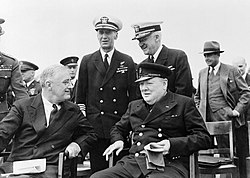
On 9 August 1941, the British battleship HMS Prince of Wales entered Placentia Bay with Churchill aboard. It was escorted by HMS Ripley, HMCS Assiniboine, and HMCS Restigouche, and met the American heavy cruiser USS Augusta, carrying Roosevelt and his staff.
Image source: Atlantic Charter
Aug 14, 1941
The joint declaration was made on 14 August 1941 from Naval Base Argentia, a US naval base on Placentia Bay. The base had recently been leased from Britain under the Destroyers-for-bases deal.
Image source: Naval Station Argentia
Aug 14, 1941
The Labour Party newspaper Daily Herald coined the name “Atlantic Charter” for the joint declaration. That name soon became the document’s generally accepted designation.
Aug 14, 1941
When released publicly on 14 August 1941, the document was titled “Joint Declaration by the President and the Prime Minister” and was generally known as the “Joint Declaration.”
Aug 14, 1941
The Atlantic Charter was issued on 14 August 1941 by the United States and Britain. It set out their goals for the world after World War II, months before the United States officially entered the conflict.
Aug 21, 1941
Roosevelt presented the content of the Atlantic Charter to the United States Congress on 21 August 1941, bringing the declaration formally into the American political discussion.
Aug 24, 1941
Churchill used the term “Atlantic Charter” in the British Parliament on 24 August 1941. The expression was subsequently adopted as the document’s standard name.
Sep 24, 1941
The government-in-exile of Luxembourg joined the unanimous adherence to the Atlantic Charter’s principles in London on 24 September 1941.
Sep 24, 1941
Representatives of the Free French Forces joined the unanimous adoption of adherence to the Atlantic Charter’s common principles in London.
Sep 24, 1941
The Soviet Union adopted adherence to the common principles of policy set forth by Britain and the United States at the Inter-Allied Council meeting.
Sep 24, 1941
The government-in-exile of Yugoslavia joined the other governments represented at the Inter-Allied Council in unanimously adopting adherence to the common principles.
Sep 24, 1941
The government-in-exile of Poland adopted adherence to the principles of policy stated by Britain and the United States.
Sep 24, 1941
The government-in-exile of Norway joined the unanimous adoption of adherence to the Atlantic Charter’s common principles at the London council meeting.
Sep 24, 1941
The government-in-exile of the Netherlands adopted the common principles of policy set forth by Britain and the United States.
Sep 24, 1941
The government-in-exile of Greece adopted adherence to the common principles associated with the Atlantic Charter at the Inter-Allied Council meeting.
Sep 24, 1941
The government-in-exile of Czechoslovakia joined the unanimous adoption of the Atlantic Charter’s common principles at the Inter-Allied Council meeting in London.
Sep 24, 1941
The government-in-exile of Belgium unanimously adopted adherence to the common principles of policy set forth by Britain and the United States at the Inter-Allied Council meeting.
Sep 24, 1941
At a meeting of the Inter-Allied Council in London on 24 September 1941, the governments and representatives unanimously adopted adherence to the common principles set out by Britain and the United States.
Jan 1, 1942
On 1 January 1942, a larger group of nations adhering to the Atlantic Charter’s principles issued the Declaration by United Nations. It stressed Allied solidarity in the defense against Hitlerism and became the basis for the modern United Nations.
Image source: Declaration by United Nations
Sep 1941
In a September 1941 speech, Churchill said the charter was intended to apply only to states under German occupation, rather than to territories under British occupation. The statement exposed tensions over the declaration’s meaning.
1942
In 1942, Mahatma Gandhi wrote to Roosevelt that Allied claims to be fighting for individual freedom and democracy sounded hollow while India and Africa were exploited by Britain. His criticism highlighted the contradiction between the charter’s principles and colonial rule.
1943
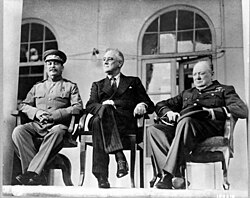
At the Tehran Conference in 1943, Roosevelt supported Josef Stalin against Churchill on imperial matters, including opposition to returning Indochina to France. Roosevelt also privately suggested cooperation with Stalin to reform an independent India, but Stalin dismissed the idea.
Image source: Tehran Conference
1943 - Mar 1944
During the war, Churchill argued for interpreting the charter in a way that would allow the Soviet Union to continue controlling the Baltic states. The United States rejected that interpretation until March 1944.
Mar 1944
By March 1944, the United States had rejected Churchill’s wartime interpretation of the Atlantic Charter that would have permitted continued Soviet control of the Baltic states.
Apr 1945
Roosevelt planned to raise the Baltic issue after the war, but he died in April 1945 before fighting had ended in Europe and before he could pursue that discussion.
Build a timeline like this one in minutes, for free. Start Yours →
Or browse the full history timeline directory, with more than 3,000 topics.
This Atlantic Charter timeline was generated with the help of AI, using information found on the internet.
We work hard to keep these timelines accurate, but mistakes do get through. If you spot one, email us at [email protected] and we'll fix it for future visitors.
Generate yours with AI or build it from scratch, for free.
Export your timeline, add your own events, edit or remove AI-generated events, and much more
No credit card required.
15-day money-back guarantee.
You can create an unlimited number of timelines with up to 10 events on each one, customize how they look, export them to PDF, PNG, PowerPoint, CSV, and Excel, and share them with a link. Timelines made with Timeline Maker AI keep every event the generator created, and you can add up to 5 events of your own. Paid plans remove the event limit, add spreadsheet imports and hide Preceden's branding, and the higher-priced plan also adds collaborators, a custom logo and a custom domain.
Yes. You can cancel your subscription from your account page at any time, and you will not be charged again. Your subscription stays active for the rest of the period you already paid for.
Yes. We email you a reminder 15 days before your annual renewal, and we email you a receipt after every payment.
Yes. You can email us within 15 days of any payment, and we will issue you a full refund.
Check out our pricing docs or send us an email anytime: [email protected].