-
Use Cases
-
Resources
-
Pricing
The Battles of Bull Run, also known as the First and Second Battles of Manassas, were two major engagements of the American Civil War fought near Manassas Junction, Virginia. The First Battle of Bull Run on July 21, 1861, was the first large-scale battle of the war and shattered Northern hopes of a quick victory, while the Second Battle in August 1862 was another decisive Confederate victory under Robert E. Lee. More Less
Dec 20, 1860
% complete
On December 20, 1860, South Carolina became the first of seven Southern states to declare secession from the Union of the United States, setting in motion the chain of events that would lead to civil war.
Image source: First Battle of Bull Run
Feb 1, 1861
% complete
By February 1, 1861, Mississippi, Florida, Alabama, Georgia, Louisiana, and Texas had passed ordinances of secession, joining South Carolina in leaving the Union.
Feb 8, 1861
% complete
On February 8, 1861, the Constitution of the Confederate States of America was adopted in Montgomery, Alabama, formally establishing the government of the new Confederacy.
Image source: Confederate States of America
Mar 1, 1861
% complete
On March 1, 1861, Confederate States Army forces assumed control of the military situation at Charleston, South Carolina from state forces, tightening their grip on the harbor where Fort Sumter stood.
Apr 12, 1861
% complete
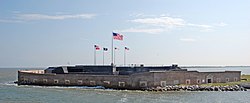
Open warfare between the Confederate States and the United States began when Confederate forces barraged Fort Sumter in Charleston Harbor, which had been occupied by the United States Army since December 26, 1860.
Image source: Fort Sumter
Apr 15, 1861
% complete
Two days after the Federal Army forces surrendered at Fort Sumter, President Abraham Lincoln issued a proclamation declaring that an insurrection against the laws of the United States had taken place.
Image source: Abraham Lincoln
May 29, 1861
% complete
With the arrival of Confederate President Jefferson Davis in Richmond, Virginia, the Confederate States capital was moved from Montgomery, placing it close to the front lines near Washington, D.C.
Image source: Jefferson Davis
1861
% complete
The name of the battle has caused controversy since 1861: Northerners typically called it Bull Run after the stream, while Southerners called it Manassas after the nearby town.
Image source: Names of the American Civil War
Jul 21, 1861
% complete
Stonewall Jackson, arguably the most important tactical contributor to the victory, received no special recognition after Bull Run, though he would later achieve glory for his 1862 Valley campaign.
Image source: Stonewall Jackson
Jul 21, 1861
% complete
Both Union and Confederate killed, wounded, and missing were a little over 1700 each, sobering figures that shattered hopes of a short war on both sides.
1993
% complete
The battle is described in Rebel (1993), the first volume of Bernard Cornwell's The Starbuck Chronicles series of historical novels.
1997
% complete
In Murder at 1600, Detective Harlan Regis (Wesley Snipes) has built a plan-relief of the battle which plays a certain role in the plot of the film.
Image source: Murder at 1600
1999
% complete
Manassas (1999) is the first volume in the James Reasoner Civil War Series of historical novels, drawing on the battle for its subject matter.
May 3, 1861
% complete
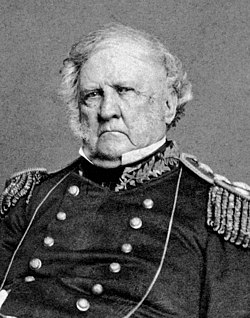
General Winfield Scott laid out his strategy on May 3, 1861 to subdue the Confederate States, a plan that would shape Union military operations in the war's early months.
Image source: Winfield Scott
Jun 28, 1861
% complete
An abstract from the return of the Department of Pennsylvania, commanded by Major-General Patterson, dated June 28, 1861, documented Union strength as forces maneuvered in the Shenandoah Valley.
Image source: First Battle of Bull Run order of battle: Union
Jun 30, 1861
% complete
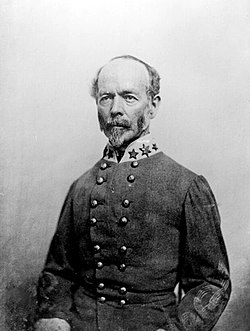
A field return for June 30, 1861 recorded the strength of Johnston's division, or Army of the Shenandoah (C.S.A.), which would soon be moved by rail to reinforce Beauregard at Manassas.
Image source: Joseph E. Johnston
Jul 1861
% complete
By July 1861, many of the thousands of Union volunteers who had answered Lincoln's call were camped in and around Washington, D.C., eager for action against the Confederates massing nearby.
Jul 16, 1861 - Jul 17, 1861
% complete
Abstracts from the returns of the Department of Northeastern Virginia, commanded by Brigadier-General McDowell, U.S.A., for July 16 and 17, 1861 documented the army as it began its advance toward Manassas Junction.
Image source: Irvin McDowell
Jul 21, 1861
% complete
Hammond had purchased approximately 400 Pattern 1853 Enfield rifles to equip his men; however, it is not clear if his troops had them at Bull Run or if the weapons arrived after the battle.
Image source: Wade Hampton III
Jul 21, 1861
% complete
Confederate casualties at the battle of Bull Run on July 21, 1861 also totaled a little over 1700 killed, wounded, and missing, roughly equal to Union losses despite the Southern victory.
Jul 21, 1861
% complete
An abstract front field return of the First Corps (Army of the Potomac) dated July 21, 1861 documented the Confederate force under Beauregard that won the battle.
Jul 21, 1861
% complete
Union artillery lost in the battle of Bull Run on July 21, 1861 included guns abandoned during the chaotic retreat toward Washington, a significant material loss for the Federal army.
Jul 21, 1861
% complete
Union casualties at the battle of Bull Run on July 21, 1861 numbered over 1700 killed, wounded, and missing, reflecting the costly repulse of the Federal advance.
Jul 21, 1861
% complete
The battle was fought on July 21, 1861, in Prince William County, Virginia, just north of what is now the city of Manassas and about thirty miles west-southwest of Washington, D.C. It ended in a decisive Confederate victory.
Oct 15, 1966
% complete
As a historic area under the National Park Service, Manassas National Battlefield Park was administratively listed on the National Register of Historic Places on October 15, 1966.
Image source: Manassas National Battlefield Park
Jan 1, 2010
% complete
The American Battlefield Trust and its partners have preserved more than 385 acres of the battlefields at Manassas in 15 transactions since 2010, mostly on the Second Manassas Battlefield.
2011
% complete
Prince William County was named the number one tourist destination in the United States for 2011 by the American Bus Association for its efforts in highlighting the historical impact of the Civil War.
Jan 1, 2011 - Dec 31, 2011
% complete
Prince William County staged special events commemorating the 150th anniversary of the Civil War throughout 2011, drawing visitors to sites including the Bull Run battlefield.
Image source: Prince William County, Virginia
Jul 21, 2011 - Jul 24, 2011
% complete
The City of Manassas commemorated the 150th anniversary of the battle July 21–24, 2011 with ceremonies and educational programs honoring those who fought there.
Image source: Manassas, Virginia
Jul 23, 2011 - Jul 24, 2011
% complete
The cornerstone of the commemoration event featured a large reenactment of the battle on July 23–24, 2011, recreating the fighting of 150 years earlier before thousands of spectators.
Or browse the full history timeline directory, with more than 2,000 topics.
This Battle of Bull Run timeline was generated with the help of AI, using information found on the internet.
We work hard to keep these timelines accurate, but mistakes do get through. If you spot one, email us at [email protected] and we'll fix it for future visitors.
Generate yours with AI or build it from scratch, for free.
Export your timeline, add your own events, edit or remove AI-generated events, and much more
No credit card required.
Cancel anytime.
Cancel anytime.
You can create an unlimited number of timelines with up to 10 events on each one, customize how they look, export them to PDF, PNG, PowerPoint, CSV, and Excel, and share them with a link. Paid plans raise the event limit and add features like spreadsheet imports and collaborators.
Yes. You can cancel your subscription from your account page at any time, and you will not be charged again. Your subscription stays active for the rest of the period you already paid for.
Yes. We will email you a reminder before the annual renewal, and we will also email you a receipt.
Yes. You can email us within 15 days of any payment, and we will issue you a full refund.
Check out our pricing docs or send us an email anytime: [email protected].