
-
Use Cases
-
Resources
-
Pricing
The Battle of Ia Drang was the first major engagement between regular forces of the United States Army and the People's Army of Vietnam during the Vietnam War. Fought in the Ia Drang Valley of the Central Highlands of South Vietnam in November 1965, it involved intense helicopter-borne combat by the U.S. 1st Cavalry Division against North Vietnamese troops, resulting in heavy casualties on both sides and shaping future American air mobility tactics. More Less
1954
% complete
During the First Indochina War against the French, Vietnamese communist forces operated in the Central Highlands area, winning a notable victory at the Battle of Mang Yang Pass in 1954.
Image source: Battle of Mang Yang Pass
1964
% complete
By 1964 North Vietnam had established the B3 Front in the central highlands of South Vietnam to coordinate operations in the region.
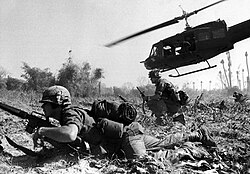
Image source: Battle of Ia Drang
Jan 1, 1965
% complete
By early 1965, the majority of rural South Vietnam was under limited Viet Cong control, increasingly supported by People's Army of Vietnam (PAVN) regulars from North Vietnam.
1965
% complete
In 1965 VC forces were in nominal control of most of the South Vietnamese countryside and had established military infrastructure in the Central Highlands, northeast of the Saigon region.
1965
% complete
During 1965, large groups of PAVN regulars moved into the Central Highlands area to conduct offensive operations.
Jun 1, 1965 - Aug 31, 1965
% complete
Under President Johnson, a build-up of American forces took place in the summer of 1965 as U.S. involvement in Vietnam escalated.
Jul 1965
% complete
The division's troopers dubbed themselves the "Air Cav" (Air Cavalry), pioneering airmobile tactics, and began deploying to Camp Radcliff at An Khê, Vietnam in July 1965.
Image source: 1st Cavalry Division (United States)
Nov 1, 1965 - Nov 14, 1965
% complete
By early November 1965, three PAVN regiments – the 32nd, 33rd and 66th – and the H15 Local Force Battalion had been assembled at the eastern foot of the Chu Pong Massif in the central highlands.
Oct 18, 1965 - Nov 26, 1965
% complete
ARVN's II Corps Command recapitulated PAVN losses from October 18 to November 26 as follows: KIA (body count) 4,254; KIA (estimated) 2,270; WIA 1,293; captured 179; crew-served weapons 169; individual weapons 1,027.
Nov 14, 1965 - Nov 18, 1965
% complete
The U.S. military confirmed 305 killed and 524 wounded, including 234 killed and 242 wounded between November 14 and 18, 1965, and claimed 3,561 PAVN killed and more than 1,000 wounded during engagements with 1st Cavalry Division troops.
1966
% complete
A 1966 PAVN Central Highlands Front report claimed that in five major engagements with U.S. forces during the campaign, communist forces inflicted significant losses on American units.
Image source: People's Army of Vietnam
Oct 23, 1965 - Nov 26, 1965
% complete
The 1st Cavalry Division (Airmobile) and attached units received the Presidential Unit Citation (DAGO 40, 1967) for the period beginning October 23, 1965, distinguished by outstanding performance of duty and extraordinary heroism against an armed enemy in the Republic of Vietnam, becoming the first unit so honored for actions during the Vietnam War.
Image source: Presidential Unit Citation (United States)
Nov 14, 1965 - Nov 16, 1965
% complete
Major Bruce Crandall flew 22 volunteer flights in his unarmed Huey into LZ X-Ray under extremely heavy enemy fire, resupplying troops and evacuating wounded; he was awarded the Medal of Honor on February 26, 2007.
Nov 14, 1965 - Nov 16, 1965
% complete
Major Ed Freeman flew 14 volunteer flights in his unarmed Huey into LZ X-Ray while enemy fire was so heavy that medical evacuation helicopters refused to approach, earning him the Medal of Honor awarded on July 16, 2001.
Nov 15, 1965
% complete
On November 15, 1965, during the battle at LZ X-Ray, a platoon leader disregarded his own safety to help rescue two wounded soldiers while under fire; he received the Silver Star and was later decorated again on January 8, 1998.
Feb 15, 1967
% complete
On February 15, 1967, a platoon leader who had served at LZ X-Ray was decorated with the Silver Star for his actions on November 14, 1965, during the three-day battle there.
Image source: Silver Star
1994
% complete
In 1994, Moore, Galloway and men who fought on both the American and North Vietnamese sides traveled back to the remote jungle clearings where the battle took place, marking a remarkable act of reconciliation between former enemies.
Image source: We Were Soldiers Once...and Young
1996
% complete
In 1996, veterans including Adams of Platoon 3, Company A, 1st Battalion, 7th Cavalry were awarded the Bronze Star with Valor for their actions during the battle.
Image source: Bronze Star Medal
Jul 16, 2001
% complete
Ed Freeman was awarded the Medal of Honor on July 16, 2001, for his 14 volunteer flights into LZ X-Ray aboard an unarmed Huey while enemy fire was so heavy that medical evacuation helicopters refused to approach.
Image source: Ed Freeman
Feb 26, 2007
% complete
Bruce Crandall was awarded the Medal of Honor on February 26, 2007, for his 22 volunteer flights in his unarmed Huey into LZ X-Ray while enemy fire was so heavy that medical evacuation helicopters refused to approach.
Image source: Bruce P. Crandall
Nov 1965
% complete
At precisely 16:00, the first wave of B-52 carpet bombings fell at YA 8702, about 7 kilometers west of LZ X-Ray, aiming mainly to strike the units of the 32nd Regiment located about 5 kilometers further west; the strikes carried on for five consecutive days.
Nov 1965
% complete
At 21:00 the 1st Air Cavalry selected coordinates for a B-52 strike in code – YA 870000, YA 830000, YA 830070, YA 870070 – with alternative targets YA 8607, YA 9007, YA 9000, and YA 8600.
Image source: Operation Arc Light
Nov 14, 1965 - Nov 16, 1965
% complete
At LZ X-Ray, American forces of the 1st Battalion, 7th Cavalry engaged PAVN units in an intense three-day battle marked by heavy fighting, close air support, and heroic actions by soldiers on both sides.
Image source: Battle of Ia Drang
Nov 14, 1965 - Nov 18, 1965
% complete
The Battle of Ia Drang was the first major battle between the United States Army and the People's Army of Vietnam (PAVN), part of the Pleiku campaign conducted early in the Vietnam War, fought at the eastern foot of the Chu Pong Massif in the central highlands of Vietnam in November 1965.
2002
% complete
Randall Wallace depicted the battle at LZ X-Ray in the 2002 movie We Were Soldiers, starring Mel Gibson and Barry Pepper as Moore and Galloway respectively.
Image source: We Were Soldiers
Or browse the full history timeline directory, with more than 2,000 topics.
This Battle of Ia Drang timeline was generated with the help of AI, using information found on the internet.
We work hard to keep these timelines accurate, but mistakes do get through. If you spot one, email us at [email protected] and we'll fix it for future visitors.
Generate yours with AI or build it from scratch, for free.
Export your timeline, add your own events, edit or remove AI-generated events, and much more
No credit card required.
Cancel anytime.
Cancel anytime.
You can create an unlimited number of timelines with up to 10 events on each one, customize how they look, export them to PDF, PNG, PowerPoint, CSV, and Excel, and share them with a link. Paid plans raise the event limit and add features like spreadsheet imports and collaborators.
Yes. You can cancel your subscription from your account page at any time, and you will not be charged again. Your subscription stays active for the rest of the period you already paid for.
Yes. We will email you a reminder before the annual renewal, and we will also email you a receipt.
Yes. You can email us within 15 days of any payment, and we will issue you a full refund.
Check out our pricing docs or send us an email anytime: [email protected].