-
Use Cases
-
Resources
-
Pricing
The Battle of Dien Bien Phu was the climactic confrontation of the First Indochina War, fought between the French Union forces and the Viet Minh communist revolutionaries. The battle took place near the village of Dien Bien Phu in northwestern Vietnam, where the Viet Minh under General Vo Nguyen Giap besieged and defeated the fortified French garrison, leading to the end of French colonial presence in Indochina. More Less
1952 - 1953
% complete
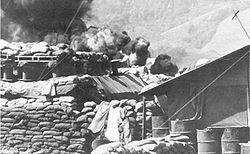
During their 1952–1953 campaign, the Viet Minh had overrun vast swathes of Laos, Vietnam's western neighbor, advancing as far as Luang Prabang and the Plain of Jars.
Image source: Battle of Dien Bien Phu
Nov 1952 - Dec 1952
% complete
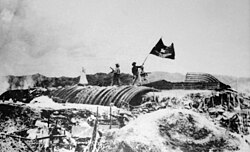
In late November and early December 1952, Giáp attacked the French outpost at Nà Sản, which was essentially an 'air-land base', a fortified camp supplied only by air.
Image source: Battle of Nà Sản
1953
% complete
By 1953, the First Indochina War was not going well for France, as Viet Minh forces under Ho Chi Minh and General Võ Nguyên Giáp gained strength and momentum across Indochina.
Image source: First Indochina War
1953
% complete
In 1953, the French began to strengthen their defenses in the Hanoi delta region to prepare for a series of offensives against Viet Minh staging areas in northwest Vietnam.
May 1953
% complete
In May 1953, French Premier René Mayer named Henri Navarre as Salan's successor to command French Union forces in Indochina.
Image source: Henri Navarre
Jun 1953
% complete
In June 1953, Major General René Cogny, the French commander in the Tonkin Delta, proposed Điện Biên Phủ, which had an old airstrip built by the Japanese during World War II, as a 'mooring point'.
Nov 17, 1953
% complete
Navarre rejected criticisms of his proposal and concluded a 17 November conference by declaring that the operation would begin three days later, on 20 November 1953.
Image source: Operation Castor
Nov 1953
% complete
Earlier, in order to succeed the pre-Điện Biên Phủ Operation Castor of November 1953, General Chester McCarty made available twelve additional C-119 Flying Boxcars flown by French crews.
Image source: Fairchild C-119 Flying Boxcar
Feb 1954
% complete
In February 1954, following the French occupation of Điện Biên Phủ, Democratic senator Michael Mansfield asked Defense Secretary Charles Erwin Wilson whether the United States would send naval or air units if the French were subjected to greater pressure there, but Wilson replied that 'for the moment there is no justification for raising United States aid above its present level'.
Image source: Mike Mansfield
1975 - 2000
% complete
The role of CIA controlled airlines in Indochina and their role at Điện Biên Phủ was little known until they were published by Robbins after the end of the Vietnam War, and not officially acknowledged until the 21st century.
Image source: Civil Air Transport
Feb 25, 2005
% complete
On 25 February 2005, the seven still-living American pilots were awarded the French Legion of Honor by Jean-David Levitte, the French Ambassador to the United States.
Nov 20, 1953
% complete
Operations at Điện Biên Phủ began at 10:35 on 20 November 1953, as French paratroopers dropped onto the valley to establish a fortified air-land base.
1954
% complete
Max Hastings stated that 'In 2018 Hanoi has still not credibly enumerated its Dien Bien Phu losses, surely a reflection of their immensity.' Mark Moyar's book Triumph Forsaken lists Viet Minh casualties as 22,900 out of an original force of 50,000.
Jan 31, 1954
% complete
The French garrison came under sporadic direct artillery fire from the Viet Minh for the first time on 31 January 1954 and patrols encountered Viet Minh troops in all directions around them.
Mar 13, 1954
% complete
The Viet Minh assault began in earnest on 13 March 1954 with an attack on the northeastern outpost, Béatrice, which was held by the 3rd Battalion, 13th Foreign Legion Demi-Brigade.
Mar 13, 1954 - May 7, 1954
% complete
The Battle of Dien Bien Phu took place between 13 March and 7 May 1954, pitting the French Union garrison against Viet Minh forces under General Võ Nguyên Giáp in a decisive confrontation of the First Indochina War.
1954
% complete
The fall of Điện Biên Phủ was a disaster not just for France but also for the United States who, by 1954, was underwriting 80% of French expenditures in Indochina.
May 1954
% complete
The fall of Dien Bien Phu, in a strictly military perspective, represented a very serious failure but one that in the immediate, that is to say, spring of 1954, did not upset the balance of forces present in Indochina.
May 1954 - May 31, 1954
% complete
By the end of May 1954, mediation by the Red Cross enabled the evacuation of 858 of the most severely wounded prisoners from the fallen fortress.
May 8, 1954
% complete
The Geneva Conference opened on 8 May 1954, the day after the surrender of the French garrison at Dien Bien Phu.
Image source: 1954 Geneva Conference
Jul 1954
% complete
The partition of Vietnam was agreed in the 1954 Geneva Accords signed ten weeks after the battle.
1956
% complete
The partition was supposed to be temporary, and the two zones were meant to be reunited through national elections in 1956, which were never held.
1956
% complete
The last French forces withdrew from Vietnam in 1956, ending nearly a century of French colonial presence in the country.
Image source: French Indochina
May 7, 1954
% complete
The surrender of the French garrison on 7 May 1954 ended the battle and became an enduring symbol of Vietnamese resistance and decolonization, remembered through films, songs, and commemorations decades later.
1966
% complete
The beginning of the 1966 film Lost Command starring Anthony Quinn showed the battle towards its end.
Image source: Lost Command
Jan 1968
% complete
In January 1968, during the Vietnam War, the North Vietnamese Army under Võ Nguyên Giáp's command initiated a siege and artillery bombardment on the US Marine Corps base at Khe Sanh in South Vietnam, as they did at Điện Biên Phủ.
Image source: Battle of Khe Sanh
1968
% complete
By 1968, the US military presence in Vietnam dwarfed that of the French in 1954, and included numerous technological advances such as effective helicopters.
1968
% complete
The US Air Force dropped 114,810 tons of bombs on the North Vietnamese at Khe Sanh, roughly as many as dropped on all of Japan in 1945 during World War II.
1989
% complete
The 1989 pop rock song We Didn't Start the Fire by American artist Billy Joel mentions the battle ('Dien Bien Phu Falls') in the second verse of the song.
Image source: We Didn't Start the Fire
1992
% complete
The battle was a subject in the 1992 French film Dien Bien Phu written and directed by Pierre Schoendoerffer, who had been present at the battle as a war cameramen.
Or browse the full history timeline directory, with more than 2,000 topics.
This Battle of Dien Bien Phu timeline was generated with the help of AI, using information found on the internet.
We work hard to keep these timelines accurate, but mistakes do get through. If you spot one, email us at [email protected] and we'll fix it for future visitors.
Generate yours with AI or build it from scratch, for free.
Export your timeline, add your own events, edit or remove AI-generated events, and much more
No credit card required.
Cancel anytime.
Cancel anytime.
You can create an unlimited number of timelines with up to 10 events on each one, customize how they look, export them to PDF, PNG, PowerPoint, CSV, and Excel, and share them with a link. Paid plans raise the event limit and add features like spreadsheet imports and collaborators.
Yes. You can cancel your subscription from your account page at any time, and you will not be charged again. Your subscription stays active for the rest of the period you already paid for.
Yes. We will email you a reminder before the annual renewal, and we will also email you a receipt.
Yes. You can email us within 15 days of any payment, and we will issue you a full refund.
Check out our pricing docs or send us an email anytime: [email protected].