-
Use Cases
-
Resources
-
Pricing
Bob Dylan is an American singer-songwriter widely regarded as one of the most influential figures in popular music. Born Robert Allen Zimmerman in Duluth, Minnesota, he rose to fame in the early 1960s as a folk artist before famously 'going electric' in 1965. Over a career spanning more than six decades, Dylan has released landmark albums such as The Freewheelin' Bob Dylan, Highway 61 Revisited, and Blood on the Tracks, penned timeless songs like 'Blowin' in the Wind' and 'Like a Rolling Stone,' and earned numerous honors including the Nobel Prize in Literature in 2016. More Less
May 24, 1941
% complete
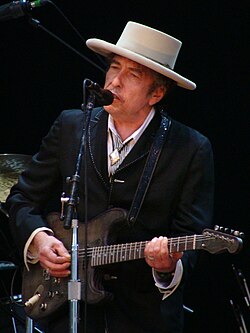
Robert Allen Zimmerman, later known as Bob Dylan, was born in Duluth, Minnesota, to Abram and Beatrice Zimmerman. He grew up in nearby Hibbing, where he developed an early passion for music, teaching himself piano and guitar and forming bands during his teenage years.
Image source: Bob Dylan
1956
% complete
While attending Hibbing High School, Dylan formed the rock and roll group The Golden Chords, performing covers of popular songs by artists like Little Richard and Elvis Presley at local events and school functions.
Image source: Daphne Guinness
Sep 1959
% complete
Dylan enrolled at the University of Minnesota in Minneapolis, where he became immersed in the local folk music scene and began performing at coffeehouses under the stage name Bob Dylan, inspired by the poet Dylan Thomas.
Jan 1961
% complete
Dylan dropped out of college and moved to Greenwich Village in New York City, where he performed in folk clubs, met his idol Woody Guthrie, and quickly built a reputation as a gifted singer-songwriter with a distinctive voice and poetic lyrics.
Sep 1961
% complete
After a rave review in The New York Times of his performance at Gerde's Folk City, Dylan signed a recording contract with Columbia Records, beginning one of the most consequential artist-label relationships in music history.
Image source: Bob Dylan (album)
Aug 28, 1963
% complete
Dylan performed 'Blowin' in the Wind' and 'When the Ship Comes In' at the historic March on Washington, shortly before Martin Luther King Jr. delivered his famous 'I Have a Dream' speech, cementing Dylan's role as a voice of the era's social movements.
Image source: March on Washington for Jobs and Freedom
Mar 19, 1962
% complete
Dylan's debut album featured mostly traditional folk songs and blues covers, with only two original compositions. Though it sold modestly at first, it established him as an authentic voice of the American folk revival.
May 27, 1963
% complete
His second album included protest anthems like 'Blowin' in the Wind' and 'A Hard Rain's a-Gonna Fall,' transforming Dylan into the leading voice of the civil rights movement and catapulting him to national fame.
Image source: The Freewheelin' Bob Dylan
Jan 13, 1964
% complete
This all-protest album solidified Dylan's reputation as the preeminent songwriter of social change, featuring the iconic title track that became an anthem for the 1960s counterculture and civil rights movements.
Image source: The Times They Are a-Changin' (song)
Aug 30, 1965
% complete
Featuring the six-minute hit single 'Like a Rolling Stone,' this album fused electric rock with surreal, literate lyrics and is widely regarded as one of the greatest albums ever recorded, revolutionizing popular music.
Image source: Highway 61 Revisited
Jun 20, 1966
% complete
Recorded largely in Nashville, Blonde on Blonde was one of the first major double albums in rock history, blending vivid surrealist imagery with bluesy rock and cementing Dylan's status as a musical genius.
Image source: Blonde on Blonde
Jun 1967 - Oct 1967
% complete
While recuperating in Woodstock, Dylan recorded dozens of informal songs with The Band in his home basement. These lo-fi recordings circulated widely as bootlegs and influenced the back-to-roots movement in rock before their official release in 1975.
Image source: The Basement Tapes
Dec 27, 1967
% complete
Marking a stark departure from his electric work, this quiet, biblical album embraced acoustic country-folk textures and included 'All Along the Watchtower,' later famously covered by Jimi Hendrix.
Image source: John Wesley Harding
Apr 9, 1969
% complete
Dylan fully embraced country music on this warm, melodic album recorded in Nashville with Johnny Cash, showcasing a new smooth singing voice and yielding the hit duet 'Lay Lady Lay.'
Image source: Nashville Skyline
Jan 20, 1975
% complete
Widely considered one of his masterpieces, this introspective album reflected the breakdown of his marriage, featuring classics like 'Tangled Up in Blue' and 'Simple Twist of Fate.'
Image source: Blood on the Tracks
Aug 20, 1979
% complete
Following a religious awakening, Dylan released this gospel-inflected album of Christian themes, which won him his first Grammy Award for Best Male Rock Vocal Performance for the song 'Gotta Serve Somebody.'
Aug 29, 2006
% complete
At age 65, Dylan scored his first number-one album in the United States since 1976 with Modern Times, proving his enduring relevance and earning widespread critical praise.
Jul 25, 1965
% complete
Dylan shocked folk purists by performing with an electric band at the Newport Folk Festival, a moment that sparked boos and controversy but marked his decisive turn toward rock music and redefined the boundaries of folk and rock.
Image source: Electric Dylan controversy
Jul 29, 1966
% complete
Dylan suffered a motorcycle accident near Woodstock, New York, breaking several vertebrae. He withdrew from public life and touring for years, using the time to write and record informally with The Band.
Jan 3, 1974 - Feb 14, 1974
% complete
Dylan launched a sold-out North American tour backed by The Band, his first concerts since 1966. The tour generated enormous demand and produced the live album Before the Flood.
Image source: Bob Dylan and the Band 1974 Tour
Oct 30, 1975 - May 25, 1976
% complete
Dylan assembled a sprawling caravan of musicians and performers, including Joan Baez and Allen Ginsberg, for a freewheeling, theatrical tour across North America celebrating communal spirit and artistic freedom.
Image source: Rolling Thunder Revue
Jul 13, 1985
% complete
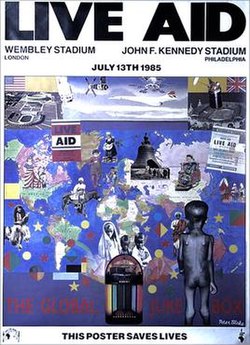
Dylan appeared at the massive global Live Aid concert in Philadelphia, performing with Keith Richards and Ron Wood, and famously suggested some proceeds go to struggling American farmers, inspiring Farm Aid.
Image source: Live Aid
1988
% complete
Dylan joined George Harrison, Tom Petty, Roy Orbison, and Jeff Lynne to form the lighthearted supergroup the Traveling Wilburys, whose debut album was a surprise commercial and critical success.
Image source: Traveling Wilburys
Jun 7, 1988
% complete
Dylan embarked on what became known as the Never Ending Tour, a relentless schedule of roughly 100 shows per year that has continued for decades, making him one of the most prolific live performers in history.
Image source: Never Ending Tour
Oct 5, 2004
% complete
Dylan released the first volume of his memoirs, an unconventional and lyrical account of his early years that spent months on bestseller lists and was nominated for the National Book Critics Circle Award.
Image source: Chronicles: Volume One
May 3, 2006 - Apr 15, 2009
% complete
Dylan hosted a weekly radio show on XM Satellite Radio, curating eclectic episodes around themes like 'Weather' and 'Coffee' while displaying his deep knowledge of American roots music and dry wit.
Dec 7, 2020
% complete
Dylan sold his entire catalog of more than 600 songs to Universal Music Publishing Group in a landmark deal reportedly worth hundreds of millions of dollars, one of the largest music publishing sales ever.
Image source: Universal Music Publishing Group
1982
% complete
Dylan received one of many early career honors when he was inducted into the Songwriters Hall of Fame, recognizing his extraordinary influence on American songwriting across multiple genres.
Image source: Songwriters Hall of Fame
Jan 20, 1988
% complete
Bruce Springsteen inducted Dylan into the Rock and Roll Hall of Fame, hailing him as the father of his country whose songs liberated listeners and transformed what popular music could be.
Image source: Rock and Roll Hall of Fame
Dec 7, 1997
% complete
Dylan was honored at the Kennedy Center Honors for his lifetime contributions to American culture, joining an elite group of artists recognized by the nation's highest artistic tribute.
Image source: Kennedy Center Honors
Feb 25, 1998
% complete
Dylan's brooding meditation on mortality, Time Out of Mind, won three Grammy Awards including Album of the Year, marking a major late-career critical resurgence after a commercially lean decade.
Image source: Time Out of Mind (Bob Dylan album)
Mar 25, 2001
% complete
Dylan won the Academy Award for Best Original Song for 'Things Have Changed' from the film Wonder Boys, adding an Oscar to his growing collection of major honors.
Image source: Things Have Changed
May 29, 2012
% complete
President Barack Obama presented Dylan with the Presidential Medal of Freedom, America's highest civilian honor, praising him as the preeminent poet of American song.
Image source: Presidential Medal of Freedom
Oct 13, 2016
% complete
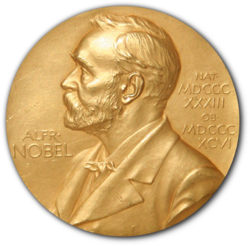
Dylan became the first musician awarded the Nobel Prize in Literature, honored 'for having created new poetic expressions within the great American song tradition,' sparking global debate about the boundaries of literature.
Image source: Nobel Prize in Literature
Or browse the full history timeline directory, with more than 2,000 topics.
This Bob Dylan timeline was generated with the help of AI, using information found on the internet.
We work hard to keep these timelines accurate, but mistakes do get through. If you spot one, email us at [email protected] and we'll fix it for future visitors.
Generate yours with AI or build it from scratch, for free.
Export your timeline, add your own events, edit or remove AI-generated events, and much more
No credit card required.
Cancel anytime.
Cancel anytime.
You can create an unlimited number of timelines with up to 10 events on each one, customize how they look, export them to PDF, PNG, PowerPoint, CSV, and Excel, and share them with a link. Paid plans raise the event limit and add features like spreadsheet imports and collaborators.
Yes. You can cancel your subscription from your account page at any time, and you will not be charged again. Your subscription stays active for the rest of the period you already paid for.
Yes. We will email you a reminder before the annual renewal, and we will also email you a receipt.
Yes. You can email us within 15 days of any payment, and we will issue you a full refund.
Check out our pricing docs or send us an email anytime: [email protected].