-
Use Cases
-
Resources
-
Pricing
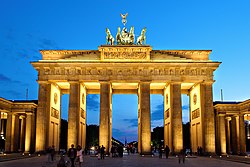
The Brandenburg Gate is an 18th-century neoclassical monument in Berlin, Germany, built on the orders of King Frederick William II. Commissioned after the restoration of order during the Batavian Revolution, it was designed by architect Carl Gotthard Langhans and completed in 1791. Modeled after the Propylaea in Athens, the gate became one of Berlin's most iconic landmarks, later crowned with the Quadriga chariot statue of victory. Throughout its history, it has witnessed Napoleon's triumphal entry, Prussian victories, World War II destruction, Cold War division as part of the Berlin Wall, and finally Germany's reunification, making it a powerful symbol of European peace and unity. More Less
1670
% complete
With the construction of Dorotheenstadt around 1670 and its inclusion in Berlin's city fortifications, a first gate was built on the site at approximately the level of today's Schadowstraße, consisting of a breach through the raised wall and a drawbridge over the dug moat.
1688
% complete
In the time of King Frederick William I (1688), shortly after the Thirty Years' War and a century before today's Brandenburg Gate was constructed, Berlin was a small walled city within a star fort with several named gates, including Spandauer Tor.
1734
% complete
With the expansion of Dorotheenstadt to the west and construction of the Berlin Customs Wall in 1734, which enclosed the old fortified city and many suburbs, a predecessor of today's Brandenburg Gate was built by Court Architect Philipp Gerlach as a city gate on the road to Brandenburg an der Havel. These structures were called 'custom houses' or 'gatehouses', and the wall was in force until 1860.
1786
% complete
Frederick William II of Prussia was in his early forties when he came to the throne in 1786. His uncle's tastes had drawn on French classicism and English Palladianism, as seen in his smaller Brandenburg Gate in Potsdam (1770–71).
Image source: Frederick William II of Prussia
1788
% complete
Frederick William II summoned new German architects to Berlin, including Carl Gotthard Langhans from Breslau (today Wrocław in Poland), who was appointed director of the 'Oberhofbauamt' (Royal Office of Works) in 1788.
Image source: Carl Gotthard Langhans
1788 - 1791
% complete
The current neoclassical structure was built from 1788 to 1791 by orders of King Frederick William II of Prussia, based on designs by royal architect Carl Gotthard Langhans. It was his first significant work in the Greek style, and his last major one; by 1792 he had designed a small neo-Gothic building for the New Garden in Potsdam.
Aug 1791
% complete
The gate was originally called 'Friedenstor' (Peace Gate) and unceremoniously opened to traffic in August 1791 before its construction had been completed.
1793
% complete
The quadriga faces east, as it did when it was originally installed in 1793 atop the Brandenburg Gate.
Image source: Brandenburg Gate
1800 - 1899
% complete
Statues in niches at the furthest side wall of Minerva and Mars were added to the gate complex during the course of the 19th century.
1814 - 1919
% complete
From 1814 to 1919, only the royal family was allowed to pass through the central archway, as well as members of the Pfuel family, honoring General Ernst von Pfuel who returned the quadriga.
1900
% complete
After 1900, due to weathering and environmental damage, smaller and larger pieces of stone began to fall from the gate. Comprehensive renovation work began in 1913 but had to be interrupted by the outbreak of World War I.
1926
% complete
The comprehensive renovation that began in 1913 was interrupted by World War I and was not completed until 1926.
1806
% complete
After the 1806 Prussian defeat at the Battle of Jena-Auerstedt, Napoleon was the first to use the Brandenburg Gate for a triumphal procession, and took its quadriga to Paris.
1814
% complete
After Napoleon's defeat in 1814 and the Prussian occupation of Paris by General Ernst von Pfuel, the quadriga was restored to Berlin.
Jan 1919 - Mar 1920
% complete
The gate was used as a firing position by government troops during both the Spartacist uprising of January 1919 and the Kapp Putsch in March 1920.
1939
% complete
In 1939, a seven-kilometer-long section between the Brandenburg Gate and Adolf-Hitler-Platz (today Theodor-Heuss-Platz) was extended and put into operation.
1945
% complete
The gate survived World War II and was one of the damaged structures still standing in the Pariser Platz ruins in 1945, another being the Academy of Fine Arts.
1945 - 1957
% complete
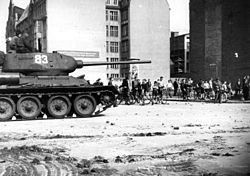
A Soviet flag flew from a flagpole atop the gate from 1945 until 1957, when it was replaced by an East German flag. During the 1953 riots in East Berlin, the Soviet flag had also been torn off by West Germans.
1949 - 1959
% complete
Despite postwar turmoil, the standard black, red, and gold tricolour flag flew from the Brandenburg Gate from 1949 until 1959, serving as a shared symbol before East Germany altered its design.
Jun 17, 1953
% complete
On 17 June 1953, amid the East German uprising of 1953, three men scaled the gate, removed the Soviet flag, and hoisted the black-red-gold flag shared by both German states.
Image source: East German uprising of 1953
Sep 21, 1956
% complete
On 21 September 1956, the East Berlin magistrate decided to restore the damaged monument, which was the only surviving city gate in Berlin.
Dec 14, 1957
% complete
The quadriga was entirely recreated using a 1942 plaster cast. Sculptor Otto Schnitzer and the traditional Hermann Noack foundry in Friedenau completed the reconstruction, and the restoration finished on 14 December 1957.
Oct 7, 1959
% complete
On 7 October 1959, the Flag of East Germany was raised on the roof of the gate to mark the 10th anniversary of the country's founding.
Image source: Flag of East Germany
Aug 13, 1961
% complete
Vehicles and pedestrians could travel freely through the gate until the day after construction began on the Berlin Wall on Barbed Wire Sunday, 13 August 1961. The wall passed directly by the western side of the gate, closing it throughout the Cold War period.
Image source: Berlin Wall
Jun 12, 1987
% complete
On 12 June 1987, U.S. President Ronald Reagan delivered his famous speech at the Brandenburg Gate challenging the Soviet Union, an iconic moment of the Cold War era at the divided monument.
Image source: Tear down this wall!
Nov 9, 1989
% complete
Thousands of people gathered at the wall to celebrate its fall on 9 November 1989. When the Revolutions of 1989 occurred and the wall was demolished, the gate symbolized freedom and the desire to unify the city of Berlin.
Dec 22, 1989
% complete
On 22 December 1989, the Brandenburg Gate border crossing was reopened when Helmut Kohl, the West German chancellor, walked through to be greeted by Hans Modrow, the East German prime minister. The wall had obstructed the gateway until its fall in 1989, serving for almost three decades as a marker of the city's division.
Dec 25, 1989
% complete
On 25 December 1989, less than two months after the Berlin Wall began to come down, conductor Leonard Bernstein conducted the Berlin Philharmonic in a version of Beethoven's Ninth Symphony at the newly opened Brandenburg Gate.
1990
% complete
In 1990, the quadriga was removed from the gate as part of renovation work carried out by the East German authorities following the fall of the wall in November 1989.
Oct 2, 1990 - Oct 3, 1990
% complete
On 2–3 October 1990, Germany was officially reunified, and the Brandenburg Gate was the scene of the official ceremony marking reunification. Since then, it has been considered not only a symbol of the tumultuous histories of Germany and Europe, but also of European unity and peace.
Image source: German reunification
Jul 12, 1994
% complete
On 12 July 1994, U.S. President Bill Clinton spoke at the Brandenburg Gate, continuing its role as a venue for major international addresses.
Dec 21, 2000
% complete
The Brandenburg Gate was privately refurbished beginning on 21 December 2000, at a cost of €6 million.
Oct 3, 2002
% complete
The Brandenburg Gate was once again opened on 3 October 2002 following extensive refurbishment, timed for the 12th anniversary of German reunification.
2009 - 2018
% complete
The Brandenburg Gate has hosted street events at the 2009 IAAF World Championships in Athletics and repeated its role at the 2018 European Athletics Championships.
Image source: 2018 European Athletics Championships
Nov 9, 2009
% complete
The Brandenburg Gate became the main venue for the 20th-anniversary celebrations of the fall of the Berlin Wall or 'Festival of Freedom' on the evening of 9 November 2009. Chancellor Angela Merkel walked through the gate with Russia's Mikhail Gorbachev and Poland's Lech Wałęsa. The high point was over 1000 colourfully designed foam domino tiles, each over 2.5 metres tall, lined up along the former wall's route.
Aug 13, 2011
% complete
On 13 August 2011, Germany marked the 50th anniversary of the day the Berlin Wall began construction with a memorial service and a minute of silence in memory of those who died trying to flee to the West.
Jun 19, 2013
% complete
On 19 June 2013, U.S. President Barack Obama spoke at the Brandenburg Gate, following in the tradition of presidential addresses at the historic site.
Jul 15, 2014
% complete
After winning the 2014 FIFA World Cup, the Germany national football team held their victory rally in front of the Brandenburg Gate, celebrating their fourth world title with hundreds of thousands of fans.
Image source: 2014 FIFA World Cup final
Jan 5, 2015
% complete
On the night of 5 January 2015, the lights illuminating the gate were completely shut off in protest against a demonstration held by far-right anti-Islamic group Pegida.
Image source: Pegida
Apr 2017
% complete
In April 2017, Die Zeit noted that the gate was not illuminated in Russian colours after the 2017 Saint Petersburg Metro bombing, drawing commentary about the selective use of landmark illuminations.
Image source: 2017 Saint Petersburg Metro bombing
Feb 2022
% complete
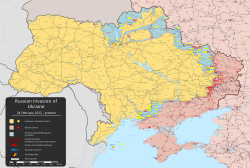
In February 2022, the Brandenburg Gate was lit up with the colours of the Ukrainian flag during the 2022 Russian invasion of Ukraine, as a show of solidarity.
Image source: Russian invasion of Ukraine
Sep 17, 2023
% complete
On 17 September 2023, German climate activists from the Last Generation group used fire extinguishers to spray paint the Brandenburg Gate's columns orange, damaging the monument in a climate protest.
Image source: Last Generation (climate movement)
Oct 7, 2023
% complete
On 7 October 2023, the gate was lit up with the flag of Israel after the October 7 attacks carried out by Hamas, demonstrating solidarity with Israel.
Image source: October 7 attacks
Or browse the full history timeline directory, with more than 2,000 topics.
This Brandenburg Gate timeline was generated with the help of AI, using information found on the internet.
We work hard to keep these timelines accurate, but mistakes do get through. If you spot one, email us at [email protected] and we'll fix it for future visitors.
Generate yours with AI or build it from scratch, for free.
Export your timeline, add your own events, edit or remove AI-generated events, and much more
No credit card required.
Cancel anytime.
Cancel anytime.
You can create an unlimited number of timelines with up to 10 events on each one, customize how they look, export them to PDF, PNG, PowerPoint, CSV, and Excel, and share them with a link. Paid plans raise the event limit and add features like spreadsheet imports and collaborators.
Yes. You can cancel your subscription from your account page at any time, and you will not be charged again. Your subscription stays active for the rest of the period you already paid for.
Yes. We will email you a reminder before the annual renewal, and we will also email you a receipt.
Yes. You can email us within 15 days of any payment, and we will issue you a full refund.
Check out our pricing docs or send us an email anytime: [email protected].