
-
Use Cases
-
Resources
-
Pricing
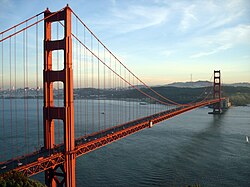
The Golden Gate Bridge is a world-famous suspension bridge spanning the Golden Gate Strait between San Francisco and Marin County, California. Completed in 1937 after four years of construction led by chief engineer Joseph Strauss, it was once the longest and tallest suspension bridge in the world and remains an enduring symbol of American engineering. More Less
1820
% complete
A ferry service began crossing the Golden Gate strait as early as 1820, with a regularly scheduled service beginning in the 1840s for the purpose of transporting water to San Francisco. For decades, ferries remained the primary link between San Francisco and Marin County.
Image source: Golden Gate Bridge
1867
% complete
In 1867, the Sausalito Land and Ferry Company opened, expanding ferry operations between San Francisco and Marin and reinforcing the growing demand for a fixed link across the strait.
1916
% complete
Although the idea of a bridge spanning the Golden Gate was not new, the proposal that eventually took hold was made in a 1916 San Francisco Bulletin article by former engineering student James Wilkins.
1916
% complete
San Francisco's City Engineer estimated the cost of a bridge at $100 million (equivalent to $3 billion in 2025), deeming it impractical for the time, which challenged supporters to find a cheaper design.
1916
% complete
Engineer Joseph Strauss produced initial drawings for a massive cantilever on each side of the strait, connected by a central suspension segment, which Strauss promised could be built for $17 million (equivalent to $503 million in 2025).
1917
% complete
The bridge's name was first used when the project was initially discussed in 1917 by M.M. O'Shaughnessy, San Francisco's city engineer, cementing the name associated with the span over the Golden Gate strait.
1923
% complete
The name became official with the passage of the Golden Gate Bridge and Highway District Act by the state legislature in 1923, creating a special district to design, build and finance the bridge.
May 1924
% complete
In May 1924, Colonel Herbert Deakyne held the second hearing on the Bridge on behalf of the Secretary of War in a request to use federal land for construction, a key step toward securing the site for the span.
1928
% complete
The Golden Gate Bridge and Highway District, authorized by an act of the California Legislature, was incorporated in 1928 as the official entity to design, construct, and finance the Golden Gate Bridge.
1929
% complete
In 1920 the ferry service had been taken over by the Golden Gate Ferry Company, which merged in 1929 with the ferry system of the Southern Pacific Railroad, becoming the Southern Pacific-Golden Gate Ferries, Ltd., the largest ferry operation in the world.
Nov 1930
% complete
After the Wall Street Crash of 1929 left the District unable to raise construction funds, it lobbied for a $30 million bond measure (equivalent to $563 million in 2025). The bonds were approved in November 1930 by votes in the counties affected by the bridge, with a construction budget at approval of $27 million (equivalent to $520 million in 2025).
Nov 1931
% complete
In November 1931, Strauss fired Charles Ellis and replaced him with a former subordinate, Clifford Paine, ostensibly for wasting too much money sending telegrams back and forth to Leon Moisseiff. In May 2007, the Golden Gate Bridge District issued a formal report giving Ellis major credit for the design of the bridge.
1932
% complete
The District was unable to sell the bonds until 1932, when Amadeo Giannini, the founder of San Francisco-based Bank of America, agreed on behalf of his bank to buy the entire issue in order to help the local economy.
Jan 5, 1933
% complete
Construction began on January 5, 1933, during the Great Depression. The project ultimately cost more than $35 million ($630 million in 2024 dollars) and was completed ahead of schedule and $1.3 million under budget (equivalent to $30.5 million in 2024).
Feb 17, 1937
% complete
Eleven men were killed in falls during construction, ten of them on February 17, 1937, when a scaffold secured by undersized bolts fell into and broke through the safety net with twelve men on it; two of the twelve survived the 200-foot fall into the water.
May 27, 1937
% complete
The bridge opened to the public on May 27, 1937, with the celebration beginning at 6:00 a.m. At the time of its opening, it was both the longest and the tallest suspension bridge in the world, with a main span of 4,200 feet (1,280 m) and towers rising 746 feet (227 m) above the water.
1938
% complete
The Round House Café, an Art Deco design by Alfred Finnila completed in 1938, has been popular throughout the years as a starting point for various commercial tours of the bridge and an unofficial gift shop. It was renovated in 2012, after which the gift shop was removed in favor of an official gift shop in the adjacent plaza.
Dec 1, 1951 - 1954
% complete
On December 1, 1951, a windstorm revealed swaying and rolling instabilities of the bridge, resulting in its closure. In 1953 and 1954, the bridge was retrofitted with lateral and diagonal bracing connecting the lower chords of the two side trusses, stiffening the deck in torsion so it would better resist the twisting that destroyed the Tacoma Narrows Bridge in 1940.
Jun 1961 - Apr 1962
% complete
In June 1961, consultants hired by BART determined the bridge's suspension section could support rail service on a new lower deck, but consulting engineer Clifford Paine disagreed in July 1961. After conflicting reports, a review board's report released in April 1962 concluded that running BART on the bridge was not advisable.
1964
% complete
Until 1964, the Golden Gate Bridge had the longest suspension bridge main span in the world at 4,200 feet (1,280 m). Since then its span has been surpassed by twenty bridges, though it retains the second-longest main span in the Americas. Its towers were the world's tallest on a suspension bridge until surpassed by Mexico's Mezcala Bridge in 1993.
1982 - 1986
% complete
From 1982 to 1986, the original bridge deck, in 747 sections, was systematically replaced with a 40% lighter and stronger steel orthotropic deck, over 401 nights without closing the roadway completely to traffic.
1990 - 1995
% complete
Since 1990, acrylic topcoats have been used instead of lead paint for air-quality reasons. The repainting program was completed in 1995, and the bridge is now maintained by 38 painters who touch up the paintwork where it becomes seriously corroded.
Mar 2005
% complete
Although there had been discussion concerning the installation of a movable barrier since the 1980s, only in March 2005 did the Bridge Board of Directors commit to finding funding to complete the $2 million study required prior to installation of a movable median barrier.
Dec 2009 - Jul 12, 2015
% complete
The former elevated approach through the San Francisco Presidio, Doyle Drive, dated to 1933. Construction on the $1 billion replacement, temporarily known as the Presidio Parkway, began in December 2009. Doyle Drive was demolished April 27–30, 2012, and traffic switched onto the finished parkway July 9–12, 2015.
Image source: Golden Gate Bridge
Jan 11, 2015
% complete
Installation of the movable median barrier was completed on January 11, 2015, following a closure of 45.5 hours to private vehicle traffic, the longest in the bridge's history. From 1968 to 2015, opposing traffic had been separated only by small plastic pylons, during which there were 16 fatalities from 128 head-on collisions.
Apr 2017 - Jan 2024
% complete
After years of debate and more than 2,000 deaths, implementation of suicide prevention barriers began in April 2017. Originally estimated at four years and over $200 million, installation of the nets was not completed until January 2024 and exceeded the budget by $17 million. As of November 21, 2024, suicides year-to-date were eight, down from an average of 33.5, and thwarted attempts were down from about 200 to 106 annually.
Jun 2020
% complete
New, more flexible slats installed starting in 2019 on the west side railing—chosen to improve aerodynamic tolerance of high winds to 100 mph—caused a humming noise noticed by residents beginning in June 2020. An independent analysis found the noise comprises Aeolian tones from wind blowing across the metal slats. On December 16, 2021, the District approved installing 12,000 U-shaped clips with rubber dampers at a cost of $450,000, expected to be completed in 2025.
1955
% complete
A statue of chief engineer Joseph Strauss was moved in 1955 to a site near the bridge, honoring his role in bringing the project to completion.
May 24, 1987
% complete
As part of the fiftieth anniversary celebration in 1987, the Golden Gate Bridge district closed the bridge to automobile traffic and allowed pedestrians to cross it on May 24. The crowd flattened the roadway's camber, though officials estimated the cables did not exceed 40% of their yielding stress.
Nov 24, 1996
% complete
On November 24, 1996, actor Woody Harrelson joined local environmentalists who draped a large banner above the roadway deck protesting CEO Charles Hurwitz over his aggressive logging advances. In response, legislation authored by State Senator Quentin Kopp and signed by Governor Pete Wilson in 1997 stiffened penalties for trespassing on the bridge.
1999
% complete
In 1999, the Golden Gate Bridge was ranked fifth on the List of America's Favorite Architecture by the American Institute of Architects, reflecting its enduring status as an iconic American landmark.
2007
% complete
A system of five foghorns set up on the bridge in 1937 remains operational to this day. When the Queen Mary 2 passed under the bridge during her 2007 visit to San Francisco, the foghorns blared wildly in greeting.
May 27, 2012
% complete
For the 75th anniversary on Sunday, May 27, 2012, uncontrolled pedestrian access was not considered due to additional law enforcement costs 'since 9/11.' To commemorate the milestone, automated user-controlled solar beacons were temporarily installed atop the towers.
2017
% complete
As of 2017, three species of cetaceans (whales) that had been absent in the area for many years showed recoveries and recolonizations in the vicinity of the bridge. Researchers encouraged stronger protections and recommended the public watch them from the bridge or land, or use a local whale watching operator.
Jun 6, 2020
% complete
On June 6, 2020, protestors occupied the bridge as part of a nationwide denunciation of police brutality in the wake of George Floyd's murder. In November 2021, two California Highway Patrol officers and three bridge employees were injured in a vehicular chain-reaction crash during a protest against government-mandated COVID-19 vaccinations.
Feb 2024 - Apr 2024
% complete
In February 2024 and again in April, pro-Palestinian protestors stopped traffic in both directions on the Golden Gate Bridge to protest the Gaza war.
Oct 1, 1983
% complete
To improve safety, the speed limit on the Golden Gate Bridge was reduced from 50 to 45 mph (80 to 72 km/h) on October 1, 1983.
2002
% complete
The bridge began accepting tolls via the FasTrak electronic toll collection system in 2002, with $4 tolls for FasTrak users and $5 for those paying cash (equivalent to $7.16 and $8.95 respectively in 2025).
Nov 2006 - Oct 2007
% complete
In November 2006, the Golden Gate Bridge, Highway and Transportation District recommended a corporate sponsorship program to address a projected operating deficit of $80 million over five years. In October 2007, the Board unanimously voted to discontinue the proposal and seek additional revenue through other means, most likely a toll increase.
Mar 2008 - Aug 2008
% complete
In March 2008, the District board approved congestion pricing at the bridge, charging higher tolls during peak hours, with the toll required by September 2009 as a condition of a grant. In August 2008, transportation officials ended the program in favor of varying rates for metered parking along the route, including Lombard Street and Van Ness Avenue.
Mar 2013
% complete
To save $19.2 million over ten years, the District voted in January 2011 to eliminate all toll takers by 2012. After delays, toll taker elimination occurred in March 2013, and all-electronic tolling has been in effect since, via FasTrak or license plate tolling.
Apr 7, 2014 - 2028
% complete
On April 7, 2014, FasTrak tolls rose from $5 to $6 while license plate tolls rose from $6 to $7. The District raised tolls by 25 cents in July 2015 and each of the next three years, approved 35-cent annual increases through 2023 in March 2019, and in March 2024 approved 50-cent annual increases through 2028. Effective July 1, 2026–June 30, 2027, license plate accounts pay $10.50 and FasTrak users pay $10.25.
Oct 18, 2013
% complete
On October 18, 2013, at around 2:00 a.m., one foghorn emitted a perpetually-sustained sound for nearly an hour due to a malfunctioning relay. Dating back to 1985, midspan foghorns had replaced original horns that partly failed in the late 1970s, causing them to sound with only a single tone.
2017 - 2025
% complete
For the 2017 marathon, the bridge was closed to all northbound traffic during the race, but in 2018 authorities refused to shut down northbound traffic out of security concerns, limiting the race to the bridge's sidewalks. As of 2025, only the sidewalks are used for the marathon.
2021
% complete
Bicycle Route 95 was designated in 2021, incorporating the Golden Gate Bridge into the national bicycle route network. Railings between the walkways and traffic lanes had been added in 2003 primarily to prevent bicyclists from falling into the roadway.
Or browse the full history timeline directory, with more than 2,000 topics.
This Golden Gate Bridge timeline was generated with the help of AI, using information found on the internet.
We work hard to keep these timelines accurate, but mistakes do get through. If you spot one, email us at [email protected] and we'll fix it for future visitors.
Generate yours with AI or build it from scratch, for free.
Export your timeline, add your own events, edit or remove AI-generated events, and much more
No credit card required.
Cancel anytime.
Cancel anytime.
You can create an unlimited number of timelines with up to 10 events on each one, customize how they look, export them to PDF, PNG, PowerPoint, CSV, and Excel, and share them with a link. Paid plans raise the event limit and add features like spreadsheet imports and collaborators.
Yes. You can cancel your subscription from your account page at any time, and you will not be charged again. Your subscription stays active for the rest of the period you already paid for.
Yes. We will email you a reminder before the annual renewal, and we will also email you a receipt.
Yes. You can email us within 15 days of any payment, and we will issue you a full refund.
Check out our pricing docs or send us an email anytime: [email protected].