-
Use Cases
-
Resources
-
Pricing
The Golden Temple, also known as Harmandir Sahib or Darbar Sahib, is the holiest Gurdwara and the most important pilgrimage site of Sikhism. Located in Amritsar, Punjab, India, it was founded by the fourth Sikh Guru, Guru Ram Das, with its construction completed by his successor, Guru Arjan Dev, in 1604. Renowned for its stunning gold-plated exterior, added under Maharaja Ranjit Singh in the 19th century, the temple houses the Guru Granth Sahib, the eternal Guru of Sikhs. The temple complex includes the Akal Takht and the sacred Amrit Sarovar pool, symbolizing spiritual and temporal authority in Sikhism. More Less
1502
% complete
According to Giani Gian Singh's Tawarikh Guru Khalsa, Guru Nanak visited the site of what would later become the Golden Temple in 1502 during one of his udasis (travel itineraries).
Nov 1573
% complete
Construction of the sacred pool was first started via digging by Guru Amar Das in November 1573, with the main bulk of the work attributed to his successor Guru Ram Das, and a later expansion by Guru Arjan.
Image source: Golden Temple
1574
% complete
After Guru Ram Das succeeded Guru Amar Das in 1574, and in the face of hostile opposition from the sons of Amar Das, Ram Das founded the town that came to be known as "Ramdaspur".
1577
% complete
The pool on the site of the gurdwara was completed by the fourth Sikh Guru, Guru Ram Das, in 1577.
1581
% complete
In 1581, Guru Arjan, the fifth Sikh Guru, initiated construction of the Golden Temple. Construction activity between 1574 and 1604 is described in Mahima Prakash Vartak, a semi-historical Sikh hagiography text likely composed in 1741.
1589
% complete
In 1589, the gurdwara made with bricks was completed at the site of the pool in Ramdaspur (later Amritsar).
Image source: Golden Temple
Aug 16, 1604
% complete
On 16 August 1604, Guru Arjan completed expanding and compiling the first version of the Sikh scripture and placed a copy of the Adi Granth in the gurdwara. He appointed Baba Buddha as the first granthi of the site.
Image source: Guru Granth Sahib
1606
% complete
Guru Arjan refused Mughal demands, was tortured and executed in 1606. His son and successor Guru Hargobind fought a Battle at Amritsar and later left Amritsar and its surrounding areas in 1635 for Kiratpur.
Image source: Guru Arjan
1635 - 1700
% complete
For about a century after Guru Hargobind's departure, the Golden Temple was occupied by the Minas, a rival Sikh sect.
Image source: Prithi Chand
1699 - 1737
% complete
In the 18th century, after creating the Khalsa, Guru Gobind Singh sent Bhai Mani Singh to take back the temple. In 1716, Banda Singh and numerous Sikhs were arrested and executed. In 1737, the Mughal governor ordered the capture and execution of the custodian Mani Singh.
Image source: Bhai Mani Singh
1709
% complete
In 1709, the governor of Lahore sent in his army to suppress and prevent the Sikhs from gathering for their festivals of Vaisakhi and Diwali.
Aug 1740
% complete
Sikhs avenged the sacrilege of the Golden Temple by assassinating Masse Khan inside the Temple in August 1740.
1746 - 1749
% complete
In 1746, Diwan Lakhpat Rai, working for Yahiya Khan and seeking revenge for the death of his brother, filled the pool with sand. In 1749, Sikhs restored the pool when Muin ul-Mulk slackened Mughal operations against Sikhs and sought their help during his operations in Multan.
1757
% complete
In 1757, the Afghan ruler Ahmad Shah Durrani, also known as Ahmad Shah Abdali, attacked Amritsar and desecrated the Golden Temple. He returned in 1762 and had the temple blown up with gunpowder.
Image source: Ahmad Shah Durrani
1764
% complete
After the original temple was destroyed by hostile forces, Jassa Singh Ahluwalia collected donations to rebuild the Golden Temple in 1764. Another source states the sanctum sanctorum itself was reconstructed in 1765.
Image source: Jassa Singh Ahluwalia
Dec 1, 1764
% complete
The newly rebuilt Golden Temple was attacked by Afghan forces under Ahmed Shah Durrani on 1 December 1764.
1776 - 1784
% complete
According to Giani Gian Singh's Tawarikh Sri Amritsar (1889), the temple tank, edifice, causeway, and entry gateway (Darshani Deori) were constructed by 1776, with another source giving 1784 for the completion of the parkerma walkway around the pool.
1783
% complete
The Udasis of Brahm Buta Akhara were responsible for digging a hansli (water channel) to feed water into the Amrit Sarovar of the Darbar Sahib complex in 1783.
1802
% complete
At age 22, Maharaja Ranjit Singh took Amritsar from the Bhangi misl, paid homage at the Golden Temple and announced that he would renovate and rebuild it with marble and gold.
Image source: Ranjit Singh
1803
% complete
The first gilded copper panel was placed on the shrine in 1803, beginning the golden adornment that gave the temple its famous name.
1809 - 1830
% complete
Maharaja Ranjit Singh, after founding the Sikh Empire, rebuilt the temple in marble and copper in 1809, and in 1830 donated gold to overlay the sanctum with gold leaf.
1809
% complete
Ranjit Singh appointed Sardar Desa Singh Majithia (1768–1832) to manage the temple and made land grants whose collected revenue was assigned to pay for its maintenance and operation.
Image source: Majithia family
1823
% complete
Ganda Singh Peshawari sent his donation for the Golden Temple's works in the year 1823.
1846 - 1849
% complete
Starting in 1846 after the first Anglo-Sikh war, the British Resident in Lahore began engaging with the management of the complex. Henry Lawrence signed an order regarding monetary allowances in November 1847, and after annexation in 1849 the complex was managed by mahants under British control until 1859.
Sep 12, 1859
% complete
Following controversy over direct British management and a meeting headed by Raja Teja Singh, an agreement was reached on 12 September 1859. A new document, the Dastur ul-Amal, was formulated to restructure administration, and its outline was followed until the Gurdwara Reform movement of the 1920s.
1862 - 1874
% complete
Construction of the clock tower at the Golden Temple started in 1862 and was completed in 1874.
1866
% complete
Since 1866, the Amrit Sarovar of the Golden Temple complex has been fed water from the Jethuwal distributory of the Upper Bari Doab via a connection between the Kaulsar Sarovar and Amrit Sarovar.
1883 - 1920
% complete
The Golden Temple became a centre of the Singh Sabha Movement between 1883 and the 1920s. The late-19th-century movement sought to rejuvenate and reform Sikhism amid active proselytising by Christians, Hindus and Muslims, bringing Khalsa control back over gurdwara administration from the mahant class.
Image source: Singh Sabha movement
1905
% complete
Before 1905, the Golden Temple had Brahmin priests, idols and images for at least a century. With the campaign of the Tat Khalsa in 1905, these idols and images were removed from the Golden Temple.
Image source: Tat Khalsa
Jun 17, 1923
% complete
Since the 1900s, the sarovar has been regularly cleaned through communal Kar Seva projects, with the first modern one held on 17 June 1923. The SGPC had come into power in 1921, ending the Giani family's exclusive right to perform Katha dating back to 1788.
1948 - 1966
% complete
The Golden Temple became a centre of the Punjabi Suba Movement between 1947 and 1966. The policy was first presented in April 1948 by the Shiromani Akali Dal, seeking a Punjabi-speaking state. Key events included the 1955 government raid and the Amritsar Convention of 1955. The movement culminated in setting Punjab's current borders in 1966.
Image source: Punjabi Suba movement
Dec 1983
% complete
In December 1983, Harchand Singh Longowal, President of the Akali Dal, invited Jarnail Singh Bhindranwale to take up residence in the Golden Temple Complex to evade arrest. Bhindranwale organised the armed militants present at the Harmandir Sahib in June 1984.
Image source: Jarnail Singh Bhindranwale
1984
% complete
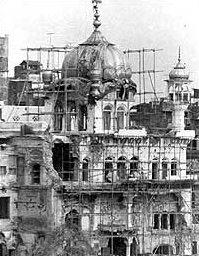
A few months after the government operation of 1984, major kar seva renovations were undertaken at the shrine complex, including a complete draining and cleaning of the temple tank by volunteers. The gurdwara complex was again rebuilt after the 1984 attack.
Image source: Sevā
Jun 1, 1984 - Jun 8, 1984
% complete
After negotiations with militants failed, Prime Minister Indira Gandhi ordered the Indian Army to launch Operation Blue Star between 1 and 8 June 1984, attacking scores of gurudwaras across Punjab. Army units surrounded the complex on 3 June. Thousands of soldiers, militants and civilians died, the Akal Takht was destroyed, and the gurdwara suffered significant damage.
Image source: Operation Blue Star
Oct 31, 1984
% complete
Five months after the operation, on 31 October 1984, Indira Gandhi was assassinated in revenge by her two Sikh bodyguards, Satwant Singh and Beant Singh. Public outcry led to the killings of more than 3,000 Sikhs in Delhi alone in the ensuing 1984 anti-Sikh riots.
Image source: Assassination of Indira Gandhi
1986 - 1999
% complete
In 1986, Rajiv Gandhi ordered repairs to the Akal Takht Sahib. These repairs were rejected and removed, and Sikhs themselves rebuilt the Akal Takht Sahib in 1999.
Image source: Akal Takht
Jun 1988
% complete
The area around the temple, including Bungas such as the Burj Gianian destroyed in 1988, was made into a public park which opened in June 1988.
Dec 2021
% complete
In December 2021, a young man was allegedly beaten to death after disrupting the Rehras Sahib (evening prayer) at the sanctum of the temple.
May 7, 2023 - May 9, 2023
% complete
The 2023 Golden Temple blasts occurred on 7 May and on 9 May 2023, shocking devotees and prompting investigations at the revered shrine.
Or browse the full history timeline directory, with more than 2,000 topics.
This Golden Temple timeline was generated with the help of AI, using information found on the internet.
We work hard to keep these timelines accurate, but mistakes do get through. If you spot one, email us at [email protected] and we'll fix it for future visitors.
Generate yours with AI or build it from scratch, for free.
Export your timeline, add your own events, edit or remove AI-generated events, and much more
No credit card required.
Cancel anytime.
Cancel anytime.
You can create an unlimited number of timelines with up to 10 events on each one, customize how they look, export them to PDF, PNG, PowerPoint, CSV, and Excel, and share them with a link. Paid plans raise the event limit and add features like spreadsheet imports and collaborators.
Yes. You can cancel your subscription from your account page at any time, and you will not be charged again. Your subscription stays active for the rest of the period you already paid for.
Yes. We will email you a reminder before the annual renewal, and we will also email you a receipt.
Yes. You can email us within 15 days of any payment, and we will issue you a full refund.
Check out our pricing docs or send us an email anytime: [email protected].