-
Use Cases
-
Resources
-
Pricing
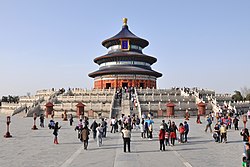
The Temple of Heaven is an imperial complex of religious buildings in Beijing, China, where emperors of the Ming and Qing dynasties performed annual ceremonies praying for good harvests. Renowned for its symbolic architecture, including the iconic Hall of Prayer for Good Harvests, it is considered a masterpiece of Chinese traditional design. More Less
1420 - 2026
% complete
From its founding in 1420 through the Jiajing additions of 1530–1534, the Qing reconstructions of 1740 and 1749, and its modern recognition in 1998, the Temple of Heaven stands as an enduring monument to six centuries of Chinese architecture and ritual tradition.
Image source: Temple of Heaven
1420
% complete
The completion of the Temple of Heaven and the Forbidden City in 1420 accompanied the Yongle Emperor's establishment of Beijing as the capital of the Ming dynasty, anchoring imperial ritual life in the new city.
Image source: Yongle Emperor
1420
% complete
The Temple of Heaven complex was first built in 1420 during the reign of the Yongle Emperor of the Ming dynasty. The same emperor was also responsible for the construction of the Forbidden City in Beijing, making this period one of the most ambitious building eras in Chinese history.
1420
% complete
The Yongle Emperor, who commissioned the Temple of Heaven in 1420, was also responsible for the construction of the Forbidden City in Beijing. Together these projects established Beijing as the imperial capital of Ming China.
Image source: Forbidden City
1530
% complete
The Circular Mound Altar was built in 1530 by the Jiajing Emperor as part of the expanding ritual complex. It became the principal site for sacrifices to heaven at the winter solstice.
Image source: Circular Mound Altar
1740
% complete
The Altar originally erected in 1530 by the Jiajing Emperor was rebuilt in 1740 during the Qing dynasty, ensuring its continued use for the great state sacrifices to heaven.
1749
% complete
Following Qing-period reconstruction, the present layout of the Temple of Heaven complex was largely formed by 1749. This work gave the complex its enduring arrangement of altars, halls, and ceremonial pathways.
1889 - 1890
% complete
After the original building was destroyed by a lightning-caused fire in 1889, restoration work followed to rebuild the structure, preserving the essential form of the complex later finalized by 1749-era design traditions.
1420 - 1534
% complete
Originally constructed as the Altar of Heaven and Earth in 1420, the site served as a place where Ming emperors performed sacrifices to heaven and earth. It retained this name until the Jiajing reign in the 16th century.
1530 - 1534
% complete
Between building the Altar in 1530 and renaming the site the Temple of Heaven in 1534, the Jiajing Emperor carried out major reforms of state sacrificial rituals, separating the worship of heaven and earth at distinct sites.
Image source: Jiajing Emperor
1534
% complete
During the Jiajing reign in the 16th century, the former Altar of Heaven and Earth was renamed the Temple of Heaven in 1534. This reflected changes in imperial ritual practice that separated the worship of heaven from that of earth.
1740 - 1911
% complete
After the rebuilding of the Altar in 1740 and the formation of the complex's final layout by 1749, Qing emperors continued performing the great sacrifices to heaven at the temple until the fall of the dynasty in 1911.
1914
% complete
In 1914, Yuan Shikai, then President of the Republic of China, performed a Ming-style prayer ceremony at the Temple of Heaven as part of an effort to have himself declared Emperor of China.
Image source: Yuan Shikai
1889
% complete
In 1889 the original main building of the temple complex was burned down in a fire caused by lightning. The destruction marked a major loss to the architectural heritage of the site.
1899 - 1901
% complete
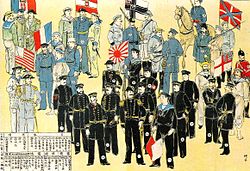
The Boxer Rebellion, an anti-foreign uprising in China, drew the Eight-Nation Alliance into Peking in 1900. During this turmoil the alliance occupied the Temple of Heaven and used it as their temporary command post for a year.
Image source: Boxer Rebellion
1900 - 1901
% complete
The occupation of the Temple of Heaven by the Eight-Nation Alliance during the Boxer Rebellion lasted for one year, ending around 1901. The sacred imperial site was used for military purposes throughout this period.
1900
% complete
In 1900, during the Boxer Rebellion, the Eight-Nation Alliance occupied the Temple of Heaven complex and turned it into the force's temporary command headquarters in Peking.
Image source: Eight-Nation Alliance
Jan 1, 1912
% complete
With the founding of the Republic of China in 1912, the Temple of Heaven passed from imperial control into state hands, culminating in Yuan Shikai's 1914 prayer ceremony and the park's opening in 1918.
Image source: Republic of China (1912–1949)
Feb 12, 1912
% complete
The abdication of the last Qing emperor ended over four centuries of imperial ceremonies at the Temple of Heaven, paving the way for its conversion into a public park in 1918.
1918
% complete
In 1918 the Temple of Heaven was turned into a park and opened to the public for the first time in its history, ending centuries of exclusive imperial use.
1918
% complete
The Temple of Heaven is located in southern Dongcheng District of Beijing, an area which until 2010 formed part of the former Chongwen District before district boundaries were redrawn.
Image source: Dongcheng, Beijing
1952 - 2010
% complete
For decades, the southern Dongcheng area containing the Temple of Heaven was administered as part of Chongwen District. In 2010 Chongwen was merged into Dongcheng District, changing the temple's administrative address.
Image source: Chongwen, Beijing
1998
% complete
In 1998 the Temple of Heaven, located in Dongcheng District, Beijing, was inscribed as a UNESCO World Heritage Site, recognizing its outstanding cultural and architectural significance.
1998
% complete
Following its 1998 inscription as a UNESCO World Heritage Site, the Temple of Heaven, open to the public since 1918, grew into one of Beijing's most visited cultural attractions, welcoming millions of visitors.
Jul 2010
% complete
In 2010 Chongwen District was abolished and merged into Dongcheng District, so the Temple of Heaven, previously part of Chongwen, became fully situated within Dongcheng District, Beijing.
Or browse the full history timeline directory, with more than 2,000 topics.
This Temple of Heaven timeline was generated with the help of AI, using information found on the internet.
We work hard to keep these timelines accurate, but mistakes do get through. If you spot one, email us at [email protected] and we'll fix it for future visitors.
Generate yours with AI or build it from scratch, for free.
Export your timeline, add your own events, edit or remove AI-generated events, and much more
No credit card required.
Cancel anytime.
Cancel anytime.
You can create an unlimited number of timelines with up to 10 events on each one, customize how they look, export them to PDF, PNG, PowerPoint, CSV, and Excel, and share them with a link. Paid plans raise the event limit and add features like spreadsheet imports and collaborators.
Yes. You can cancel your subscription from your account page at any time, and you will not be charged again. Your subscription stays active for the rest of the period you already paid for.
Yes. We will email you a reminder before the annual renewal, and we will also email you a receipt.
Yes. You can email us within 15 days of any payment, and we will issue you a full refund.
Check out our pricing docs or send us an email anytime: [email protected].