
-
Use Cases
-
Resources
-
Pricing
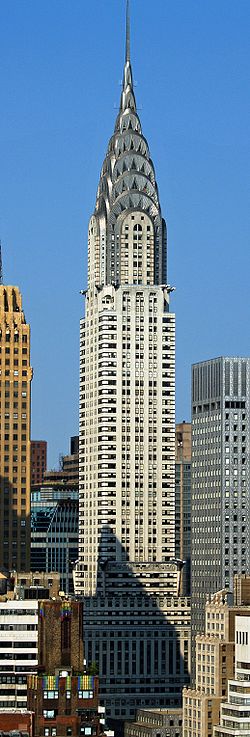
The Chrysler Building is an iconic Art Deco skyscraper in Manhattan, New York City. Designed by architect William Van Alen and commissioned by Walter P. Chrysler, it was the world's tallest building for a brief period before being surpassed by the Empire State Building. It remains celebrated for its distinctive terraced crown and stainless steel ornamentation inspired by Chrysler automobiles. More Less
1928
% complete
A plot of land at the northeast corner of Lexington Avenue and East 42nd Street in Midtown Manhattan was secured for the project. The site was formerly occupied by the old Cornell University New York Hospital buildings.
Image source: Chrysler Building
1928
% complete
William Van Alen, who had previously designed the Reynolds Building prototype, was commissioned by Walter Chrysler to design the tower. Van Alen had once partnered with H. Craig Severance, who would soon become his rival in the race for the world's tallest building.
Image source: William Van Alen
Sep 1928
% complete
Automobile magnate Walter P. Chrysler decided to build a new headquarters for his company in Manhattan, personally financing the project with no loans or mortgages. He hired architect William Van Alen to design what would become one of the most iconic skyscrapers in the world.
1928
% complete
Van Alen's former partner H. Craig Severance announced plans for the Bank of Manhattan Trust Building at 40 Wall Street, intending it to be the tallest building in the world. This sparked one of the most famous skyscraper races in history between the two architects.
Image source: 40 Wall Street
Oct 1928
% complete
Existing buildings on the Lexington Avenue site were demolished to make way for the new skyscraper, clearing the ground for construction of what would become an Art Deco masterpiece.
1929
% complete
In secret, Van Alen ordered the assembly of a 185-foot stainless steel spire inside the building's fire shaft. The gambit was hidden from competitors and even from the public, allowing the Chrysler Building to dramatically surpass 40 Wall Street.
Apr 1929
% complete
Severance's Bank of Manhattan Trust Building was completed with a spire that brought its height to 927 feet, seemingly winning the height race against the Chrysler Building, whose planned height appeared to be less.
Sep 10, 1929
% complete
The steel framework of the Chrysler Building began rising at a remarkable pace, averaging four floors per week. The rapid construction was aided by mild winter weather and efficient coordination among contractors.
Oct 23, 1929
% complete
The secret spire was raised into position in just 90 minutes, bringing the Chrysler Building's height to 1,046 feet and making it the tallest building in the world, surpassing both 40 Wall Street and the Eiffel Tower in Paris.
Nov 1929
% complete
The exterior of the building was finished in November 1929, showcasing its distinctive crown of seven radiating terraced arches clad in Nirosta stainless steel, along with eagle-head gargoyles modeled after Chrysler automobile hood ornaments.
Nov 1929 - May 1930
% complete
Following completion of the exterior, workers finished the lavish interiors, including the triangular lobby clad in Moroccan marble with African granite, yellow Sienna marble walls, and a painted ceiling by Edward Trumbull depicting transportation scenes.
Oct 29, 1929
% complete
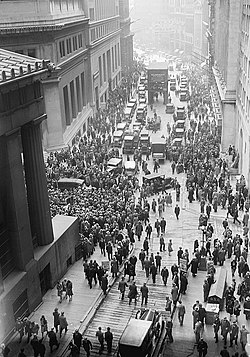
Just six days after the spire was installed, the stock market crashed, plunging the nation into the Great Depression. Despite the economic turmoil, the nearly completed Chrysler Building stood as a symbol of ambition and Art Deco optimism.
Image source: Wall Street Crash of 1929
1930 - 1933
% complete
Due to the Great Depression, the Chrysler Building struggled with low occupancy in its early years, earning it the nickname 'Chrysler's Folly' as critics doubted whether such a grand structure could ever be filled.
May 1930
% complete
The building featured a public observatory on the 71st floor, offering panoramic views of New York City. It quickly became a popular tourist attraction during the early 1930s before closing during World War II.
May 27, 1930
% complete
The Chrysler Building opened on May 27, 1930, after about 20 months of construction. It was the first man-made structure taller than 1,000 feet and became the world's tallest building, a title it would hold until the Empire State Building opened in 1931.
Sep 1930
% complete
The Empire State Building, rising just blocks away on Fifth Avenue, overtook the Chrysler Building as the world's tallest structure. The Chrysler Building held the title for only about eleven months.
Image source: Empire State Building
1933
% complete
By the mid-1930s, occupancy improved and the Chrysler Building turned a profit, vindicating Walter Chrysler's investment. Its reputation grew as tenants appreciated the prestige of the address at 405 Lexington Avenue.
Aug 18, 1940
% complete
Walter P. Chrysler, founder of the Chrysler Corporation and patron of the building bearing his name, died at age 65. His family retained ownership interests in the tower following his death.
Image source: Walter Chrysler
1957
% complete
The Chrysler family sold its majority interest in the building to real estate developer William Zeckendorf's Webb & Knapp, beginning a series of ownership changes for the landmark over subsequent decades.
Image source: William Zeckendorf
1960
% complete
Massachusetts Mutual Life Insurance Company purchased the Chrysler Building, holding it as a long-term investment and maintaining its operations through the 1960s and 1970s.
1975
% complete
Canadian-American businessman Jack Kent Cooke bought the building for $85 million, but he later defaulted on payments, leading to further changes in ownership.
Image source: Jack Kent Cooke
Jul 26, 1978
% complete
The New York City Landmarks Preservation Commission designated the Chrysler Building an official city landmark, protecting its celebrated Art Deco facade and crown from alteration.
Image source: New York City Landmarks Preservation Commission
1979
% complete
After Jack Kent Cooke's default, developer Sheldon Solow took control of the Chrysler Building through foreclosure proceedings, later selling a stake to Prudential Insurance.
Image source: Sheldon Solow
1982
% complete
The building was listed on the National Register of Historic Places, formally recognizing its significance as an outstanding example of Art Deco architecture and American engineering achievement.
Image source: National Register of Historic Places
1995
% complete
A comprehensive renovation restored the famous lobby murals and modernized building systems. The project revived Edward Trumbull's ceiling paintings and updated the tower for contemporary office tenants.
1997
% complete
Real estate firm Tishman Speyer acquired a controlling interest in the Chrysler Building, investing in upgrades and leasing efforts that helped attract major corporate tenants.
Image source: Tishman Speyer
2001
% complete
Tishman Speyer sold a 75 percent stake in the building to TIAA-CREF (Teachers Insurance and Annuity Association), valuing the property at approximately $300 million.
Image source: TIAA
Jun 2008
% complete
The Abu Dhabi Investment Council purchased a 75 percent stake from TIAA-CREF for $800 million, valuing the entire building at around $1 billion, with TIAA retaining 25 percent ownership.
Image source: Abu Dhabi Investment Council
Mar 2019
% complete
Austrian investor Signa Holding, led by Rene Benko, purchased a 60 percent controlling stake in the Chrysler Building from the Abu Dhabi Investment Council, valuing the property at approximately $150 million, a fraction of its previous worth.
2021
% complete
Owners announced plans to convert part of the Chrysler Building into a Ritz-Carlton hotel with private residences, marking a significant change in use for the historic office tower amid shifting Manhattan office markets.
Or browse the full history timeline directory, with more than 2,000 topics.
This Chrysler Building timeline was generated with the help of AI, using information found on the internet.
We work hard to keep these timelines accurate, but mistakes do get through. If you spot one, email us at [email protected] and we'll fix it for future visitors.
Generate yours with AI or build it from scratch, for free.
Export your timeline, add your own events, edit or remove AI-generated events, and much more
No credit card required.
Cancel anytime.
Cancel anytime.
You can create an unlimited number of timelines with up to 10 events on each one, customize how they look, export them to PDF, PNG, PowerPoint, CSV, and Excel, and share them with a link. Paid plans raise the event limit and add features like spreadsheet imports and collaborators.
Yes. You can cancel your subscription from your account page at any time, and you will not be charged again. Your subscription stays active for the rest of the period you already paid for.
Yes. We will email you a reminder before the annual renewal, and we will also email you a receipt.
Yes. You can email us within 15 days of any payment, and we will issue you a full refund.
Check out our pricing docs or send us an email anytime: [email protected].