-
Use Cases
-
Resources
-
Pricing
Nov 13, 1897
% complete
The original Waldorf-Astoria Hotel opened at the site of Fifth Avenue and 34th Street, where it stood for decades. The hotel's eventual demolition would clear the way for the construction of the Empire State Building, one of the most ambitious skyscraper projects in history.
Image source: Empire State Building
Aug 1929
% complete
Former General Motors executive John J. Raskob conceived the idea of building the world's tallest building on the former Waldorf-Astoria site, reportedly telling architect William Lamb to make the building tall enough that it could not be surpassed.
Sep 11, 1929
% complete
The Empire State Building Corporation was formed by John J. Raskob, Pierre du Pont, and other investors to finance and oversee the construction of what they intended to be the tallest building in the world.
Oct 1929
% complete
The architectural firm Shreve, Lamb & Harmon, led by William F. Lamb, completed the design of the Empire State Building in just two weeks. The Art Deco design drew inspiration from earlier projects including the Reynolds Building in North Carolina.
Image source: Shreve, Lamb & Harmon
Oct 1, 1929
% complete
Demolition of the old Waldorf-Astoria Hotel began, clearing the site at 34th Street and Fifth Avenue. The demolition was accelerated with crews working around the clock, completing the work by early 1930 despite the onset of the Great Depression.
Image source: Waldorf-Astoria (1893–1929)
Oct 1929 - 1931
% complete
Plans were revised to include a 200-foot dirigible mooring mast atop the tower, intended to allow airships to dock and let off passengers. This addition pushed the building's height above its rivals, though it proved impractical for actual airship use.
Image source: Airship
Jan 22, 1930
% complete
Excavation began at the construction site, moving forward at an astonishing pace. The Starrett Brothers and Eken firm managed construction, which employed thousands of workers during the depths of the Great Depression.
Mar 17, 1930
% complete
The first steel columns were erected, marking the start of vertical construction. Steel arrived from mills in Pennsylvania and was riveted into place at a pace of four and a half stories per week, a record-breaking rate of construction.
May 28, 1930
% complete
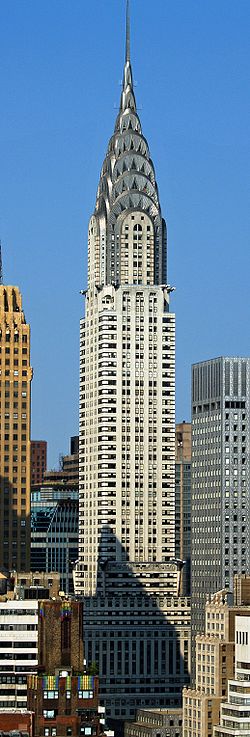
The Chrysler Building, a rival New York City skyscraper project led by Walter Chrysler, was completed and briefly claimed the title of world's tallest building, spurring the Empire State team to add floors and a mooring mast to surpass it.
Image source: Chrysler Building
Apr 10, 1931
% complete
The Empire State Building reached its full height of 1,250 feet (381 meters), surpassing the Chrysler Building and claiming the title of the tallest building in the world. It held this record for nearly four decades.
Image source: History of the world's tallest structures
1931 - 1940
% complete
During the Great Depression, so much office space sat vacant that the building earned the nickname the 'Empty State Building.' Rent revenue did not cover operating costs for years, and observers dubbed it a 'white elephant' until occupancy improved in the 1940s.
1931
% complete
The 86th floor observation deck opened shortly after the building's completion, quickly becoming one of New York City's most popular tourist attractions and drawing over a million visitors annually within a few years.
May 1, 1931
% complete
Construction was completed after only 410 days, remarkably ahead of schedule and under budget at roughly $41 million. The building rose from plans to completion faster than any skyscraper before it, employing about 3,400 workers at peak, many of them European immigrants and Mohawk ironworkers.
May 1, 1931
% complete
President Herbert Hoover officially opened the Empire State Building by pressing a button from the White House that turned on the building's lights. Governor Franklin D. Roosevelt attended ceremonies in New York, and the event drew enormous public attention.
Mar 2, 1933
% complete
The classic film King Kong premiered, featuring its iconic climax atop the Empire State Building where the giant ape scales the tower while clutching Fay Wray. The film forever cemented the skyscraper's place in popular culture.
Image source: King Kong (1933 film)
Jul 28, 1945
% complete
A B-25 Mitchell bomber, flying in heavy fog, crashed into the north side of the building between the 78th and 80th floors. Elevator operator Betty Lou Oliver survived a 75-story elevator fall, earning a Guinness World Record. Fourteen people died in the accident, yet the building remained structurally sound.
Image source: 1945 Empire State Building B-25 crash
1968
% complete
This decade saw the building featured prominently in countless works of art, literature, and advertising as an enduring symbol of New York City and American ambition, reinforcing its status as an international cultural icon.
Image source: Barbapapa
Jul 26, 1976
% complete
The tower's floodlights were first illuminated in colored lights—red, white, and blue for the American Bicentennial—beginning a beloved tradition of lighting the building in colors commemorating holidays, events, and causes.
1950 - 1951
% complete
A 222-foot television antenna tower was erected on top of the building, raising its total height to 1,472 feet and making it a key broadcast transmission point for New York City's radio and television stations.
Dec 23, 1970
% complete
The North Tower of the World Trade Center topped out, surpassing the Empire State Building as New York City's and the world's tallest building after a reign of nearly 40 years.
Image source: 6 World Trade Center (1974–2001)
May 3, 1973
% complete
Chicago's Sears Tower was completed, taking the world's tallest title from New York City. The Empire State Building nonetheless retained unmatched prestige and continued to define the Manhattan skyline.
Image source: Willis Tower
Jun 24, 1980
% complete
The New York City Landmarks Preservation Commission designated the Empire State Building an official city landmark, formally protecting its iconic exterior and recognizing its architectural and historical significance.
Image source: New York City Landmarks Preservation Commission
Nov 17, 1982
% complete
The Empire State Building was listed on the National Register of Historic Places, followed in 1986 by designation as a National Historic Landmark, cementing its status among America's most treasured historic structures.
Image source: National Register of Historic Places
1984 - 1986
% complete
A major renovation program updated the building's Art Deco lobby with marble and restored decorative elements, while mechanical systems were upgraded to keep the aging skyscraper competitive with newer office towers.
May 30, 1997
% complete
A lone gunman opened fire on the observation deck in July 1997, killing one person and wounding several others before turning the gun on himself. The incident prompted significant security upgrades at the popular tourist destination.
Image source: 1997 Empire State Building shooting
2002
% complete
Control of the Empire State Building passed through real estate transactions involving Peter Malkin's family interests, which later consolidated ownership under Empire State Realty Trust, setting the stage for extensive modernization efforts.
Image source: Empire State Building
Apr 6, 2009 - 2011
% complete
Owners announced a groundbreaking $550 million retrofit program with the Clinton Climate Initiative, including new windows, insulation, lighting, and HVAC systems projected to cut energy use by nearly 40 percent and serve as a model for green retrofits worldwide.
Nov 2012
% complete
The building's exterior floodlights were replaced with a computerized LED system capable of displaying 16 million colors with dynamic effects, dramatically expanding the famous tower light shows seen across the city.
Oct 2, 2013
% complete
Empire State Realty Trust, owner of the Empire State Building, launched its initial public offering on the New York Stock Exchange under ticker ESRT, formalizing corporate stewardship of the iconic property.
Oct 21, 2019
% complete
After a $165 million renovation, the enclosed 102nd floor observatory reopened with floor-to-ceiling glass windows offering panoramic views, complementing the open-air 86th floor deck and enhancing one of the world's most visited attractions.
Jul 16, 2020
% complete
Following months of pandemic-related closure, the Empire State Building's observatories reopened to visitors with enhanced health protocols, symbolizing resilience as New York City gradually recovered from the COVID-19 crisis.
Image source: COVID-19 pandemic in New York City
Or browse the full history timeline directory, with more than 2,000 topics.
This Empire State Building timeline was generated with the help of AI, using information found on the internet.
We work hard to keep these timelines accurate, but mistakes do get through. If you spot one, email us at [email protected] and we'll fix it for future visitors.
Generate yours with AI or build it from scratch, for free.
Export your timeline, add your own events, edit or remove AI-generated events, and much more
No credit card required.
Cancel anytime.
Cancel anytime.
You can create an unlimited number of timelines with up to 10 events on each one, customize how they look, export them to PDF, PNG, PowerPoint, CSV, and Excel, and share them with a link. Paid plans raise the event limit and add features like spreadsheet imports and collaborators.
Yes. You can cancel your subscription from your account page at any time, and you will not be charged again. Your subscription stays active for the rest of the period you already paid for.
Yes. We will email you a reminder before the annual renewal, and we will also email you a receipt.
Yes. You can email us within 15 days of any payment, and we will issue you a full refund.
Check out our pricing docs or send us an email anytime: [email protected].