
-
Resources
-
Pricing
The Achaemenid Empire was the first great Persian Empire, founded by Cyrus the Great and expanded across much of the ancient Near East, Egypt, and Central Asia. More Less
Build a timeline like this one in minutes, for free. Start Yours →
Part of our collection of ancient history timelines.
1000 BC
Persian communities became established in northwestern Iran during the period of migration traditionally dated to around 1000 BC.
1000 BC
The incoming Persians settled alongside the native Elamites, creating a cultural and political environment that shaped early southwestern Iranian history.
Image source: Elam
1000 BC
Persian groups settled Persis in southwestern Iran, the homeland from which the later Achaemenid Empire emerged.
1000 BC
The Persians, an Iranic people, arrived in what is now Iran around 1000 BC. They settled across northwestern Iran, the Zagros Mountains, and Persis alongside the native Elamites.
1000 BC
As part of their wider migration, Persian groups settled in the Zagros Mountains, a region that later became central to the development of Persian political power.
Image source: Persians
700 BC
By the seventh century BC, Persis in the southwestern Iranian plateau had been settled by Persian people.
Image source: Persis
650 BC
Achaemenes was a minor seventh-century BC ruler of Anshan in southwestern Iran and is remembered as the eponymous ancestor of the Achaemenid dynasty.
650 BC
During Achaemenes's time, Anshan was a vassal of Assyria, placing the early Persian ruling house within the political sphere of the Assyrian Empire.
Image source: Achaemenes
650 BC
The early Achaemenid ruling tradition developed in Anshan and Persis in southwestern Iran, from a modest regional base that later expanded into an empire.
Image source: Achaemenid Empire
550 BC
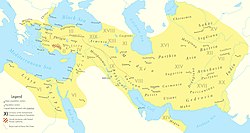
By the fifth century BC, Persian authority extended across Anatolia, greatly expanding the empire beyond the Iranian plateau.
550 BC
Egypt formed part of the western imperial territories ruled by the Persian kings by the fifth century BC.
Image source: History of Persian Egypt
550 BC
Cyprus was included among the territories formerly controlled by Assyria that came under Persian imperial rule or subordination.
550 BC
The Levant became part of the extensive western territories ruled or subordinated by the Persian kings by the fifth century BC.
550 BC
Mesopotamia was among the former Assyrian territories incorporated into the broad imperial realm ruled or subordinated by the Persian kings.
550 BC
By the fifth century BC, Persian kings ruled or subordinated territories encompassing the entire Persian Plateau.
550 BC
The territories formerly held by the Assyrian Empire, including Mesopotamia, the Levant, Cyprus, and Egypt, later formed part of the Persian imperial sphere.
Image source: Assyria
550 BC
The empire extended eastward into Central Asia, reaching regions as far as the Aral Sea, the Oxus, and the Jaxartes.
550 BC
Parts of Oman were among the southern and southeastern regions associated with the broad fifth-century Persian imperial sphere.
550 BC
Parts of eastern Libya, particularly Cyrenaica, were identified among the southwestern territories within the reach of Persian imperial power.
Image source: Cyrenaica
550 BC
Parts of northern Arabia were included among the southern territories ruled or subordinated by the Persian kings.
550 BC
The western Indus basin, corresponding broadly to parts of modern Afghanistan and Pakistan, lay within the eastern extent of Persian power.
550 BC
The Hindu Kush marked part of the far eastern reach of the Persian imperial territories described for the fifth century BC.
550 BC
Parts of the North Caucasus were among the northern territories included within the broad reach of Persian imperial power.
550 BC
The Persian imperial sphere extended into the Southern Caucasus by the fifth century BC.
Image source: Caucasus
550 BC
Armenia was among the territories encompassed by Persian rule or subordination during the empire's fifth-century expansion.
Image source: Satrapy of Armenia
500 BC
By the fifth century BC, the empire encountered Greek and Egyptian forces whose maritime traditions and capabilities altered the strategic environment facing Persia.
492 BC
Mardonius made Macedonia a fully subordinate part of the Persian Empire in 492 BC. Macedonia had been a vassal since the late sixth century BC but had retained considerable autonomy.
492 BC
In 492 BC, the Persian general Mardonius re-subjugated Thrace during the empire's efforts to consolidate its European territories.
Image source: Mardonius (nephew of Darius I)
250 BC
Native Iranian rule was restored by the Parthians of northeastern Iran over the course of the second century BC through the Parthian Empire.
Image source: Parthian Empire
250 BC
Iranian elites in the central plateau later reclaimed power from the Seleucids and established the Parthian Empire, which endured for nearly half a millennium before the Sasanian Empire succeeded it.
200 BC - 150 BC
Local rulers held power in southwestern Persia from the end of the third century to the beginning of the second century BC, before Vahbarz or Vādfradād I secured independence around 150 BC.
150 BC
Vahbarz, or Vādfradād I, obtained independence around 150 BC as Seleucid power waned in southwestern Persia and the Persian Gulf region.
224
Many centuries after the Achaemenid Empire fell, Aramaic script and Aramaic vocabulary used as ideograms survived as essential characteristics of the Pahlavi writing system.
Image source: Pahlavi scripts
1250
By the time of the great Mongol invasions in the thirteenth century, Iranian Islam had become a dominant element within Islam, while major centers of Islamic power and civilization were located in regions marked by Iranian civilization.
Image source: Iranian Intermezzo
Build a timeline like this one in minutes, for free. Start Yours →
Or browse the full history timeline directory, with more than 2,500 topics.
This Achaemenid Empire timeline was generated with the help of AI, using information found on the internet.
We work hard to keep these timelines accurate, but mistakes do get through. If you spot one, email us at [email protected] and we'll fix it for future visitors.
Generate yours with AI or build it from scratch, for free.
Export your timeline, add your own events, edit or remove AI-generated events, and much more
No credit card required.
15-day money-back guarantee.
You can create an unlimited number of timelines with up to 10 events on each one, customize how they look, export them to PDF, PNG, PowerPoint, CSV, and Excel, and share them with a link. Timelines made with Timeline Maker AI keep every event the generator created, and you can add up to 5 events of your own. Paid plans remove the event limit, add spreadsheet imports and hide Preceden's branding, and the higher-priced plan also adds collaborators, a custom logo and a custom domain.
Yes. You can cancel your subscription from your account page at any time, and you will not be charged again. Your subscription stays active for the rest of the period you already paid for.
Yes. We email you a reminder 15 days before your annual renewal, and we email you a receipt after every payment.
Yes. You can email us within 15 days of any payment, and we will issue you a full refund.
Check out our pricing docs or send us an email anytime: [email protected].