-
Use Cases
-
Resources
-
Pricing
The Ghana Empire (c. 300–1240 CE) was a powerful West African kingdom located in present-day southeastern Mauritania and western Mali. It grew wealthy by controlling the trans-Saharan gold and salt trade between sub-Saharan Africa and the Mediterranean world. Known to its rulers as Wagadu, it was called the 'Land of Gold' by Arab scholars before declining due to Almoravid invasions, drought, and the rise of rival powers like the Sosso and later the Mali Empire. More Less
1300 BCE - 300 BCE
% complete
The earliest proto-polity ancestral to Ghana likely arose from a large collection of ancient proto-Mande agro-pastoralist chiefdoms spread over the western-most portion of the Niger River basin for over a millennium, roughly spanning 1300 BCE to 300 BCE.
300 CE
% complete
Towards the end of the 3rd century CE, a wet period in the Sahel created areas for human habitation and exploitation which had not been habitable for the best part of a millennium, resulting in Wagadu rising out of the Tichitt culture.
800 CE
% complete
By the time Arab writers started describing the Ghana Empire in the 8th century it was already regarded as a wealthy state. Muhammad ibn Ibrahim al-Fazari listed it as equal in size to the Idrisid state of Morocco while coining it the 'Land of Gold.'
Image source: Ghana Empire
833 CE
% complete
In 833, the Ghana Empire was featured on Al-Khwarizmi's world map, reflecting its growing fame among Arab geographers.
Image source: Al-Khwarizmi
920 CE
% complete
Al-Masudi, writing in the first half of the 10th century, refers to the King of Ghana as supreme with vassals under him and describes the kingdom itself as being of great importance because of its gold trade.
Image source: Al-Masudi
1036 CE - 1068 CE
% complete
Writers including those writing around 1036 CE and al-Bakri (1068 CE) all describe the population and rulers of Ghana as 'negroes'.
1067 CE - 1068 CE
% complete
Further information about the empire was provided by the accounts of Cordoban scholar al-Bakri when he wrote about the region in the 11th century. His detailed geography shows Ghana surrounded by independent kingdoms, with Sila 'almost a match for the king of Ghana.'
1067 CE - 1068 CE
% complete
According to Al-Bakri's description in 1067/1068, the capital actually consisted of two cities 10 kilometres apart but 'between these two towns are continuous habitations', so that they might be said to have merged into one.
1116 CE - 1117 CE
% complete
Al-Idrisi states that the royal palace he knew was built in 510 AH (1116–1117 CE), suggesting that it was a newer town, rebuilt closer to the river than Koumbi Saleh.
Image source: Koumbi Saleh
300 CE
% complete
The introduction of the camel to the western Sahara in the 3rd century CE, along with pressure from the nomadic Saharan Sanhaja, served as major catalysts for the transformative social changes that resulted in the empire's formation.
600 CE
% complete
Since the 6th–7th centuries CE, the Ghana Empire was in charge of trade in central West Africa, building wealth on trans-Saharan commerce.
700 CE
% complete
By the time of the Muslim conquest of North Africa in the 7th century, the camel had changed the ancient, irregular trade routes into a network running between North Africa and the Niger River.
Image source: Trans-Saharan trade
950 CE
% complete
Ghana was the master of an extensive trade system in the Senegal river valley, first established by Takrur in the 10th century, that exported salt from Awlil throughout the region.
Image source: Takrur
1000 CE
% complete
According to Kati's Tarikh al-Fettash, in a section probably composed around 1580 but citing the chief judge Ida al-Massini who lived somewhat earlier, twenty kings ruled Ghana before the advent of Islam.
Image source: Tarikh al-fattash
1054 CE
% complete
Awdaghost, at the time a seat of the king, fell to the Almoravids in 1054, an early sign of Almoravid expansion into Ghana's sphere of influence.
Image source: Aoudaghost
1063 CE
% complete
Ghana Bassi died in 1063, and was succeeded by his nephew Tunka Manin, who ruled at the height of the empire's fame in Arabic sources.
1076 CE - 1077 CE
% complete
A tradition in historiography maintains that Ghana was conquered by the Almoravid dynasty in 1076–77, but this interpretation has been sharply questioned by modern scholars such as Conrad and Fisher (1982), who argued it is merely perpetuated folklore.
Image source: Almoravid dynasty
1083 CE
% complete
In 1083, Ghana requested the help of the Almoravids to attack and conquer Tadmekka, Silla, an unidentified town named NSLA, and may have reached Gao, helping to spread Sunni orthodoxy there as well.
1050 CE
% complete
Ghana had developed higher learning institutions by the 11th century, with the first reference coming from Al-Bakri who mentioned the empire's scholars and jurists.
1076 CE
% complete
Whether the Almoravids conquered Ghana or not, the country certainly did convert to Islam around 1076.
Image source: Islam in Africa
1154 CE
% complete
Al-Idrisi, whose account was written in 1154, has the country fully Muslim by that date. He also described Ghana's royal city as lying on a riverbank, a river he called the 'Nile,' following the custom of confusing the Niger and Senegal Rivers.
Image source: Muhammad al-Idrisi
1180 CE
% complete
Al-Sharishi, writing in the late 12th century, mentions the spread of Islam among Ghana's inhabitants and makes note of their schools. Further mentions of their schools were made during the later part of the 12th century.
1250 CE
% complete
Chronicles by al-Idrisi in the 11th century and Ibn Said in the 13th noted that rulers of Ghana traced their descent from the clan of Muhammad, either through his protector Abi Talib or through his son-in-law Ali.
Image source: Omar ibn Said
1394 CE
% complete
Ibn Khaldun reported an ambiguous account of the country's history as related to him by 'Uthman, a faqih of Ghana who took a pilgrimage to Mecca in 1394, according to which the power of Ghana waned as that of the 'veiled people' grew through the Almoravid movement.
Image source: Ibn Khaldun
1203 CE
% complete
By 1203, the Sosso had risen against their masters and conquered Ghana, establishing a short-lived empire.
1203 CE
% complete
According to much later traditions from the late nineteenth and twentieth centuries, Diara Kante of Sosso took control of Koumbi Saleh and established the Diarisso dynasty.
1235 CE
% complete
After Soumaoro's defeat at the Battle of Kirina in 1235 (a date assigned arbitrarily by Delafosse, who also gave 1235 for Diara Kante's takeover), the new rulers of Koumbi Saleh became permanent allies of the Mali Empire.
1235 CE - 1300 CE
% complete
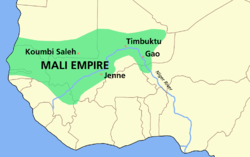
After centuries of prosperity, the empire began its decline in the second millennium, and would finally become a vassal state of the rising Mali Empire at some point in the 13th century.
Image source: Mali Empire
1250 CE - 1400 CE
% complete
In its last centuries, Ghana increasingly lost control of the gold trade to the Mali Empire and relied on slave raiding and trading as a principal economic activity.
1400 CE - 1500 CE
% complete
Koumbi Saleh was abandoned sometime in the 15th century, marking the end of the old imperial capital.
1590 CE
% complete
In the 16th century many notables of the Saadi Kingdom of Morocco, in an attempt to dissuade al-Mansur from fighting Songhai, argued that none of the previous Moroccan dynasties had ever attempted such an expedition into the Sudan.
Image source: Ahmad al-Mansur
1650 CE
% complete
A 17th-century chronicle written in Timbuktu, the Tarikh al-fattash, gave the name of the empire's capital as 'Koumbi'.
1949 CE - 1950 CE
% complete
The site of Koumbi Saleh was excavated in 1949–50 by Paul Thomassey and Raymond Mauny, and by another French team in 1975–81.
1950 CE
% complete
Beginning in the mid 20th century as more archeological data became available, scholars began to favor a purely local origin for Ghana. Modern works bring together archaeology, geographical sources written between 830 and 1400 CE, the Tarikhs from the 16th and 17th centuries, and oral traditions.
Mar 6, 1957
% complete
In 1957, the Gold Coast, under the leadership of Kwame Nkrumah named itself Ghana upon independence, honoring the medieval empire.
Image source: Ghana
1969 CE
% complete
In 1969 Patrick Munson excavated at Dhar Tichitt (a site associated with the ancestors of the Soninke), which clearly reflected a complex culture that was present by 1600 BCE and had architectural and material cultural elements similar to those found at Koumbi Saleh.
Image source: Dhar Tichitt
Or browse the full history timeline directory, with more than 2,000 topics.
This Ghana Empire timeline was generated with the help of AI, using information found on the internet.
We work hard to keep these timelines accurate, but mistakes do get through. If you spot one, email us at [email protected] and we'll fix it for future visitors.
Generate yours with AI or build it from scratch, for free.
Export your timeline, add your own events, edit or remove AI-generated events, and much more
No credit card required.
Cancel anytime.
Cancel anytime.
You can create an unlimited number of timelines with up to 10 events on each one, customize how they look, export them to PDF, PNG, PowerPoint, CSV, and Excel, and share them with a link. Paid plans raise the event limit and add features like spreadsheet imports and collaborators.
Yes. You can cancel your subscription from your account page at any time, and you will not be charged again. Your subscription stays active for the rest of the period you already paid for.
Yes. We will email you a reminder before the annual renewal, and we will also email you a receipt.
Yes. You can email us within 15 days of any payment, and we will issue you a full refund.
Check out our pricing docs or send us an email anytime: [email protected].