-
Use Cases
-
Resources
-
Pricing
The Mali Empire was a wealthy and influential West African empire that flourished from the 13th to the 17th century. Founded by Sundiata Keita after the Battle of Kirina, it became renowned for its gold trade, Islamic scholarship in cities like Timbuktu, and its most famous ruler, Mansa Musa, considered one of the wealthiest people in history. More Less
1000
% complete
Historian Fage notes that Islam was present in the Mande region by at least the 10th century, laying an early religious foundation that would later shape the Mali Empire's culture and its rulers' engagement with the wider Muslim world.
1190
% complete
Gold mines in Boure, located in present-day Guinea, were discovered sometime near the end of the 12th century. These rich deposits would later make Mali one of the world's most important sources of gold.
1300
% complete
By the beginning of the 14th century, Mali was the source of almost half the Old World's gold exported from mines in Bambuk, Boure, and Galam, underpinning the empire's legendary wealth.
1300
% complete
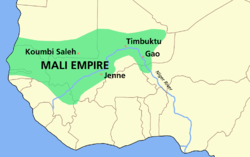
By the 14th century, a pax mandinka reigned in West Africa, allowing trade to flourish across the Sahel and securing Mali's role as the commercial hub of the region.
Image source: Mali Empire
1550
% complete
Three bowmen supporting one spearman was the ratio in Kaabu and the Gambia by the mid-16th century, illustrating the composition of Mali's military forces in its later period.
Image source: Kaabu
1000
% complete
From at least the beginning of the 11th century, Mandinka kings ruled Manden from Ka-ba in the name of the Ghana Empire (Wagadou), marking the early political organization of the region that would later become the heart of the Mali Empire.
1100 - 1200
% complete
The Mali Empire began to develop during the 11th and 12th centuries as the Ghana Empire, or Wagadu, declined and trade epicentres shifted southward, allowing new powers to emerge along the trans-Saharan trade routes.
1140
% complete
In approximately 1140 the Sosso Empire, often called Kaniaga, another former vassal of Wagadou, began conquering the lands of its old rulers, filling the power vacuum left by Ghana's decline.
Image source: Sosso Empire
1150
% complete
In the 12th century, Wagadou's control over Manden came to an end, freeing the Mandinka lands to pursue their own political destiny amid the decline of the old imperial order.
1203
% complete
In 1203, the Sosso king and sorcerer Soumaoro Kanté came to power and reportedly conquered much of Manden, imposing harsh rule over the Mandinka city-states.
1214
% complete
Sundiata Keita, the future founder of the Mali Empire, was born around 1214. After many years in exile, he would return to lead a revolt against the Kaniaga Kingdom and forge one of West Africa's greatest empires.
Image source: Sundiata Keita
1234
% complete
After many years in exile, Sundiata led the combined armies of Mema, Wagadou and the Mandinka city-states in a revolt against the Kaniaga Kingdom around 1234, beginning his campaign to liberate Manden.
1235
% complete
The combined forces of northern and southern Manden defeated the Sosso army at the Battle of Kirina in approximately 1235. The conquest of Sosso marked the emergence of Mali as a major power, with the Kouroukan Fouga serving as its constitution.
1255
% complete
Following the death of Sundiata Keita around 1255, the kings or emperors of Mali were referred to by the title mansa, establishing the nomenclature for Mali's rulers for generations to come.
1275
% complete
As a result of steady tax revenue and stable government beginning in the last quarter of the 13th century, the Mali Empire was able to project its power throughout its own extensive domain and beyond.
1285
% complete
In 1285, Sakura, a former slave of the imperial family who had risen to the rank of general, carried out a military coup and seized control of the empire.
1290 - 1400
% complete
The number and frequency of conquests in the late 13th century and throughout the 14th century indicate the Kolonkan mansas inherited and/or developed a capable military that sustained Mali's expansion.
1312
% complete
Due to Muhammad's failure to return, Musa was recognized as mansa in approximately 1312. His reign would become the most celebrated in Malian history, renowned for wealth and piety.
1324
% complete
A devout and well-educated Muslim, Mansa Musa took an interest in the scholarly city of Timbuktu, which he peaceably annexed in 1324, transforming Sankore from an informal madrasah into an Islamic university.
Image source: University of Timbuktu
1324 - 1326
% complete
Mansa Musa Keita's crowning achievement was his famous pilgrimage to Mecca from 1324 to 1326, where his generous gifts and expenditure of gold caused significant inflation in Egypt and made Mali famous across the Islamic world.
Image source: Mansa Musa
1350
% complete
By 1350, the Mali Empire covered approximately 478,819 square miles (1,240,140 km²), making it one of the largest states in the history of West Africa.
1340
% complete
Imperial Mali is known through the account of Shihab al-'Umari, written in about 1340 by a geographer-administrator in Mamluk Egypt, providing valuable detail on the empire at its height.
Image source: Mansa Musa
Jul 1352 - 1353
% complete
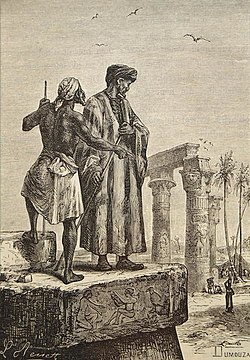
The traveller Ibn Battuta visited the capital city from 1352 to 1353 during Sulayman's reign, leaving the first account of a West African kingdom made directly by an eyewitness; he called the capital Mali.
Image source: Ibn Battuta
1375
% complete
The 1375 Catalan Atlas portrayed a 'city of Melly' (ciutat de Melly) in West Africa, depicting Mansa Musa holding a gold nugget and spreading knowledge of Mali's wealth in Europe.
Image source: Catalan Atlas
1406
% complete
After Ibn Khaldun's death in 1406, there are no further Arab primary sources except for Leo Africanus, who wrote more than a century later, creating a gap in the written record of Mali.
Image source: Ibn Khaldun
1507
% complete
Upon Leo Africanus's visit at the beginning of the 16th century, his descriptions of the territorial domains of Mali showed that it was still a kingdom of considerable size, though decline was underway.
Image source: Leo Africanus
1360
% complete
Upon Sulayman's death in 1360, the empire was ruled by a string of short-lived, cruel, or incompetent rulers, marking the beginning of Mali's long decline.
1387
% complete
By the time of Mansa Musa Keita II's death in 1387, Mali was financially solvent and in control of all of its previous conquests except Gao and Dyolof, despite growing internal instability.
1387 - 1400
% complete
The late 14th century again saw a series of short reigns, often ending in palace coups, further weakening central authority in the empire.
1433 - 1434
% complete
In 1433–1434, the Empire lost control of Timbuktu to the Tuareg, led by Akil Ag-Amalwal, a major blow to Mali's prestige and commercial power.
1465
% complete
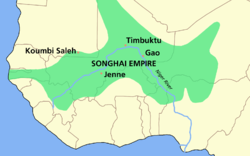
The rising Songhai Empire conquered Mema, one of Mali's oldest possessions, in 1465, continuing the erosion of Mali's territory.
Image source: Songhai Empire
1468
% complete
Songhai seized Timbuktu from the Tuareg in 1468 under Sunni Ali Ber, cementing Songhai's rise as the dominant power in the region at Mali's expense.
1477
% complete
In 1477, the Mossi emperor Naba Nasséré made yet another raid into Macina, this time conquering it and the old province of BaGhana (Wagadou), stripping Mali of more territory.
Image source: Mossi Kingdoms
1487
% complete
In an attempt to stem the tide of losses, Mansa Mahmud Keita II opened diplomatic relations with Portugal, receiving the envoys Pêro d'Évora and Gonçalo Enes in 1487.
1493
% complete
In 1493 Mahmud Keita II sent another envoy proposing an alliance against the threat of Tenguella, but this came to nothing.
1502
% complete
Songhai forces under the command of Askia Muhammad I defeated the Mali general Fati Quali Keita in 1502 and seized the province of Diafunu, further shrinking the empire.
Image source: Askia Muhammad I
1507
% complete
From 1507 onwards neighboring states such as Diarra, Great Fulo, Yatenga, and the Songhai Empire chipped away at Mali's borders, accelerating the empire's contraction.
1514
% complete
In 1514, the Denianke dynasty was established in Tekrour, and it was not long before the new kingdom of Great Fulo was warring against Mali's remaining provinces.
1544 - 1545
% complete
In 1544 or 1545, a Songhai force led by kanfari Dawud, who later succeeded his brother Askia Ishaq as ruler of the Songhai Empire, sacked the capital of Mali and purportedly used the royal palace as a latrine.
1550
% complete
Around 1550, Mali attacked Bighu in an effort to regain access to its gold, reflecting the empire's struggle to maintain its economic foundations.
Image source: Begho
1571
% complete
Songhai authority over Bendugu and Kala declined by 1571, and Mali may have been able to reassert some authority over them as its fortunes improved somewhat.
1576
% complete
The breakup of the Wolof Empire allowed Mali to reassert authority over some of its former subjects on the north bank of the Gambia, such as Wuli, by 1576.
Image source: Jolof Empire
1599
% complete
Mali made a brief comeback in the late 16th century and was poised to take advantage of Songhai's collapse after the 1593 Moroccan invasion, but a disastrous defeat outside Djenne in 1599 ended those hopes. The end of the Mali Empire came in 1599 under Mansa Mahmud IV.
1610
% complete
Around 1610, Mahmud Keita IV died, marking the end of the last significant mansa of a unified Mali Empire.
1645
% complete
The Gbara or Great Assembly served as the Mandinka deliberative body and council of state until the collapse of the empire in 1645, closing the final chapter of imperial Mali.
Or browse the full history timeline directory, with more than 2,000 topics.
This Mali Empire timeline was generated with the help of AI, using information found on the internet.
We work hard to keep these timelines accurate, but mistakes do get through. If you spot one, email us at [email protected] and we'll fix it for future visitors.
Generate yours with AI or build it from scratch, for free.
Export your timeline, add your own events, edit or remove AI-generated events, and much more
No credit card required.
Cancel anytime.
Cancel anytime.
You can create an unlimited number of timelines with up to 10 events on each one, customize how they look, export them to PDF, PNG, PowerPoint, CSV, and Excel, and share them with a link. Paid plans raise the event limit and add features like spreadsheet imports and collaborators.
Yes. You can cancel your subscription from your account page at any time, and you will not be charged again. Your subscription stays active for the rest of the period you already paid for.
Yes. We will email you a reminder before the annual renewal, and we will also email you a receipt.
Yes. You can email us within 15 days of any payment, and we will issue you a full refund.
Check out our pricing docs or send us an email anytime: [email protected].